
Chemical Engineering
GATE CH exam:gate PYQs
Build your understanding with focused practice from past exam papers.
Questions 561–570 of 650. Imported answers require independent review unless marked reviewed.
Question 31
Open questionCHMCQ2 marksNeeds review
The decay ratio for a system having complex conjugate poles as (−1/10 + j 2/15) and (−1/10 − j 2/15) is
Your answerChoose one option.
Log in to check the answer
You can attempt this question now. Sign in to view the answer key, explanations and discussion.Log in to check answerQuestion 32
Open questionCHMCQ2 marksNeeds review
Match the items in Column A with the items in Column B
Column A | Column B |
|---|---|
(P) Pure dead-time | (I) |
(Q) Pure capacitive | (II) with |
(R) Inverse response | (III) |
(S) First-order process with unit gain | (IV) |
Here,
denotes the phase shift,
and
the process gains,
the time constant, and AR the amplitude ratio.Your answerChoose one option.
Log in to check the answer
You can attempt this question now. Sign in to view the answer key, explanations and discussion.Log in to check answerQuestion 33
Open questionCHNAT2 marksNeeds review
In a laboratory batch setup, reaction of P over a catalyst was studied at various temperatures. The reactions occurring are
At the end of one hour of operation, the batch contains
,
and
mole fractions of P, Q and R components, respectively. The mole fractions of product components (
and
) were found to vary linearly with temperature as given in the figure. 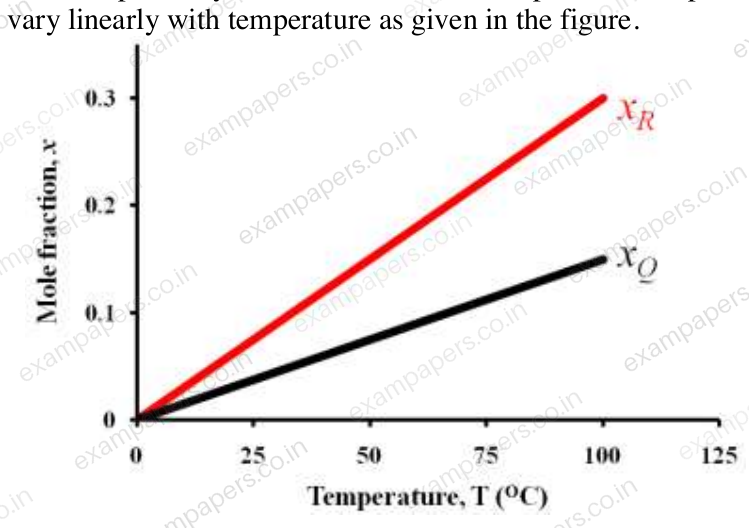
If the yield of Q based on reactant P consumed (
) at 25 °C was found to be 0.40, then the value of
at 60 °C is __________ (rounded off to second decimal place).Log in to check the answer
You can attempt this question now. Sign in to view the answer key, explanations and discussion.Log in to check answerQuestion 34
Open questionCHNAT2 marksNeeds review
An insulated storage tank contains 1000 kg liquid of specific heat 10 kJ kg⁻¹ K⁻¹. The liquid is heated by saturated steam, condensing in a helical coil at a temperature of 180 °C. The heat transfer area of the coil is 0.1 m². If the overall heat transfer coefficient is constant at 1000 W m⁻² K⁻¹, then the time (in hours) required to raise the temperature of the liquid in the tank from 20 °C to 80 °C is __________ (rounded off to second decimal place).
Log in to check the answer
You can attempt this question now. Sign in to view the answer key, explanations and discussion.Log in to check answerQuestion 35
Open questionCHNAT2 marksNeeds review
The wall of a pipe of radius 1 m is at a uniform temperature of 200 °C, and is covered by insulation of thickness 0.1 m. The ambient air outside the insulated pipe is at 20 °C and has heat transfer coefficient of 10 W m⁻² K⁻¹. The thermal conductivity of the insulation material is 0.05 W m⁻¹ K⁻¹. If the heat transfer occurs at steady state, the temperature (in °C) of the outer surface of insulation is __________ (rounded off to second decimal place).
Log in to check the answer
You can attempt this question now. Sign in to view the answer key, explanations and discussion.Log in to check answerQuestion 36
Open questionCHNAT2 marksNeeds review
Vapour bubbles are formed in the nucleate boiling regime at a frequency of 10 bubbles per second per nucleation site. There are 100 nucleation sites per m² of heating area. The latent heat of vaporization and the density of vapour under the operating condition are 1000 kJ/kg and 1 kg/m³ respectively. The diameter of each bubble is 10⁻³ m. Assume that the entire heat supplied is used for vapour generation. The heat flux (in Watt per m² of heating area) is ______________ (rounded off to third decimal place).
Log in to check the answer
You can attempt this question now. Sign in to view the answer key, explanations and discussion.Log in to check answerQuestion 37
Open questionCHNAT2 marksNeeds review
Under isothermal condition, a vertical tube of length L = 100 m contains a gas of molecular weight equal to 60. The pressure and temperature at the top of the tube are 100 kPa and 25 °C respectively. Consider the universal gas constant and acceleration due to gravity as 8.314 J mol⁻¹ K⁻¹ and 9.81 m s⁻² respectively. If the gas is ideal, the pressure (in kPa) at the bottom of the tube will be __________ (rounded off to third decimal place).
Log in to check the answer
You can attempt this question now. Sign in to view the answer key, explanations and discussion.Log in to check answerQuestion 38
Open questionCHNAT2 marksNeeds review
At a shear rate of 10 s⁻¹, the apparent viscosity of a non-Newtonian liquid was found to be 1 Pa s. At a shear rate of 100 s⁻¹, the apparent viscosity of the same liquid was found to be 0.5 Pa s. If the liquid flows power law behavior, the apparent viscosity (in Pa s) at a shear stress of 10 N m⁻² is __________ (rounded off to two decimal place).
Log in to check the answer
You can attempt this question now. Sign in to view the answer key, explanations and discussion.Log in to check answerQuestion 39
Open questionCHNAT2 marksNeeds review
A CSTR and a PFR of equal volume are connected in series as shown below to carry out a first-order, isothermal, liquid phase reaction
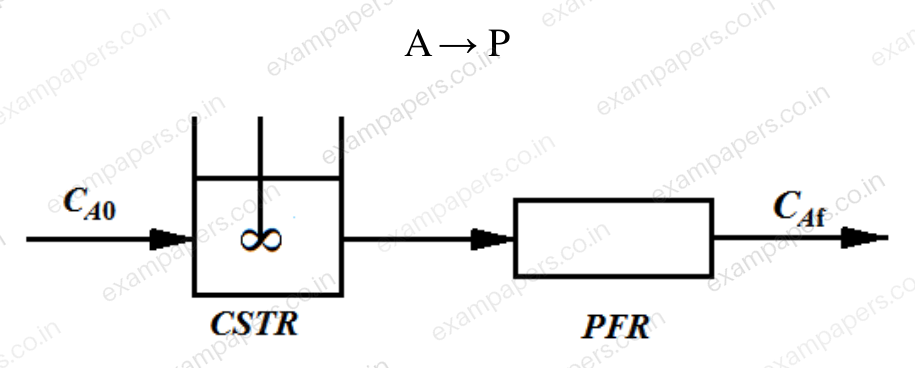
The rate constant is 0.2 s⁻¹. The space-time is 5 s for both the reactors. The overall fractional conversion of A is ____________ (rounded off to third decimal place).
Log in to check the answer
You can attempt this question now. Sign in to view the answer key, explanations and discussion.Log in to check answerQuestion 40
Open questionCHNAT2 marksNeeds review
The elementary second-order liquid phase reaction A + B → C + D is carried out in an isothermal plug flow reactor of 2 m³ volume. The inlet volumetric flow rate is 10 m³/h. The initial concentrations of both A and B are 2 kmol/m³. The rate constant is given as 2.5 m³ kmol⁻¹ h⁻¹. The percentage conversion of A is __________.
Log in to check the answer
You can attempt this question now. Sign in to view the answer key, explanations and discussion.Log in to check answer