
Chemical Engineering
GATE CH Fluid Mechanics and Mechanical Operations PYQs
Build your understanding with focused practice from past exam papers.
Questions 51–60 of 77. Imported answers require independent review unless marked reviewed.
Question 36
Open questionCHMCQ2 marksNeeds review
A student performs a flow experiment with Bingham Plastic under fully developed laminar flow conditions in a tube of radius 0.01 m with a pressure drop (
) of 10 kPa over tube length (
) of 1.0 m. The velocity profile is flat for
and parabolic for
, as shown in the figure.
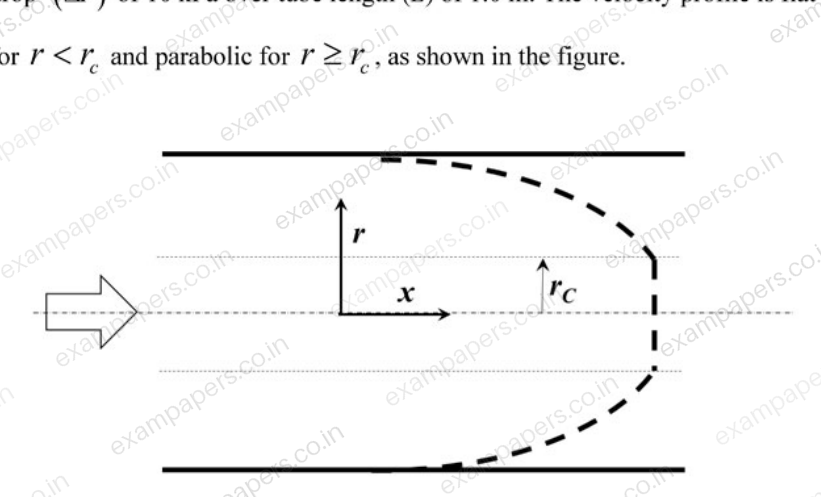
Consider
and
as the radial and axial directions, and the shear stress is finite as
approaches zero. A force balance results in the following equation
where
is the shear stress. If
is 0.001 m, then the magnitude of yield stress for this Bingham Plastic (in Pa) isYour answerChoose one option.
Log in to check the answer
You can attempt this question now. Sign in to view the answer key, explanations and discussion.Log in to check answerQuestion 38
Open questionCHMCQ2 marksNeeds review
A U-tube manometer contains two manometric fluids of densities 100 kg m
and 600 kg m
. When both the limbs are open to atmosphere, the difference between the two levels is 10 cm at equilibrium, as shown in the figure.The rest of the manometer is filled with air of negligible density. The acceleration due to gravity is 9.81 m s
and the atmospheric pressure is 100 kPa. How much absolute pressure (in kPa) has to be applied on the limb ‘P’ to raise fluid in the limb ‘Q’ by another 20 cm? 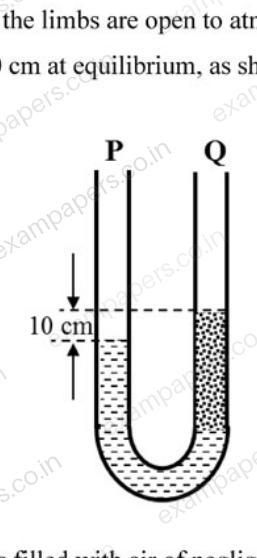
Your answerChoose one option.
Log in to check the answer
You can attempt this question now. Sign in to view the answer key, explanations and discussion.Log in to check answerQuestion 43
Open questionCHNAT2 marksNeeds review
Liquid water is pumped at a volumetric flow rate of 0.02 m
s
from Tank I to Tank II, as shown in the figure.
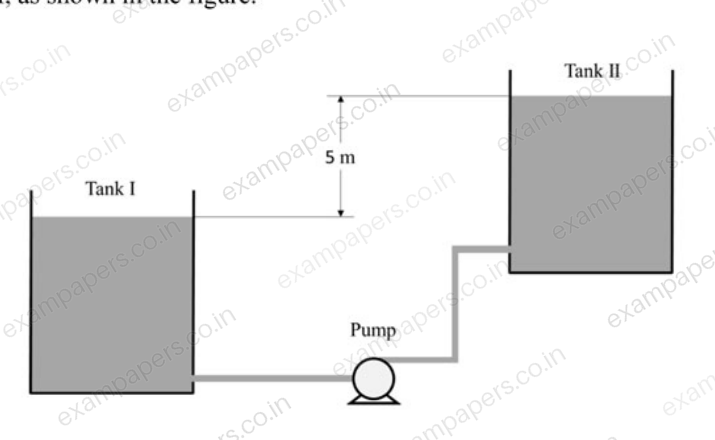
Both the tanks are open to the atmosphere. The total frictional head loss for the pipe system is 1.0 m of water.
In addition, use the following data and assumptions:
Density of water is 1000 kg m
Acceleration due to gravity is 9.81 m s
Efficiency of the pump is 100%
The liquid surfaces in the tanks have negligible velocities
The power supplied (in W) by the pump to lift the water is ________ (round off to 1 decimal place).
Log in to check the answer
You can attempt this question now. Sign in to view the answer key, explanations and discussion.Log in to check answerQuestion 46
Open questionCHNAT2 marksNeeds review
A vertically held packed bed has a height of 1 m, and a void fraction of 0.1, when there is no flow through the bed. The incipient (minimum) fluidization is set in by injection of a fluid of density 1 kg m
. The particle density (
) of the solids is 3000 kg m
. Acceleration due to gravity is 9.81 m s
. The pressure drop (in Pa) across the height of the bed is ________ (round off to nearest integer).Log in to check the answer
You can attempt this question now. Sign in to view the answer key, explanations and discussion.Log in to check answerQuestion 6
Open questionCHMCQ1 markNeeds review
For a fully-developed turbulent hydrodynamic boundary layer for flow past a flat plate, the thickness of the boundary layer increases with distance
from the leading edge of the plate, along the free-stream flow direction, asYour answerChoose one option.
Log in to check the answer
You can attempt this question now. Sign in to view the answer key, explanations and discussion.Log in to check answerQuestion 7
Open questionCHMCQ1 markNeeds review
Consider a cylinder (diameter
and length
), a sphere (diameter
) and a cube (side length
). Which of the following statements concerning the sphericity (
) of the above objects is true:Your answerChoose one option.
Log in to check the answer
You can attempt this question now. Sign in to view the answer key, explanations and discussion.Log in to check answerQuestion 8
Open questionCHMCQ1 markNeeds review
Prandtl number signifies the ratio of
Your answerChoose one option.
Log in to check the answer
You can attempt this question now. Sign in to view the answer key, explanations and discussion.Log in to check answerQuestion 23
Open questionCHNAT1 markNeeds review
For a hydraulic lift with dimensions shown in figure, assuming
, the maximum diameter
(in m) that lifts a vehicle of mass 1000 kg using a force of 100 N is ______ (rounded off to two decimal places). 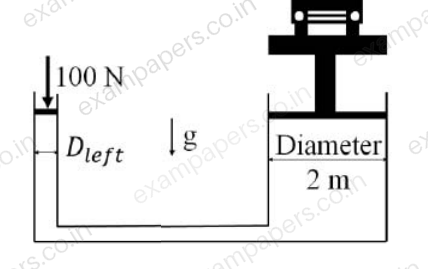
Log in to check the answer
You can attempt this question now. Sign in to view the answer key, explanations and discussion.Log in to check answerQuestion 28
Open questionCHMCQ2 marksNeeds review
An incompressible Newtonian fluid flows in a pipe of diameter
at volumetric flow rate
. Fluid with same properties flows in another pipe of diameter
at the same flow rate
. The transition length required for achieving fully-developed flow is
for the tube of diameter
, while it is
for the tube of diameter
. Assuming steady laminar flow in both cases, the ratio
is:Your answerChoose one option.
Log in to check the answer
You can attempt this question now. Sign in to view the answer key, explanations and discussion.Log in to check answerQuestion 29
Open questionCHMCQ2 marksNeeds review
A disk turbine is used to stir a liquid in a baffled tank. To design the agitator, experiments are performed in a lab-scale model with a turbine diameter of 0.05 m and a turbine impeller speed of 600 rpm. The liquid viscosity is 0.01 Pa s while the liquid density is 1000 kg/m
. The actual application has a turbine diameter of 0.5 m, an impeller speed of 600 rpm, a liquid viscosity of 0.1 Pa s and a liquid density of 1000 kg/m
. The effect of gravity is negligible. If the power required in the lab-scale model is
and the estimated power for the actual application is
, then the ratio
isYour answerChoose one option.
Log in to check the answer
You can attempt this question now. Sign in to view the answer key, explanations and discussion.Log in to check answer