
Chemical Engineering
GATE CH format:mcq PYQs
Build your understanding with focused practice from past exam papers.
Questions 291–300 of 378. Imported answers require independent review unless marked reviewed.
Question 17
Open questionCHMCQ1 markNeeds review
Producer gas is obtained by
Your answerChoose one option.
Log in to check the answer
You can attempt this question now. Sign in to view the answer key, explanations and discussion.Log in to check answerQuestion 18
Open questionCHMCQ1 markNeeds review
In Kraft process, the essential chemical reagents used in the digester are
Your answerChoose one option.
Log in to check the answer
You can attempt this question now. Sign in to view the answer key, explanations and discussion.Log in to check answerQuestion 19
Open questionCHMCQ1 markNeeds review
The most common catalyst used for oxidation of o-xylene to phthalic anhydride is
Your answerChoose one option.
Log in to check the answer
You can attempt this question now. Sign in to view the answer key, explanations and discussion.Log in to check answerQuestion 20
Open questionCHMCQ1 markNeeds review
In petroleum refining operations, the process used for converting paraffins and naphthenes to aromatics is
Your answerChoose one option.
Log in to check the answer
You can attempt this question now. Sign in to view the answer key, explanations and discussion.Log in to check answerQuestion 21
Open questionCHMCQ1 markNeeds review
The combination that correctly matches the polymer in Group-1 with the polymerization reaction type in Group-2 is
Group-1: P) Nylon 6; Q) Polypropylene; R) Polyester
Group-2: I) Condensation polymerization; II) Ring opening polymerization; III) Addition polymerization
Your answerChoose one option.
Log in to check the answer
You can attempt this question now. Sign in to view the answer key, explanations and discussion.Log in to check answerQuestion 26
Open questionCHMCQ2 marksNeeds review
The solution of the ordinary differential equation
, subject to the initial condition
at
, isYour answerChoose one option.
Log in to check the answer
You can attempt this question now. Sign in to view the answer key, explanations and discussion.Log in to check answerQuestion 27
Open questionCHMCQ2 marksNeeds review
The value of the complex number
(where
) isYour answerChoose one option.
Log in to check the answer
You can attempt this question now. Sign in to view the answer key, explanations and discussion.Log in to check answerQuestion 28
Open questionCHMCQ2 marksNeeds review
An incompressible Newtonian fluid flows in a pipe of diameter
at volumetric flow rate
. Fluid with same properties flows in another pipe of diameter
at the same flow rate
. The transition length required for achieving fully-developed flow is
for the tube of diameter
, while it is
for the tube of diameter
. Assuming steady laminar flow in both cases, the ratio
is:Your answerChoose one option.
Log in to check the answer
You can attempt this question now. Sign in to view the answer key, explanations and discussion.Log in to check answerQuestion 29
Open questionCHMCQ2 marksNeeds review
A disk turbine is used to stir a liquid in a baffled tank. To design the agitator, experiments are performed in a lab-scale model with a turbine diameter of 0.05 m and a turbine impeller speed of 600 rpm. The liquid viscosity is 0.01 Pa s while the liquid density is 1000 kg/m
. The actual application has a turbine diameter of 0.5 m, an impeller speed of 600 rpm, a liquid viscosity of 0.1 Pa s and a liquid density of 1000 kg/m
. The effect of gravity is negligible. If the power required in the lab-scale model is
and the estimated power for the actual application is
, then the ratio
isYour answerChoose one option.
Log in to check the answer
You can attempt this question now. Sign in to view the answer key, explanations and discussion.Log in to check answerQuestion 30
Open questionCHMCQ2 marksNeeds review
Consider two non-interacting tanks-in-series as shown in figure. Water enters TANK 1 at
cm
/s and drains down to TANK 2 by gravity at a rate
(cm
/s). Similarly, water drains from TANK 2 by gravity at a rate
(cm
/s) where
and
represent levels of TANK 1 and TANK 2, respectively (see figure). Drain valve constant
cm
/s and cross-sectional areas of the two tanks are
cm
. At steady state operation, the water inlet flow rate is
cm
/s. The transfer function relating the deviation variables
(cm) to flow rate
(cm
/s) is, 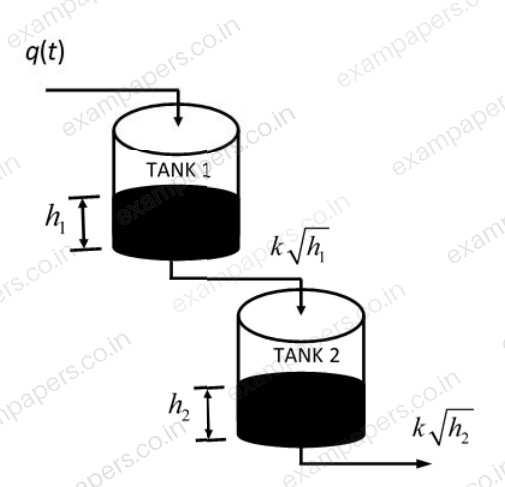
Your answerChoose one option.
Log in to check the answer
You can attempt this question now. Sign in to view the answer key, explanations and discussion.Log in to check answer