
Chemical Engineering
GATE CH format:nat PYQs
Build your understanding with focused practice from past exam papers.
Questions 161–170 of 252. Imported answers require independent review unless marked reviewed.
Question 45
Open questionCHNAT2 marksNeeds review
An aqueous suspension at 60 °C is fed to the first effect of a double effect forward feed evaporator with a mass flow rate of 1.25 kg s
. The sum of the rates of water evaporated from the first and second effects is 1.0 kg s
. Temperatures of the exit streams from the first and the second effects are 100 °C, and 60 °C, respectively. Consider the specific heat of the aqueous suspension, and the latent heat of phase change for water to be 4 kJ kg
K
and 2200 kJ kg
, respectively, over this temperature range. The steam economy (in kg per kg) is ________ (round off to 2 decimal places).Log in to check the answer
You can attempt this question now. Sign in to view the answer key, explanations and discussion.Log in to check answerQuestion 46
Open questionCHNAT2 marksNeeds review
A vertically held packed bed has a height of 1 m, and a void fraction of 0.1, when there is no flow through the bed. The incipient (minimum) fluidization is set in by injection of a fluid of density 1 kg m
. The particle density (
) of the solids is 3000 kg m
. Acceleration due to gravity is 9.81 m s
. The pressure drop (in Pa) across the height of the bed is ________ (round off to nearest integer).Log in to check the answer
You can attempt this question now. Sign in to view the answer key, explanations and discussion.Log in to check answerQuestion 47
Open questionCHNAT2 marksNeeds review
Two ideal cross-current stages operate to extract P from a feed containing P and Q, as shown below.
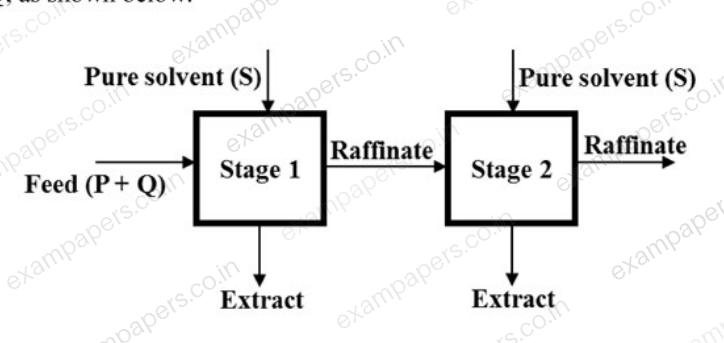
The mass flow rates of P and Q fed to Stage 1 are 1,000 kg h
and 10,000 kg h
, respectively. Pure solvent (S) is injected at mass flow rates of 5,000 kg h
and 15,000 kg h
to Stages 1 and 2, respectively. The components Q and S are immiscible. The equilibrium relation is given by
, where
is the mass of P per unit mass of Q in the raffinate, and
is the mass of P per unit mass of S in the extract, which is in equilibrium with the raffinate. The mass flow rate of P (in kg h
) in the raffinate from Stage 2 is ________ (round off to nearest integer).Log in to check the answer
You can attempt this question now. Sign in to view the answer key, explanations and discussion.Log in to check answerQuestion 48
Open questionCHNAT2 marksNeeds review
Consider a vertically falling film of water over an impermeable wall. The film is in contact with a static pool of non-reactive pure gas. The gas diffuses into the water film over the entire height of the falling film. The height of the film is 1.0 m, and its thickness is
m. The velocity of water, averaged over the film thickness, is 0.01 m s
. The gas concentration (in kg m
), averaged over the film thickness is
where
is the vertical position in meters measured from the top of the wall.In addition, use the following data and assumptions:
The flow is fully developed
The width of the film is much larger than the thickness of the film, and the dissolved gas concentration is invariant over this width
The solubility of the gas in water,
, is constantPure water enters at
The evaporation of water is negligible
The mass transfer coefficient on the liquid side (in mm s
), averaged over the entire height of the falling film is ________ (round off to 3 decimal places).Log in to check the answer
You can attempt this question now. Sign in to view the answer key, explanations and discussion.Log in to check answerQuestion 49
Open questionCHNAT2 marksNeeds review
An exothermic, aqueous phase, irreversible, first order reaction,
is carried out in an ideal continuous stirred tank reactor (CSTR) operated adiabatically at steady state. Rate of consumption of Y (in mol liter
minute
) is given by
where
is the concentration of Y (in mol liter
), and
is the temperature of the reaction mixture (in K). Reactant Y is fed at 50 °C. Its inlet concentration is 1.0 mol liter
, and its volumetric flow rate is 1.0 liter minute
.In addition, use the following data and assumptions:
Heat of the reaction = −4200 J mol
Specific heat capacity of the reaction mixture = 4.2 J g
K
Density of the reaction mixture = 1000 g liter
Heat of the reaction, specific heat capacity and density of the reaction mixture do not vary with temperature
Shaft work is negligible
If the conversion of Y at the exit of the reactor is 90%, the volume of the CSTR (in liter) is ________ (round off to 2 decimal places).
Log in to check the answer
You can attempt this question now. Sign in to view the answer key, explanations and discussion.Log in to check answerQuestion 50
Open questionCHNAT2 marksNeeds review
The liquid phase irreversible reactions,
and
, are carried out in an ideal continuous stirred tank reactor (CSTR) operating isothermally at steady state. The space time of the CSTR is 1 minute. Both the reactions are first order with respect to the reactant P, and
and
denote the rate constants of the two reactions. At the exit of the reactor, the conversion of reactant P is 60%, and the selectivity of Q with respect to R is 50%. The value of the first order rate constant
(in minute
) is ________ (correct up to one decimal place).Log in to check the answer
You can attempt this question now. Sign in to view the answer key, explanations and discussion.Log in to check answerQuestion 51
Open questionCHNAT2 marksNeeds review
A catalytic gas phase reaction
is conducted in an isothermal packed bed reactor operated at steady state. The reaction is irreversible and second order with respect to the reactant P. The feed is pure P with a volumetric flow rate of 1.0 liter minute
and concentration of 2.0 mol liter
.In addition, use the following assumptions:
The reactant and product are ideal gases
There is no volume change associated with the reaction
Ideal plug flow conditions prevail in the packed bed
When the mass of catalyst in the reactor is 4 g, the concentration of P measured at the exit is 0.4 mol liter
. The second order rate constant (in liter
g
mol
minute
) is ________ (correct up to one decimal place).Log in to check the answer
You can attempt this question now. Sign in to view the answer key, explanations and discussion.Log in to check answerQuestion 52
Open questionCHNAT2 marksNeeds review
Flow of water through an equal percentage valve is 900 liter h
at 30% opening, and 1080 liter h
at 35% opening. Assume that the pressure drop across the valve remains constant. The flow rate (in liter h
) through the valve at 45% opening is ________ (round off to nearest integer).Log in to check the answer
You can attempt this question now. Sign in to view the answer key, explanations and discussion.Log in to check answerQuestion 53
Open questionCHNAT2 marksNeeds review
Consider the following closed loop system.
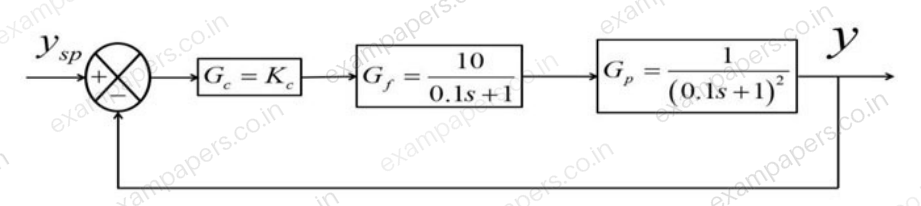
,
, and
are the transfer functions of the controller, the final control element and the process, respectively.
and
are the response and its set point, respectively. For a gain margin of 1.6, the design value of
is ________ (correct up to one decimal place).Log in to check the answer
You can attempt this question now. Sign in to view the answer key, explanations and discussion.Log in to check answerQuestion 54
Open questionCHNAT2 marksNeeds review
Given
, and
, the value of
at
is ________ (round off to nearest integer).Log in to check the answer
You can attempt this question now. Sign in to view the answer key, explanations and discussion.Log in to check answer