
Chemical Engineering
GATE CH format:nat PYQs
Build your understanding with focused practice from past exam papers.
Questions 11–20 of 252. Imported answers require independent review unless marked reviewed.
Question 55
Open questionCHNAT2 marksNeeds review
A first-order homogeneous liquid-phase reaction (A→B) occurs in an adiabatic, ideal mixed flow reactor operating at steady state. The volumetric flow rate of the feed is 4 L min⁻¹ and volume of the reactor is 20 L. At the reactor temperature of 500 K, the reaction rate constant is 1 min⁻¹, and heat of reaction is −20 kcal mol⁻¹. The average heat capacity of the feed as well as the reaction mixture in the temperature range of interest is 0.3 cal mol⁻¹ K⁻¹.
At the inlet, the feed temperature (in K) is ________ (rounded off to one decimal place).
Log in to check the answer
You can attempt this question now. Sign in to view the answer key, explanations and discussion.Log in to check answerQuestion 56
Open questionCHNAT2 marksNeeds review
A first-order homogeneous liquid-phase reaction (A→B) occurs in a non-ideal isothermal reactor operating at steady state. The variance (σ²) of residence time distribution (RTD) from a pulse tracer experiment is 4 min². The volumetric flow rate of the feed is 5 L min⁻¹ and volume of the reactor is 25 L. The reaction rate constant is 0.4 min⁻¹. Based on the tanks-in-series model, the conversion (in %) is ______ (rounded off to one decimal place).
Log in to check the answer
You can attempt this question now. Sign in to view the answer key, explanations and discussion.Log in to check answerQuestion 57
Open questionCHNAT2 marksNeeds review
A feed containing 10 mol % propylene, 15 mol % ammonia and rest air is charged into a reactor to produce acrylonitrile (C₃H₃N) according to the following reaction.
Assume, air contains 80 mol % N₂ and 20 mol % O₂.
If the conversion of the limiting reactant is 30%, the composition of C₃H₃N (in mol %) in the product stream is __________ (rounded off to two decimal places).
Log in to check the answer
You can attempt this question now. Sign in to view the answer key, explanations and discussion.Log in to check answerQuestion 58
Open questionCHNAT2 marksNeeds review
A gas mixture of 50 wt. % argon and 50 wt. % helium flowing through a horizontal tube of uniform diameter at a rate of 1 kg s⁻¹ is heated from 300 K to 400 K at 1 bar. Neglect shaft work, and changes in kinetic as well as potential energies between the inlet and the outlet. Assume the mixture exhibits ideal gas behavior. The specific enthalpies of the components are given in the following table.
Component | Specific enthalpy (kJ kg⁻¹) at 300 K | Specific enthalpy (kJ kg⁻¹) at 400 K |
|---|---|---|
Argon | 348 | 400 |
Helium | 1574 | 2092 |
At steady state, the heat input required (in kW) is __________ (rounded off to the nearest integer).
Log in to check the answer
You can attempt this question now. Sign in to view the answer key, explanations and discussion.Log in to check answerQuestion 59
Open questionCHNAT2 marksNeeds review
When a cylindrical capillary glass tube, open at both ends, is vertically inserted in a pool of water, the water level in the tube rises to 7 cm relative to the water level outside the tube. Consider that the surface tension of water is 0.07 N m⁻¹ and that the contact angle of water on glass is 0°. The density of water is 1000 kg m⁻³, and the local acceleration due to gravity is 10 m s⁻². The diameter of the capillary tube (in μm) is __________ (rounded off to the nearest integer).
Log in to check the answer
You can attempt this question now. Sign in to view the answer key, explanations and discussion.Log in to check answerQuestion 60
Open questionCHNAT2 marksNeeds review
Consider a two-dimensional, steady, laminar flow of an incompressible fluid with zero pressure gradient, over a thin horizontal flat plate of length 2 m. The free stream velocity is 1 m s⁻¹. A boundary layer thickness of 1 mm is observed at a distance of 0.25 m from the leading edge of the plate. At 1 m from the leading edge, the boundary layer thickness (in mm) is ________ (rounded off to the nearest integer).
Log in to check the answer
You can attempt this question now. Sign in to view the answer key, explanations and discussion.Log in to check answerQuestion 61
Open questionCHNAT2 marksNeeds review
The flooding velocity curves for two different structured packings are shown in the figure. The ratio of mass velocities of liquid (
) to that of the gas (
) is 1.27. The density of the liquid (
) is 1200 kg m⁻³ and that of the gas (
) is 1.2 kg m⁻³. For both the packings, the allowable superficial vapor velocity is 60% of flooding velocity (
). The ratio of allowable mass velocity of the vapor in packing P to that in packing Q is __________ (rounded off to one decimal place). 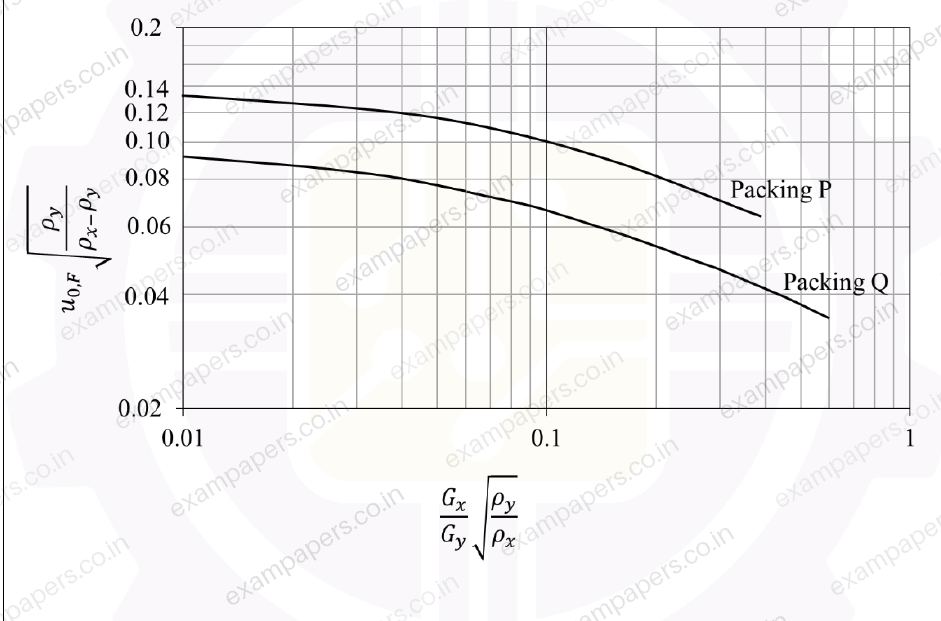
Log in to check the answer
You can attempt this question now. Sign in to view the answer key, explanations and discussion.Log in to check answerQuestion 62
Open questionCHNAT2 marksNeeds review
Consider a differential equation:
The value of y at x = 2 is ______ (rounded off to two decimal places).
Log in to check the answer
You can attempt this question now. Sign in to view the answer key, explanations and discussion.Log in to check answerQuestion 63
Open questionCHNAT2 marksNeeds review
The data given in the table are fitted to the equation
using the method of least squares. The value of m is _____ (rounded off to one decimal place). | 1 | 2 | 3 | 4 |
|---|---|---|---|---|
| 2 | 6 | 7 | 10 |
Log in to check the answer
You can attempt this question now. Sign in to view the answer key, explanations and discussion.Log in to check answerQuestion 64
Open questionCHNAT2 marksNeeds review
Cyclohexane (C₆H₁₂) is produced from benzene (C₆H₆) and hydrogen (H₂) according to the following reaction.
Consider the process flow diagram shown in the figure.
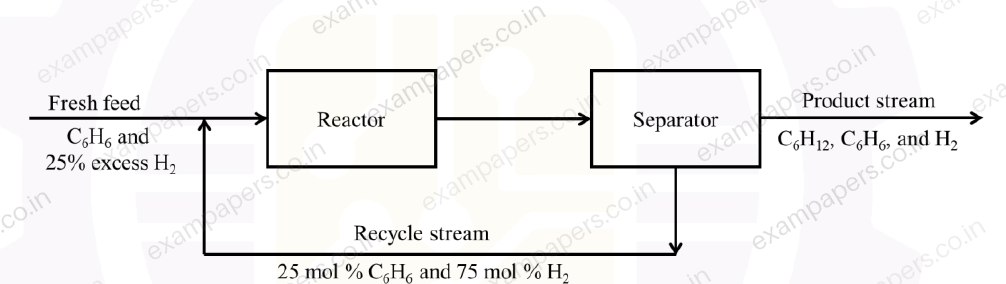
In this process, the overall and single-pass conversions are 90% and 25%, respectively. The recycle stream contains 25 mol % C₆H₆ and 75 mol % H₂. If the fresh feed contains 25% excess H₂, at steady state, the ratio of the molar flow rate of recycle stream to that of the fresh feed is _________ (rounded off to one decimal place).
Log in to check the answer
You can attempt this question now. Sign in to view the answer key, explanations and discussion.Log in to check answer