
Chemical Engineering
GATE CH Heat Transfer PYQs
Build your understanding with focused practice from past exam papers.
Questions 11–20 of 57. Imported answers require independent review unless marked reviewed.
Question 34
Open questionCHNAT1 markNeeds review
The opposite faces of a metal slab of thickness 5 cm and thermal conductivity 400 W m
°C
are maintained at 50 °C and 200 °C. The area of each face is 0.02 m
. Assume that the heat transfer is steady and occurs only in the direction perpendicular to the faces. The magnitude of the heat transfer rate, in kW, rounded off to the nearest integer, is _____Log in to check the answer
You can attempt this question now. Sign in to view the answer key, explanations and discussion.Log in to check answerQuestion 37
Open questionCHMCQ2 marksNeeds review
The temperatures of two large parallel plates of equal emissivity are 900 K and 300 K. A reflection radiation shield of low emissivity and negligible conductive resistance is placed parallel between them. The steady-state temperature of the shield, in K, is
Your answerChoose one option.
Log in to check the answer
You can attempt this question now. Sign in to view the answer key, explanations and discussion.Log in to check answerQuestion 38
Open questionCHMCQ2 marksNeeds review
Hot oil at 110 °C heats water from 30 °C to 70 °C in a counter-current double-pipe heat exchanger. The flow rates of water and oil are 50 kg min
and 100 kg min
, respectively and their specific heat capacities are 4.2 kJ kg
°C
and 2.0 kJ kg
°C
, respectively. Assume the heat exchanger is at steady state. If the overall heat transfer coefficient is 200 W m
°C
, the heat transfer area in m
isYour answerChoose one option.
Log in to check the answer
You can attempt this question now. Sign in to view the answer key, explanations and discussion.Log in to check answerQuestion 39
Open questionCHMCQ2 marksNeeds review
A solid slab of thickness
is initially at a uniform temperature
. At time
, the temperature of the top surface at
is increased to
, while the bottom surface at
is maintained at
for
. Assume heat transfer occurs only in the
-direction, and all thermal properties of the slab are constant. The time required for the temperature at
to reach 99% of its final steady value is
. If the thickness of the slab is doubled to
, and the time required for the temperature at
to reach 99% of its final steady value is
, then
isYour answerChoose one option.
Log in to check the answer
You can attempt this question now. Sign in to view the answer key, explanations and discussion.Log in to check answerQuestion 21
Open questionCHMCQ1 markNeeds review
Match the quantities in Group 1 with their units in Group 2 listed in the table below.
Group 1 | Group 2 |
|---|---|
P) Thermal conductivity | I) W·m⁻²K⁻¹ |
Q) Convective heat transfer coefficient | II) W·m⁻¹K⁻¹ |
R) Stefan-Boltzmann constant | III) W·K⁻¹ |
S) Heat capacity rate | IV) W·m⁻²K⁻⁴ |
Your answerChoose one option.
Log in to check the answer
You can attempt this question now. Sign in to view the answer key, explanations and discussion.Log in to check answerQuestion 22
Open questionCHMCQ1 markNeeds review
A slab of thickness
, as shown in the figure below, has cross-sectional area
and constant thermal conductivity
.
and
are the temperatures at
and
, respectively. Which one of the following options is the CORRECT expression of the thermal resistance for steady-state one-dimensional heat conduction? 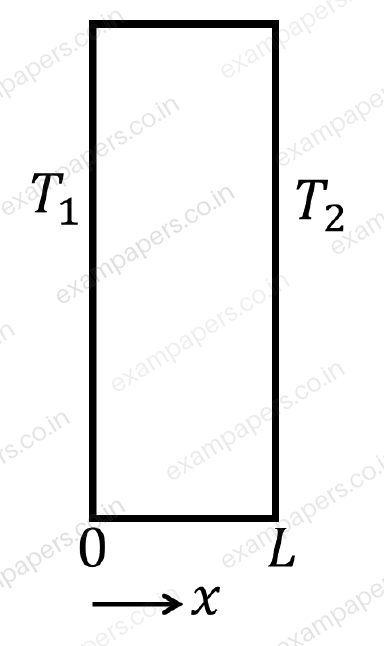
Your answerChoose one option.
Log in to check the answer
You can attempt this question now. Sign in to view the answer key, explanations and discussion.Log in to check answerQuestion 27
Open questionCHMCQ1 markNeeds review
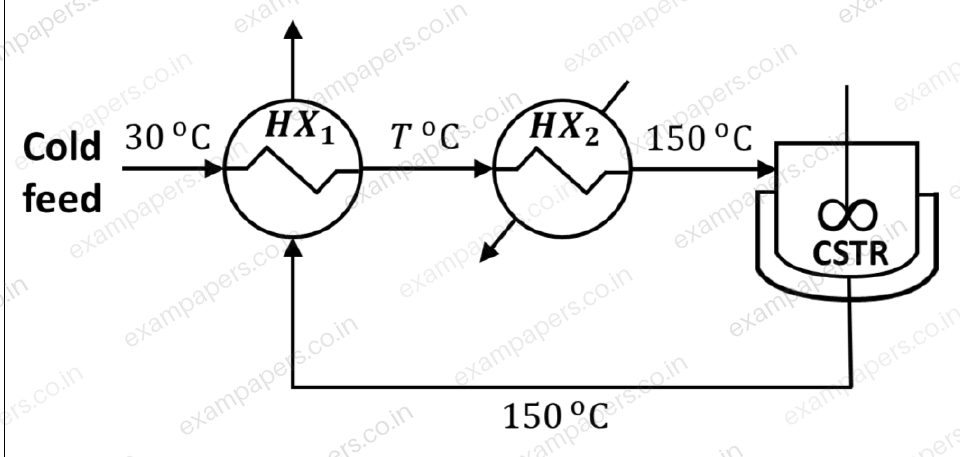
An isothermal jacketed continuous stirred tank reactor (CSTR) operating at 150 °C is shown in the figure below. The cold feed entering the system at 30 °C is preheated to a temperature
(
°C) using a heat exchanger
. This preheated feed is further heated to 150 °C using the utility heater
. The mass flow rate and heat capacity are same for all the process streams, and the overall heat transfer coefficient is independent of temperature. Which one of the following statements is the CORRECT action to take if it is desired to increase the value of
? 
Your answerChoose one option.
Log in to check the answer
You can attempt this question now. Sign in to view the answer key, explanations and discussion.Log in to check answerQuestion 30
Open questionCHMSQ1 markNeeds review
Given that
(in W·m
) is the total hemispherical emissive power of a surface maintained at a certain temperature, which of the following statements is/are CORRECT?Your answerSelect all correct options. You can choose more than one.
Log in to check the answer
You can attempt this question now. Sign in to view the answer key, explanations and discussion.Log in to check answerQuestion 46
Open questionCHMSQ2 marksNeeds review
Which of the following statements is/are CORRECT?
Your answerSelect all correct options. You can choose more than one.
Log in to check the answer
You can attempt this question now. Sign in to view the answer key, explanations and discussion.Log in to check answerQuestion 54
Open questionCHNAT2 marksNeeds review
A fluid is flowing steadily under laminar conditions over a thin rectangular plate at temperature
as shown in the figure below. The velocity and temperature of the free stream are
and
, respectively. When the fluid flow is only in the
-direction,
is the local heat transfer coefficient. Similarly, when the fluid flow is only in the
-direction,
is the corresponding local heat transfer coefficient. Use the correlation
for the local heat transfer coefficient, where, Nu, Re and Pr are the appropriate Nusselt, Reynolds and Prandtl numbers. The average heat transfer coefficients are defined as
and
. If
m and
m, the value of the ratio of
to
is ______ (in integer). 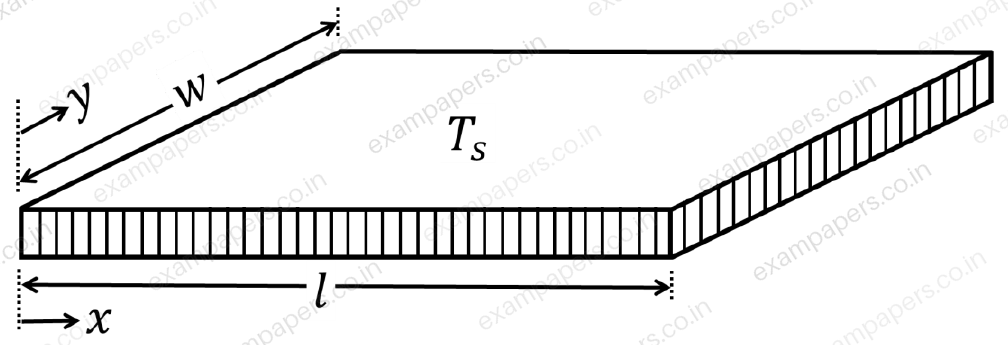
Log in to check the answer
You can attempt this question now. Sign in to view the answer key, explanations and discussion.Log in to check answer