
Chemical Engineering
GATE CH kind:question PYQs
Build your understanding with focused practice from past exam papers.
Questions 121–130 of 650. Imported answers require independent review unless marked reviewed.
Question 56
Open questionCHNAT2 marksNeeds review
Solute
is absorbed from a gas into water in a packed bed operating at steady state. The absorber operating pressure and temperature are 1 atm and 300 K, respectively. At the gas-liquid interface
where
and
are the interfacial gas and liquid mole fractions of
, respectively. At a particular location in the absorber, the mole fractions of
in the bulk gas and in the bulk water are 0.02 and 0.002, respectively. If the ratio of the local individual mass transfer coefficients for the transport of
on the gas-side (
) to that on the water-side (
),
, then
equals ____ (rounded off to 3 decimal places).Log in to check the answer
You can attempt this question now. Sign in to view the answer key, explanations and discussion.Log in to check answerQuestion 57
Open questionCHNAT2 marksNeeds review
Components
and
form an azeotrope. The saturation vapour pressures of
and
at the boiling point are 87 kPa and 72.7 kPa, respectively. The azeotrope composition is ____ mol%
(rounded off to the nearest integer).GIVEN:
where
and
are the liquid phase mole fraction and activity coefficient of component
, respectively.Log in to check the answer
You can attempt this question now. Sign in to view the answer key, explanations and discussion.Log in to check answerQuestion 58
Open questionCHNAT2 marksNeeds review
The reaction
with reaction rate,
, occurs in an isothermal PFR operating at steady state. The conversion (
) at two axial locations (1 and 2) of the PFR is shown in the figure.
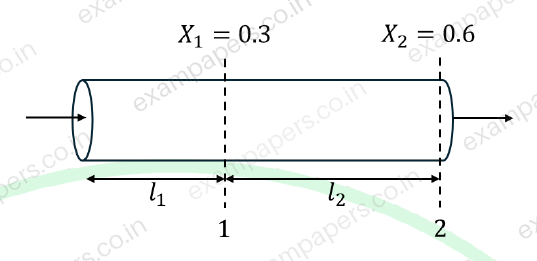
The value of
is ____ (rounded off to 2 decimal places).Log in to check the answer
You can attempt this question now. Sign in to view the answer key, explanations and discussion.Log in to check answerQuestion 59
Open questionCHNAT2 marksNeeds review
The catalytic gas phase reaction
is carried out in an isothermal batch reactor of 10 L volume using 0.1 kg of a solid catalyst. The reaction is first-order with
where
and
is the concentration of
in mol/L.The catalyst activity
undergoes first order decay with rate constant
per hour and
.The reactant conversion after 1 day of operation is ____ (rounded off to 2 decimal places).
Log in to check the answer
You can attempt this question now. Sign in to view the answer key, explanations and discussion.Log in to check answerQuestion 60
Open questionCHNAT2 marksNeeds review
Consider a process with transfer function
A first-order plus dead time (FOPDT) model is to be fitted to the unit step process reaction curve (PRC) by applying the maximum slope method.Let
and
denote the time constant and dead time, respectively, of the fitted FOPDT model. The value of
is ____ (rounded off to 2 decimal places).GIVEN:
For
the unit step output response:
Log in to check the answer
You can attempt this question now. Sign in to view the answer key, explanations and discussion.Log in to check answerQuestion 61
Open questionCHNAT2 marksNeeds review
Methanol is produced by the reversible, gas-phase hydrogenation of carbon monoxide as
and
are charged to a reactor and the reaction proceeds to equilibrium at 453 K and 2 atm. The reaction equilibrium constant, which depends only on the temperature, is 1.68 at the reaction conditions. The mole fraction of
in the product is 0.4. Assuming ideal gas behaviour, the mole fraction of methanol in the product is ____ (rounded off to 2 decimal places).Log in to check the answer
You can attempt this question now. Sign in to view the answer key, explanations and discussion.Log in to check answerQuestion 62
Open questionCHNAT2 marksNeeds review
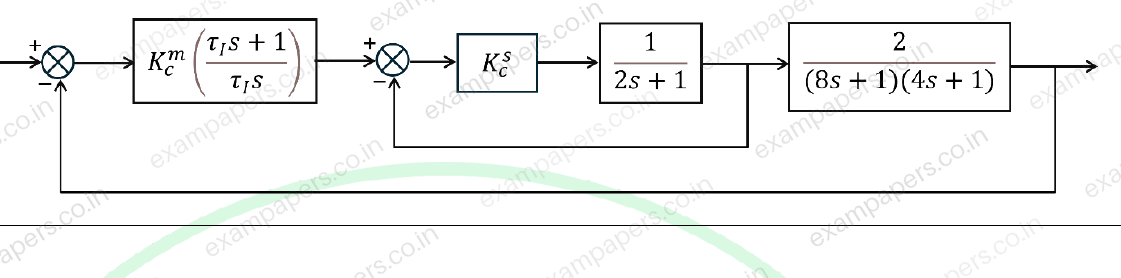
The block diagram of a series cascade control system (with time in minutes) is shown in the figure. For
min and
, the maximum value of
, below which the cascade control system is stable, is ____ (rounded off to the nearest integer).
Log in to check the answer
You can attempt this question now. Sign in to view the answer key, explanations and discussion.Log in to check answerQuestion 63
Open questionCHNAT2 marksNeeds review
It is proposed to install thermal insulation in a residence to save on the summer-monsoon season air-conditioning costs. The estimated yearly saving is 20 thousand rupees. The cost of installation of the insulation is 150 thousand rupees. The life of the insulation is 12 years. For a compound interest rate of 9% per annum, the minimum salvage value of the insulation for which the proposal is competitive, is ____ thousand rupees (rounded off to nearest integer).
Log in to check the answer
You can attempt this question now. Sign in to view the answer key, explanations and discussion.Log in to check answerQuestion 64
Open questionCHNAT2 marksNeeds review
Consider the flowsheet in the figure for manufacturing
via the reaction
in an isothermal CSTR. The split in the separator is perfect so that the recycle stream is free of
and the product stream is pure
. Let
denote the mole fraction of species
(
) in the CSTR, which is operated in excess
with
. The reaction is first-order in
with the reaction rate
, where
kmol/(m
h).
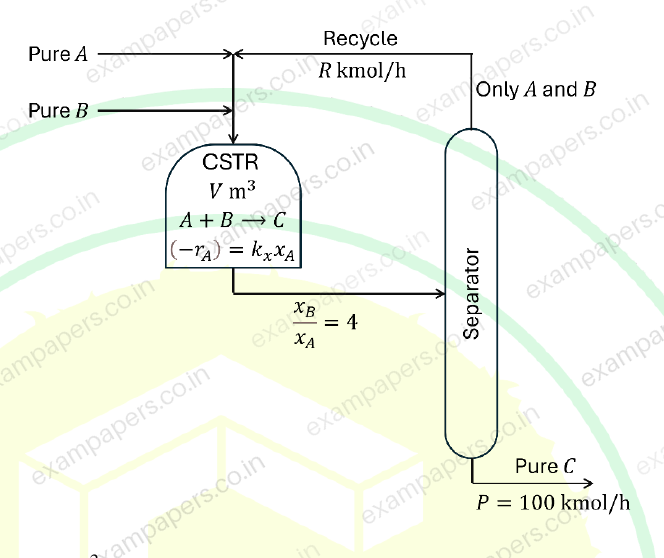
The reactor volume
in m
is to be optimized to minimize the cost objective
, where
is the recycle rate in kmol/h. For a product rate
kmol/h, the optimum value of
is ____ m
(rounded off to the nearest integer).GIVEN:
Log in to check the answer
You can attempt this question now. Sign in to view the answer key, explanations and discussion.Log in to check answerQuestion 65
Open questionCHNAT2 marksNeeds review
A wet solid of 100 kg containing 30 wt% moisture is to be dried to 2 wt% moisture in a tray dryer. The critical moisture content is 10 wt% and the equilibrium moisture content is 1 wt%. The drying rate during the constant rate period is 10 kg/(h m
). The drying curve in the falling rate period is linear. If the drying area is 5 m
, the time required for drying is ____ h (rounded off to 1 decimal place).Note: All the moisture values given are on dry-solid basis.
Log in to check the answer
You can attempt this question now. Sign in to view the answer key, explanations and discussion.Log in to check answer