
Chemical Engineering
GATE CH kind:question PYQs
Build your understanding with focused practice from past exam papers.
Questions 501–510 of 650. Imported answers require independent review unless marked reviewed.
Question 36
Open questionCHNAT2 marksNeeds review
The Newton-Raphson method is used to determine the root of the equation
. If the initial guess for the root is 0, the estimate of the root after two iterations is ________ (rounded off to three decimal places).Log in to check the answer
You can attempt this question now. Sign in to view the answer key, explanations and discussion.Log in to check answerQuestion 37
Open questionCHNAT2 marksNeeds review
Carbon monoxide (CO) reacts with hydrogen sulfide (H₂S) at a constant temperature of 800 K and a constant pressure of 2 bar as:
The Gibbs free energy of the reaction
J/mol and universal gas constant
J/(mol K). Both the reactants and products can be assumed to be ideal gases. If initially only 4 mol of H₂S and 1 mol of CO are present, the extent of the reaction (in mol) at equilibrium is ________ (rounded off to two decimal places).Log in to check the answer
You can attempt this question now. Sign in to view the answer key, explanations and discussion.Log in to check answerQuestion 38
Open questionCHNAT2 marksNeeds review
For a given binary system at constant temperature and pressure, the molar volume (in m³/mol) is given by:
, where
and
are the mole fractions of components A and B, respectively. The volume change of mixing
(in m³/mol) at
is ________ (rounded off to one decimal place).Log in to check the answer
You can attempt this question now. Sign in to view the answer key, explanations and discussion.Log in to check answerQuestion 39
Open questionCHNAT2 marksNeeds review
Consider a vessel containing steam at 180 °C. The initial steam quality is 0.5 and the initial volume of the vessel is 1 m³. The vessel loses heat at a constant rate
under isobaric conditions so that the quality of steam reduces to 0.1 after 10 hours. The thermodynamic properties of water at 180 °C are (subscript
: vapor phase; subscript
: liquid phase):
specific volume:
m³/kg,
m³/kg;
specific internal energy:
kJ/kg,
kJ/kg;
specific enthalpy:
kJ/kg,
kJ/kg.
The rate of heat loss
(in kJ/hour) is __________ (rounded off to the nearest integer).Log in to check the answer
You can attempt this question now. Sign in to view the answer key, explanations and discussion.Log in to check answerQuestion 40
Open questionCHNAT2 marksNeeds review
A fractionator recovers 95 mol % n-propane as the distillate from an equimolar mixture of n-propane and n-butane. The condensate is a saturated liquid at 55 °C. The Antoine equation is of the form,
, and the constants are provided below:Component | A | B | C |
|---|---|---|---|
n-propane | 9.1058 | 1872.46 | −25.16 |
n-butane | 9.0580 | 2154.90 | −34.42 |
Assuming Raoult’s law, the condenser pressure (in bar) is __________ (rounded off to one decimal place).
Log in to check the answer
You can attempt this question now. Sign in to view the answer key, explanations and discussion.Log in to check answerQuestion 41
Open questionCHNAT2 marksNeeds review
A centrifugal pump is used to pump water (density 1000 kg/m³) from an inlet pressure of 10⁵ Pa to an exit pressure of 2×10⁵ Pa. The exit is at an elevation of 10 m above the pump. The average velocity of the fluid is 10 m/s. The cross-sectional area of the pipes at the pump inlet and outlet is 10⁻³ m² and acceleration due to gravity is
m/s². Neglecting losses in the system, the power (in Watts) delivered by the pump is ________ (rounded off to the nearest integer).Log in to check the answer
You can attempt this question now. Sign in to view the answer key, explanations and discussion.Log in to check answerQuestion 42
Open questionCHNAT2 marksNeeds review
A solid sphere of radius 1 cm and initial temperature of 25 °C is exposed to a gas stream at 100 °C. For the solid sphere, the density is 10⁴ kg/m³ and the specific heat capacity is 500 J/(kg K). The density of the gas is 0.6 kg/m³ and its specific heat capacity is 10³ J/(kg K). The solid sphere is approximated as a lumped system (Biot number<< 1) and all specific heats are constant. If the heat transfer coefficient between the solid and gas is 50 W/(m² K), the time (in seconds) needed for the sphere to reach 95 °C is __________ (rounded off to the nearest integer).
Log in to check the answer
You can attempt this question now. Sign in to view the answer key, explanations and discussion.Log in to check answerQuestion 43
Open questionCHNAT2 marksNeeds review
Stream A with specific heat capacity
J/(kg K) is cooled from 90 °C to 45 °C in a concentric double pipe counter current heat exchanger having a heat transfer area of 8 m². The cold stream B of specific heat capacity
J/(kg K) enters the exchanger at a flow rate of 1 kg/s and 40 °C. The overall heat transfer coefficient
W/(m² K). Assume that the mean driving force is based on the arithmetic mean temperature difference, that is
where
and
refer to the temperature of the
stream (
) at the inlet and exit, respectively. The mass flow rate of stream A (in kg/s), is __________ (rounded off to two decimal places).Log in to check the answer
You can attempt this question now. Sign in to view the answer key, explanations and discussion.Log in to check answerQuestion 44
Open questionCHNAT2 marksNeeds review
A 20 cm diameter cylindrical solid pellet of a nuclear fuel with density 600 kg/m³ and conductivity of 300 W/(m K) generates heat by nuclear fission at a spatially uniform rate of 10⁴ W/kg. The heat from the fuel pellet is transferred to the surrounding coolant by convection such that the pellet wall temperature remains constant at 300 °C. Neglecting the axial and azimuthal dependence, the maximum temperature (in °C) in the pellet at steady state is __________ (rounded off to the nearest integer).
Log in to check the answer
You can attempt this question now. Sign in to view the answer key, explanations and discussion.Log in to check answerQuestion 45
Open questionCHNAT2 marksNeeds review
The elementary, irreversible, liquid-phase, parallel reactions, 2A → D and 2A → U, take place in an isothermal non-ideal reactor. The C-curve measured in a tracer experiment is shown in the figure, where
is the concentration of the tracer in g/m³ at the reactor exit at time
(in min).
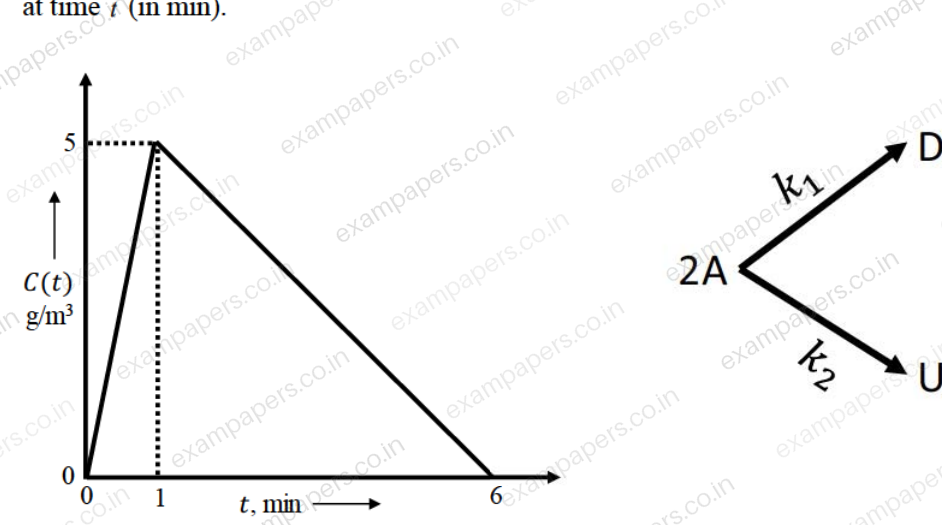
The rate constants are
Liter/(mol min) and
Liter/(mol min). Pure A is fed to the reactor at a concentration of 2 mol/Liter. Using the segregated model, the percentage conversion in the reactor is __________ (rounded off to the nearest integer).Log in to check the answer
You can attempt this question now. Sign in to view the answer key, explanations and discussion.Log in to check answer