
Chemical Engineering
GATE CH Process Calculations and Thermodynamics PYQs
Build your understanding with focused practice from past exam papers.
How to practice Process Calculations and Thermodynamics
Attempt a question, record the concept and assumptions, then check the available answer. Rework mistakes after revising the relevant concepts. Topic tags can overlap; review the question context.
Questions 1–10 of 79. Imported answers require independent review unless marked reviewed.
Question 15
Open questionCHMCQ1 markNeeds review
Consider a closed system of one mole of an ideal gas undergoing a polytropic process. The process follows
, where P is the pressure, V is the volume and n is a constant. If the process is isobaric, which one of the following is the value of n?Your answerChoose one option.
Log in to check the answer
You can attempt this question now. Sign in to view the answer key, explanations and discussion.Log in to check answerQuestion 16
Open questionCHMCQ1 markNeeds review
According to the phase rule, which one of the following is the number of degrees of freedom for pure water at its triple point?
Your answerChoose one option.
Log in to check the answer
You can attempt this question now. Sign in to view the answer key, explanations and discussion.Log in to check answerQuestion 19
Open questionCHMCQ1 markNeeds review
For an irreversible reaction containing inerts in the feed, single-pass conversion in a reactor is 70%. Which one of the following statements is CORRECT?
Your answerChoose one option.
Log in to check the answer
You can attempt this question now. Sign in to view the answer key, explanations and discussion.Log in to check answerQuestion 27
Open questionCHMSQ1 markNeeds review
Which of the following statements regarding the heat of reaction is/are CORRECT?
Your answerSelect all correct options. You can choose more than one.
Log in to check the answer
You can attempt this question now. Sign in to view the answer key, explanations and discussion.Log in to check answerQuestion 31
Open questionCHNAT1 markNeeds review
Consider a homogeneous gas phase reaction, A + 2B → 2C + 3D, occuring at constant temperature and pressure in a varying volume batch reactor. The vessel is initially charged with 50 moles of A and 150 moles of B. The gases behave ideally. For complete conversion of A, the ratio of the final volume to the initial volume is _____ (rounded off to one decimal place).
Log in to check the answer
You can attempt this question now. Sign in to view the answer key, explanations and discussion.Log in to check answerQuestion 36
Open questionCHMCQ2 marksNeeds review
K value is defined as the ratio of mole fraction of a component in the vapor phase to that in the liquid phase. The K values of propane and iso-butane at 293 K are given in the table.
Pressure (kPa) | Propane | iso-Butane |
|---|---|---|
1100 | 1.8 | 0.85 |
1200 | 1.6 | 0.75 |
1300 | 1.4 | 0.65 |
1400 | 1.25 | 0.5 |
1500 | 1.1 | 0.45 |
Which one of the following is closest to the bubble point pressure (in kPa) of an equimolar mixture of propane and iso-butane at 293 K?
Your answerChoose one option.
Log in to check the answer
You can attempt this question now. Sign in to view the answer key, explanations and discussion.Log in to check answerQuestion 57
Open questionCHNAT2 marksNeeds review
A feed containing 10 mol % propylene, 15 mol % ammonia and rest air is charged into a reactor to produce acrylonitrile (C₃H₃N) according to the following reaction.
Assume, air contains 80 mol % N₂ and 20 mol % O₂.
If the conversion of the limiting reactant is 30%, the composition of C₃H₃N (in mol %) in the product stream is __________ (rounded off to two decimal places).
Log in to check the answer
You can attempt this question now. Sign in to view the answer key, explanations and discussion.Log in to check answerQuestion 58
Open questionCHNAT2 marksNeeds review
A gas mixture of 50 wt. % argon and 50 wt. % helium flowing through a horizontal tube of uniform diameter at a rate of 1 kg s⁻¹ is heated from 300 K to 400 K at 1 bar. Neglect shaft work, and changes in kinetic as well as potential energies between the inlet and the outlet. Assume the mixture exhibits ideal gas behavior. The specific enthalpies of the components are given in the following table.
Component | Specific enthalpy (kJ kg⁻¹) at 300 K | Specific enthalpy (kJ kg⁻¹) at 400 K |
|---|---|---|
Argon | 348 | 400 |
Helium | 1574 | 2092 |
At steady state, the heat input required (in kW) is __________ (rounded off to the nearest integer).
Log in to check the answer
You can attempt this question now. Sign in to view the answer key, explanations and discussion.Log in to check answerQuestion 64
Open questionCHNAT2 marksNeeds review
Cyclohexane (C₆H₁₂) is produced from benzene (C₆H₆) and hydrogen (H₂) according to the following reaction.
Consider the process flow diagram shown in the figure.
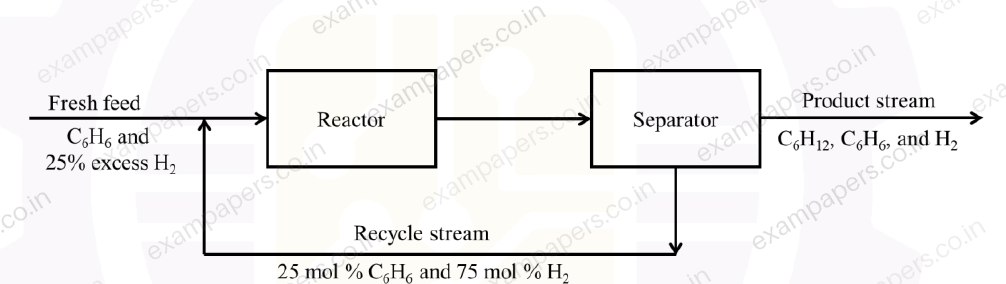
In this process, the overall and single-pass conversions are 90% and 25%, respectively. The recycle stream contains 25 mol % C₆H₆ and 75 mol % H₂. If the fresh feed contains 25% excess H₂, at steady state, the ratio of the molar flow rate of recycle stream to that of the fresh feed is _________ (rounded off to one decimal place).
Log in to check the answer
You can attempt this question now. Sign in to view the answer key, explanations and discussion.Log in to check answerQuestion 15
Open questionCHMCQ1 markNeeds review
The number of independent intensive variables that need to be specified to determine the thermodynamic state of a ternary mixture at vapor-liquid-liquid equilibrium is
Your answerChoose one option.
Log in to check the answer
You can attempt this question now. Sign in to view the answer key, explanations and discussion.Log in to check answer