
Chemical Engineering
GATE CH purpose:exam-prep PYQs
Build your understanding with focused practice from past exam papers.
Questions 171–180 of 650. Imported answers require independent review unless marked reviewed.
Question 41
Open questionCHMCQ2 marksNeeds review
Sulfur dioxide (SO
) gas diffuses through a stagnant air-film of thickness 2 mm at 1 bar and 30 °C. The diffusion coefficient of SO
in air is
. The SO
partial pressures at the opposite sides of the film are 0.15 bar and 0.05 bar. The universal gas constant is 8.314 J mol
K
. Assume ideal gas behavior, the steady-state flux of SO
in mol m
s
through the air-film isYour answerChoose one option.
Log in to check the answer
You can attempt this question now. Sign in to view the answer key, explanations and discussion.Log in to check answerQuestion 42
Open questionCHMCQ2 marksNeeds review
A simple distillation column separates a binary mixture of
and
. The relative volatility of
with respect to
is 2. The steady-state composition of
in the vapour leaving the 1
, 2
and 3
trays in the rectifying section are 94, 90 and 85 mol%, respectively. For ideal trays and constant molar overflow, the reflux-to-distillate ratio isYour answerChoose one option.
Log in to check the answer
You can attempt this question now. Sign in to view the answer key, explanations and discussion.Log in to check answerQuestion 43
Open questionCHMCQ2 marksNeeds review
Alumina particles with an initial moisture content of 5 kg per kg dry solid are dried in a batch dryer. For the first two hours, the measured drying rate is constant at 2 kg m
h
. Thereafter, in the falling-rate period, the rate decreases linearly with the moisture content. The equilibrium moisture content is 0.05 kg per kg dry solid and the drying area of the particles is 0.5 m
per kg dry solid. The total drying time, in h, to reduce the moisture content to half its initial value isYour answerChoose one option.
Log in to check the answer
You can attempt this question now. Sign in to view the answer key, explanations and discussion.Log in to check answerQuestion 44
Open questionCHMCQ2 marksNeeds review
A first-order heterogeneous reaction
is carried out using a porous spherical catalyst. Assume isothermal conditions, and that intraphase diffusion controls the reaction rate. At a bulk
concentration of 0.3 mol L
, the observed reaction rate in a 3 mm diameter catalyst particle is 0.2 mol s
L
catalyst volume. At a bulk
concentration of 0.1 mol L
, the observed reaction rate, in mol s
L
catalyst volume, in a 6 mm diameter catalyst particle, isYour answerChoose one option.
Log in to check the answer
You can attempt this question now. Sign in to view the answer key, explanations and discussion.Log in to check answerQuestion 45
Open questionCHMCQ2 marksNeeds review
A first-order liquid phase reaction
is carried out in two isothermal plug flow reactors (PFRs) of volume 1 m
each, connected in series. The feed flow rate and concentration of
to the first reactor are 10 m
h
and 1 kmol m
, respectively. At steady-state, the concentration of
at the exit of the second reactor is 0.2 kmol m
. If the two PFRs are replaced by two equal-volume continuously stirred tank reactors (CSTRs) to achieve the same overall steady-state conversion, the volume of each CSTR, in m
, isYour answerChoose one option.
Log in to check the answer
You can attempt this question now. Sign in to view the answer key, explanations and discussion.Log in to check answerQuestion 46
Open questionCHMCQ2 marksNeeds review
The residence time distribution,
, for a non-ideal flow reactor is given in the figure. A first-order liquid phase reaction with a rate constant 0.2 min
is carried out in the reactor. For an inlet reactant concentration of 2 mol L
, the reactant concentration (in mol L
) in the exit stream is 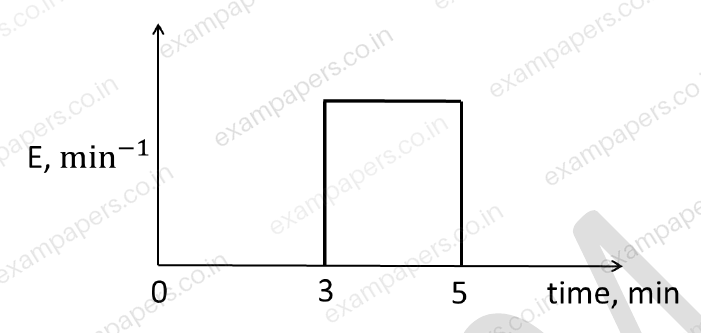
Your answerChoose one option.
Log in to check the answer
You can attempt this question now. Sign in to view the answer key, explanations and discussion.Log in to check answerQuestion 47
Open questionCHMCQ2 marksNeeds review
Let
and
be the polar coordinates defined by
and
. The area of the cardioid
,
, is 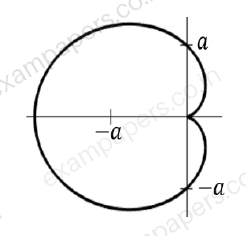
Your answerChoose one option.
Log in to check the answer
You can attempt this question now. Sign in to view the answer key, explanations and discussion.Log in to check answerQuestion 48
Open questionCHMCQ2 marksNeeds review
For the block diagram shown in the figure, the correct expression for the transfer function
is 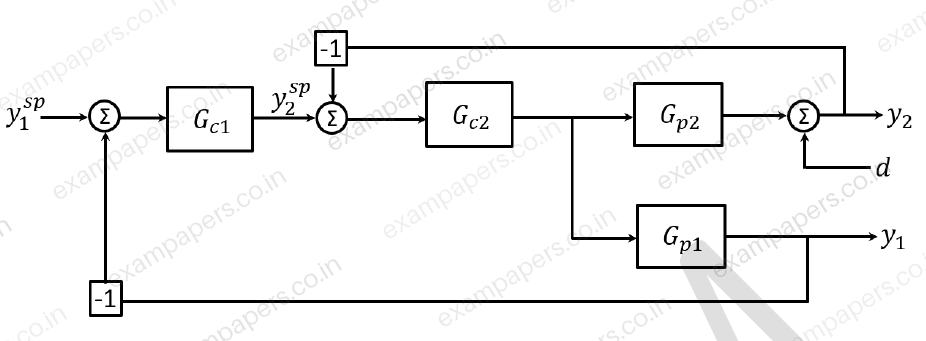
Your answerChoose one option.
Log in to check the answer
You can attempt this question now. Sign in to view the answer key, explanations and discussion.Log in to check answerQuestion 49
Open questionCHMCQ2 marksNeeds review
For purchasing a batch reactor, three alternatives P, Q and R have emerged, as summarized in the table. For a compound interest rate of 10% per annum, choose the correct option that arranges the alternatives, in order, from the least expensive to the most expensive.
| P | Q | R |
|---|---|---|---|
Installed Cost (lakh rupees) | 15 | 25 | 35 |
Equipment Life (years) | 3 | 5 | 7 |
Maintenance Cost (lakh rupees per year) | 4 | 3 | 2 |
Your answerChoose one option.
Log in to check the answer
You can attempt this question now. Sign in to view the answer key, explanations and discussion.Log in to check answerQuestion 50
Open questionCHNAT2 marksNeeds review
The Newton-Raphson method is used to solve
, where
. If the initial guess
, the value of the next iterate,
, rounded off to 2 decimal places, is ______Log in to check the answer
You can attempt this question now. Sign in to view the answer key, explanations and discussion.Log in to check answer