
Chemical Engineering
GATE CH topic:chemical-engineering PYQs
Build your understanding with focused practice from past exam papers.
Questions 371–380 of 650. Imported answers require independent review unless marked reviewed.
Question 36
Open questionCHNAT2 marksNeeds review
For the ordinary differential equation
with initial conditions
, the value of
________ (round off to 3 decimal places).Log in to check the answer
You can attempt this question now. Sign in to view the answer key, explanations and discussion.Log in to check answerQuestion 37
Open questionCHNAT2 marksNeeds review
Formaldehyde is produced by the oxidation of methane in a reactor. The following two parallel reactions occur:
Methane and oxygen are fed to the reactor. The product gases leaving the reactor include methane, oxygen, formaldehyde, carbon dioxide and water vapor.60 mol s
of methane enters the reactor. The molar flowrate (in mol s
) of CH
, O
and CO
leaving the reactor are 26, 2 and 4, respectively. The molar flowrate of oxygen entering the reactor is ________ mol s
.Log in to check the answer
You can attempt this question now. Sign in to view the answer key, explanations and discussion.Log in to check answerQuestion 38
Open questionCHNAT2 marksNeeds review
The combustion of carbon monoxide is carried out in a closed, rigid and insulated vessel. 1 mol of CO, 0.5 mol of O
and 2 mol of N
are taken initially at 1 bar and 298 K, and the combustion is carried out to completion.The standard molar internal energy change of reaction (
) for the combustion of carbon monoxide at 298 K = −282 kJ mol
. At constant pressure, the molar heat capacities of N
and CO
are 33.314 J mol
K
and 58.314 J mol
K
, respectively. Assume the heat capacities to be independent of temperature, and the gases are ideal. Take R = 8.314 J mol
K
.The final pressure in the vessel at the completion of the reaction is ______ bar (round off to 1 decimal place).
Log in to check the answer
You can attempt this question now. Sign in to view the answer key, explanations and discussion.Log in to check answerQuestion 39
Open questionCHNAT2 marksNeeds review
A gaseous mixture at 1 bar and 300 K consists of 20 mol % CO
and 80 mol% inert gas.Assume the gases to be ideal. Take R = 8.314 J mol
K
.The magnitude of minimum work required to separate 100 mol of this mixture at 1 bar and 300 K into pure CO
and inert gas at the same temperature and pressure is ________ kJ (round off to nearest integer).Log in to check the answer
You can attempt this question now. Sign in to view the answer key, explanations and discussion.Log in to check answerQuestion 40
Open questionCHNAT2 marksNeeds review
A binary liquid mixture consists of two species 1 and 2. Let
and
represent the activity coefficient and the mole fraction of the species, respectively. Using a molar excess Gibbs free energy model,
vs.
and
vs.
are plotted. A tangent drawn to the
vs.
curve at a mole fraction of
has a slope = −1.728.The slope of the tangent drawn to the
vs.
curve at the same mole fraction is ________ (correct to 3 decimal places).Log in to check the answer
You can attempt this question now. Sign in to view the answer key, explanations and discussion.Log in to check answerQuestion 41
Open questionCHNAT2 marksNeeds review
Consider a tank filled with 3 immiscible liquids A, B and C at static equilibrium, as shown in the figure.
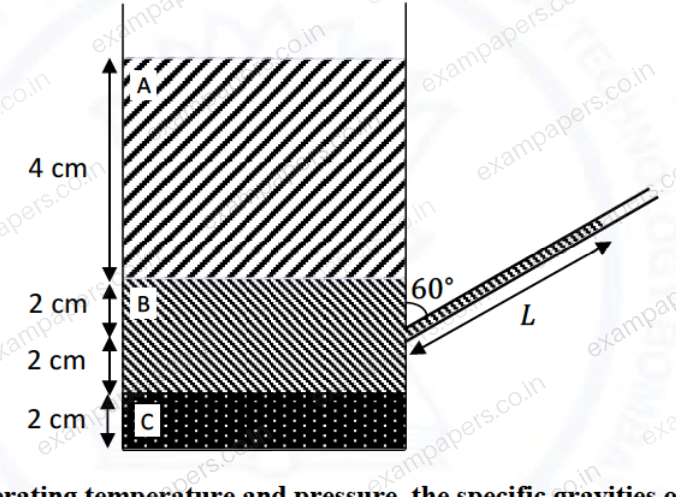
At 2 cm below the liquid A – liquid B interface, a tube is connected from the side of the tank. Both the tank and the tube are open to the atmosphere.
At the operating temperature and pressure, the specific gravities of liquids A, B and C are 1, 2 and 4, respectively. Neglect any surface tension effects in the calculations. The length of the tube
that is wetted by liquid B is ________ cm.Log in to check the answer
You can attempt this question now. Sign in to view the answer key, explanations and discussion.Log in to check answerQuestion 42
Open questionCHNAT2 marksNeeds review
Seawater is passed through a column containing a bed of resin beads.
Density of seawater = 1025 kg m
Density of resin beads = 1330 kg m
Diameter of resin beads = 50 μm
Void fraction of the bed at the onset of fluidization = 0.4
Acceleration due to gravity = 9.81 m s
The pressure drop per unit length of the bed at the onset of fluidization is ________ Pa m
(round off to nearest integer).Log in to check the answer
You can attempt this question now. Sign in to view the answer key, explanations and discussion.Log in to check answerQuestion 43
Open questionCHNAT2 marksNeeds review
A straight fin of uniform circular cross section and adiabatic tip has an aspect ratio (length/diameter) of 4. If the Biot number (based on radius of the fin as the characteristic length) is 0.04, the efficiency is ________ % (round off to nearest integer).
Log in to check the answer
You can attempt this question now. Sign in to view the answer key, explanations and discussion.Log in to check answerQuestion 44
Open questionCHNAT2 marksNeeds review
A double-effect evaporator is used to concentrate a solution. Steam is sent to the first effect at 110 °C and the boiling point of the solution in the second effect is 63.3 °C. The overall heat transfer coefficient in the first effect and second effect are 200 W m
K
and 1500 W m
K
, respectively. The heat required to raise the temperature of the feed to the boiling point can be neglected. The heat flux in the two evaporators can be assumed to be equal.The temperature at which the solution boils in the first effect is ________ °C (round off to nearest integer).
Log in to check the answer
You can attempt this question now. Sign in to view the answer key, explanations and discussion.Log in to check answerQuestion 45
Open questionCHNAT2 marksNeeds review
Consider a solid slab of thickness 2L and uniform cross section A. The volumetric rate of heat generation within the slab is
(W m
). The slab loses heat by convection at both ends to air with heat transfer coefficient
. Assuming steady state, one-dimensional heat transfer, the temperature profile within the slab along the thickness is given by:
where
is the thermal conductivity of the slab and
is the surface temperature. If
K, ambient air temperature
K, and Biot number (based on L as the characteristic length) is 0.5, the maximum temperature in the slab is ________ K (round off to nearest integer).Log in to check the answer
You can attempt this question now. Sign in to view the answer key, explanations and discussion.Log in to check answer