
Chemical Engineering
GATE CH topic:chemical-processes PYQs
Build your understanding with focused practice from past exam papers.
Questions 431–440 of 650. Imported answers require independent review unless marked reviewed.
Question 31
Open questionCHMCQ2 marksNeeds review
Consider the gas phase reaction
occurring in an isothermal and isobaric reactor maintained at 298 K and 1.0 bar. The standard Gibbs energy change of the reaction at 298 K is
J mol⁻¹. The standard states are those of pure ideal gases at 1.0 bar. The equilibrium mixture in the reactor behaves as an ideal gas. The value of the universal gas constant is 8.314 J mol⁻¹ K⁻¹. If one mole of pure N₂O₄ is initially charged to the reactor, the fraction of N₂O₄ that decomposes into NO₂ at equilibrium isYour answerChoose one option.
Log in to check the answer
You can attempt this question now. Sign in to view the answer key, explanations and discussion.Log in to check answerQuestion 32
Open questionCHMCQ2 marksNeeds review
A tank initially contains a gas mixture with 21 mol % oxygen and 79 mol % nitrogen. Pure nitrogen enters the tank, and a gas mixture of nitrogen and oxygen exits the tank. The molar flow rate of both the inlet and exit streams is 8 mol s
. In addition, use the following data and assumptions:• Assume the tank contents to be well mixed
• Assume ideal gas behavior
• The temperature and pressure inside the tank are held constant
• Molar density of the gas mixture in the tank is constant at 40 mol m
If the volume of the tank is 20 m
, then the time (in seconds) required for oxygen content in the tank to decrease to 1 mol % isYour answerChoose one option.
Log in to check the answer
You can attempt this question now. Sign in to view the answer key, explanations and discussion.Log in to check answerQuestion 33
Open questionCHMCQ2 marksNeeds review
Consider steady, laminar, fully developed flow of an incompressible Newtonian fluid through two horizontal straight pipes, I and II, of circular cross section. The volumetric flow rates in both the pipes are the same. The diameter of pipe II is twice the diameter of pipe I, i.e.,
. The ratio of the shear stress at the wall of pipe I to the shear stress at the wall of pipe II isYour answerChoose one option.
Log in to check the answer
You can attempt this question now. Sign in to view the answer key, explanations and discussion.Log in to check answerQuestion 34
Open questionCHMCQ2 marksNeeds review
Equilibrium data for a binary mixture of E and F at two different pressures is shown in the figure.
It is desired to process a feed containing 80 mol % E and 20 mol % F, and obtain a product with a purity of 99.5 mol % E. A sequence of two distillation columns, one operating at pressure
and another at
, is employed for this operation, as shown below.The mole fraction of E in the distillate obtained from column 1 is 0.9. If the column pressures
and
are in kPa, which one of the following is correct? 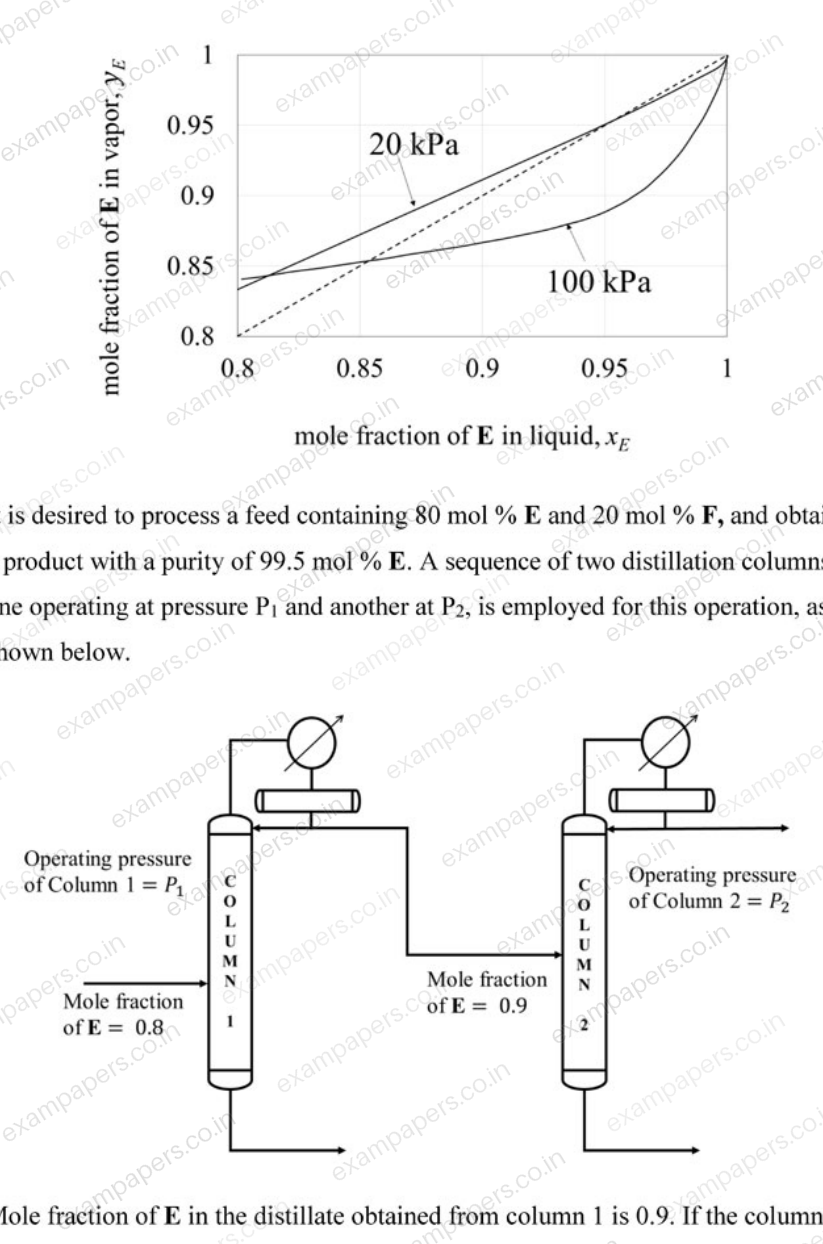
Your answerChoose one option.
Log in to check the answer
You can attempt this question now. Sign in to view the answer key, explanations and discussion.Log in to check answerQuestion 35
Open questionCHMCQ2 marksNeeds review
A hollow cylinder of equal length and inner diameter (i.e.,
) is sealed at both ends with flat plate, as shown in the figure. Its inner surfaces,
,
, and
radiate energy.
denotes the fraction of radiation energy leaving the surface
which reaches the surface
. It is also known that
. Which one of the following is correct? 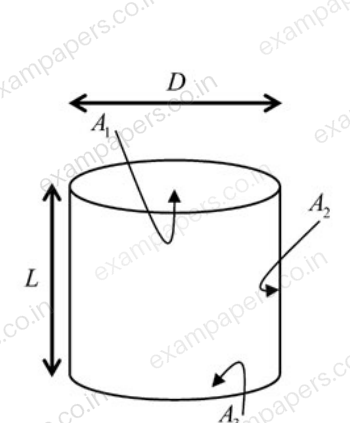
Your answerChoose one option.
Log in to check the answer
You can attempt this question now. Sign in to view the answer key, explanations and discussion.Log in to check answerQuestion 36
Open questionCHMCQ2 marksNeeds review
A student performs a flow experiment with Bingham Plastic under fully developed laminar flow conditions in a tube of radius 0.01 m with a pressure drop (
) of 10 kPa over tube length (
) of 1.0 m. The velocity profile is flat for
and parabolic for
, as shown in the figure.
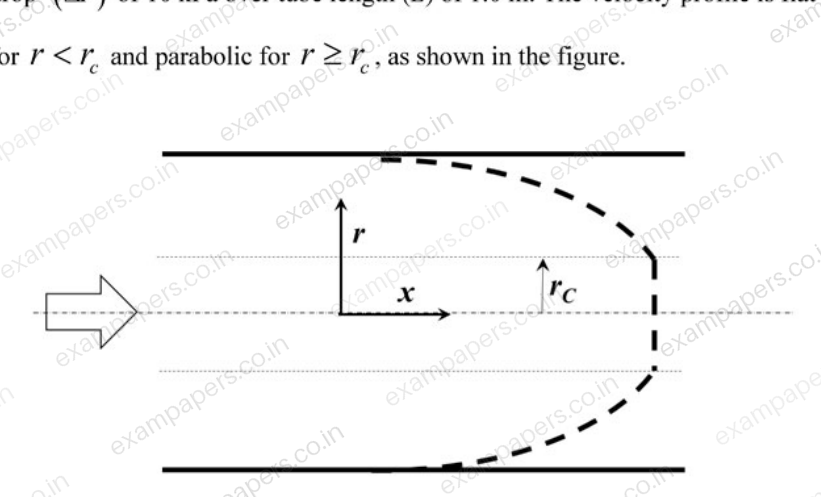
Consider
and
as the radial and axial directions, and the shear stress is finite as
approaches zero. A force balance results in the following equation
where
is the shear stress. If
is 0.001 m, then the magnitude of yield stress for this Bingham Plastic (in Pa) isYour answerChoose one option.
Log in to check the answer
You can attempt this question now. Sign in to view the answer key, explanations and discussion.Log in to check answerQuestion 37
Open questionCHMCQ2 marksNeeds review
A feed stream containing pure species L flows into a reactor, where L is partly converted to M as shown in the figure.
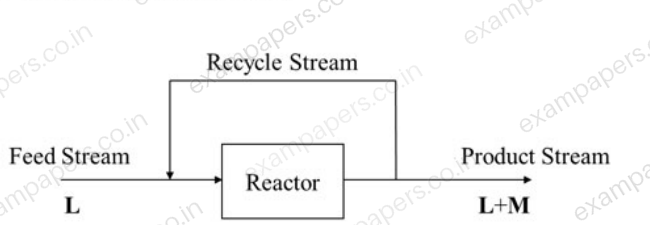
The mass flow rate of the recycle stream is 20% of that of the product stream. The overall conversion of L (based on mass units) in the process is 30%. Assuming steady state operation, the one-pass conversion of L (based on mass units) through the reactor is
Your answerChoose one option.
Log in to check the answer
You can attempt this question now. Sign in to view the answer key, explanations and discussion.Log in to check answerQuestion 38
Open questionCHMCQ2 marksNeeds review
A U-tube manometer contains two manometric fluids of densities 100 kg m
and 600 kg m
. When both the limbs are open to atmosphere, the difference between the two levels is 10 cm at equilibrium, as shown in the figure.The rest of the manometer is filled with air of negligible density. The acceleration due to gravity is 9.81 m s
and the atmospheric pressure is 100 kPa. How much absolute pressure (in kPa) has to be applied on the limb ‘P’ to raise fluid in the limb ‘Q’ by another 20 cm? 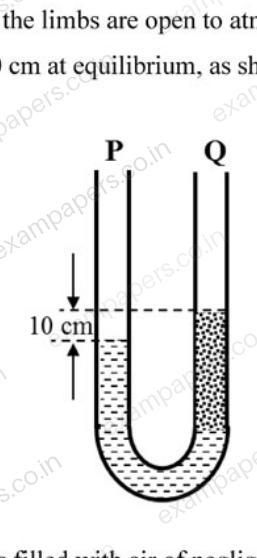
Your answerChoose one option.
Log in to check the answer
You can attempt this question now. Sign in to view the answer key, explanations and discussion.Log in to check answerQuestion 39
Open questionCHMCQ2 marksNeeds review
A pure gas obeys the equation of state given by
where
is the pressure,
is the absolute temperature,
is the molar volume of the gas,
is the universal gas constant, and
is a parameter independent of
and
. The residual molar Gibbs energy,
, of the gas is given by the relation
where
is the compressibility factor and the integral is evaluated at constant
. If the value of
is
, the residual molar enthalpy (in J mol
) of the gas at 100 kPa and 300 K isYour answerChoose one option.
Log in to check the answer
You can attempt this question now. Sign in to view the answer key, explanations and discussion.Log in to check answerQuestion 40
Open questionCHMCQ2 marksNeeds review
Consider one mole of an ideal gas in a closed system. It undergoes a change in state from L to N through two different non-isothermal processes, as shown in the P-V diagram (where
is the pressure and
is the molar volume of the gas). Process I is carried out in a single step, namely LN, whereas process II is carried out in two steps, namely LM and MN. All the steps are reversible.The net heat flowing into the system for process I is
, and that for process II is
. The value of
(in J) is 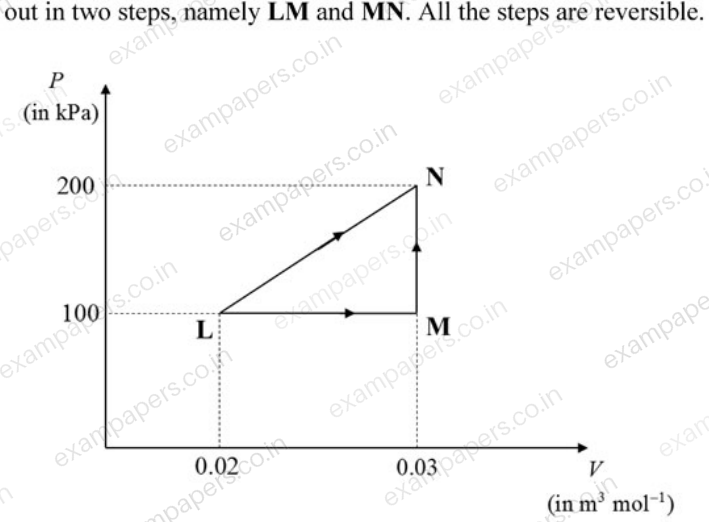
Your answerChoose one option.
Log in to check the answer
You can attempt this question now. Sign in to view the answer key, explanations and discussion.Log in to check answer