
Chemical Engineering
GATE CH topic:chemical-reaction-engineering PYQs
Build your understanding with focused practice from past exam papers.
Questions 41–50 of 70. Imported answers require independent review unless marked reviewed.
Question 7
Open questionCHMCQ1 markNeeds review
The square of Thiele modulus,
, is given by
, where
is the characteristic length of the catalyst pellet,
is the rate constant of a first order reaction, and
is the effective diffusivity of the species in the pores.
is a measure ofYour answerChoose one option.
Log in to check the answer
You can attempt this question now. Sign in to view the answer key, explanations and discussion.Log in to check answerQuestion 24
Open questionCHNAT1 markNeeds review
The decomposition of acetaldehyde (X) to methane and carbon monoxide follows four-step free radical mechanism. The overall rate of decomposition of X is
where,
,
, and
denote the rate constants of the elementary steps, with corresponding activation energies (in kJ mol⁻¹) of 320, 40, and 0, respectively. The temperature dependency of the rate constants is described by Arrhenius equation.
denotes the concentration of acetaldehyde. The rate constant for the overall reaction is
. The activation energy for the overall reaction (in kJ mol⁻¹) is ________ (round off to nearest integer).Log in to check the answer
You can attempt this question now. Sign in to view the answer key, explanations and discussion.Log in to check answerQuestion 37
Open questionCHMCQ2 marksNeeds review
A feed stream containing pure species L flows into a reactor, where L is partly converted to M as shown in the figure.
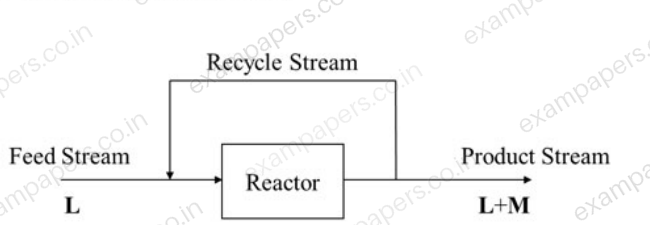
The mass flow rate of the recycle stream is 20% of that of the product stream. The overall conversion of L (based on mass units) in the process is 30%. Assuming steady state operation, the one-pass conversion of L (based on mass units) through the reactor is
Your answerChoose one option.
Log in to check the answer
You can attempt this question now. Sign in to view the answer key, explanations and discussion.Log in to check answerQuestion 44
Open questionCHNAT2 marksNeeds review
An elementary liquid phase reversible reaction
is carried out in an ideal continuous stirred tank reactor (CSTR) operated at steady state. The rate of consumption of P,
(in mol liter
minute
), is given by
where
and
are the concentrations (in mol liter
) of P and Q, respectively.The feed contains only the reactant P at a concentration of 1 mol liter
, and the conversion of P at the exit of the CSTR is 75% of the equilibrium conversion. Assume that there is no volume change associated with the reaction, and the temperature of the reaction mixture is constant throughout the operation. The space time (in minutes) of the CSTR is ________ (round off to 1 decimal place).Log in to check the answer
You can attempt this question now. Sign in to view the answer key, explanations and discussion.Log in to check answerQuestion 49
Open questionCHNAT2 marksNeeds review
An exothermic, aqueous phase, irreversible, first order reaction,
is carried out in an ideal continuous stirred tank reactor (CSTR) operated adiabatically at steady state. Rate of consumption of Y (in mol liter
minute
) is given by
where
is the concentration of Y (in mol liter
), and
is the temperature of the reaction mixture (in K). Reactant Y is fed at 50 °C. Its inlet concentration is 1.0 mol liter
, and its volumetric flow rate is 1.0 liter minute
.In addition, use the following data and assumptions:
Heat of the reaction = −4200 J mol
Specific heat capacity of the reaction mixture = 4.2 J g
K
Density of the reaction mixture = 1000 g liter
Heat of the reaction, specific heat capacity and density of the reaction mixture do not vary with temperature
Shaft work is negligible
If the conversion of Y at the exit of the reactor is 90%, the volume of the CSTR (in liter) is ________ (round off to 2 decimal places).
Log in to check the answer
You can attempt this question now. Sign in to view the answer key, explanations and discussion.Log in to check answerQuestion 50
Open questionCHNAT2 marksNeeds review
The liquid phase irreversible reactions,
and
, are carried out in an ideal continuous stirred tank reactor (CSTR) operating isothermally at steady state. The space time of the CSTR is 1 minute. Both the reactions are first order with respect to the reactant P, and
and
denote the rate constants of the two reactions. At the exit of the reactor, the conversion of reactant P is 60%, and the selectivity of Q with respect to R is 50%. The value of the first order rate constant
(in minute
) is ________ (correct up to one decimal place).Log in to check the answer
You can attempt this question now. Sign in to view the answer key, explanations and discussion.Log in to check answerQuestion 51
Open questionCHNAT2 marksNeeds review
A catalytic gas phase reaction
is conducted in an isothermal packed bed reactor operated at steady state. The reaction is irreversible and second order with respect to the reactant P. The feed is pure P with a volumetric flow rate of 1.0 liter minute
and concentration of 2.0 mol liter
.In addition, use the following assumptions:
The reactant and product are ideal gases
There is no volume change associated with the reaction
Ideal plug flow conditions prevail in the packed bed
When the mass of catalyst in the reactor is 4 g, the concentration of P measured at the exit is 0.4 mol liter
. The second order rate constant (in liter
g
mol
minute
) is ________ (correct up to one decimal place).Log in to check the answer
You can attempt this question now. Sign in to view the answer key, explanations and discussion.Log in to check answerQuestion 10
Open questionCHMCQ1 markNeeds review
The desired liquid-phase reaction
is accompanied by an undesired side reaction
Four isothermal reactor schemes (CSTR: ideal Continuous-Stirred Tank Reactor; PFR: ideal Plug Flow Reactor) for processing equal molar feed rates of D and E are shown in figure. Each scheme is designed for the same conversion. The scheme that gives the most favorable product distribution is:
Your answerChoose one option.
Log in to check the answer
You can attempt this question now. Sign in to view the answer key, explanations and discussion.Log in to check answerQuestion 11
Open questionCHMCQ1 markNeeds review
For a first order reaction in a porous spherical catalyst pellet, diffusional effects are most likely to lower the observed rate of reaction for
Your answerChoose one option.
Log in to check the answer
You can attempt this question now. Sign in to view the answer key, explanations and discussion.Log in to check answerQuestion 45
Open questionCHNAT2 marksNeeds review
The elementary, irreversible, liquid-phase, parallel reactions, 2A → D and 2A → U, take place in an isothermal non-ideal reactor. The C-curve measured in a tracer experiment is shown in the figure, where
is the concentration of the tracer in g/m³ at the reactor exit at time
(in min).
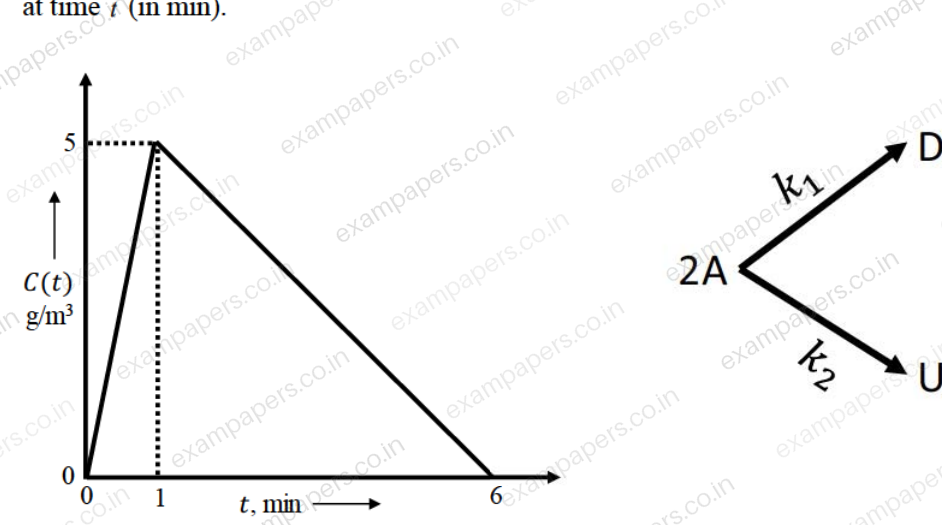
The rate constants are
Liter/(mol min) and
Liter/(mol min). Pure A is fed to the reactor at a concentration of 2 mol/Liter. Using the segregated model, the percentage conversion in the reactor is __________ (rounded off to the nearest integer).Log in to check the answer
You can attempt this question now. Sign in to view the answer key, explanations and discussion.Log in to check answer