
Chemical Engineering
GATE CH topic:chemical-reaction-engineering PYQs
Build your understanding with focused practice from past exam papers.
Questions 61–70 of 70. Imported answers require independent review unless marked reviewed.
Question 40
Open questionCHNAT2 marksNeeds review
The elementary second-order liquid phase reaction A + B → C + D is carried out in an isothermal plug flow reactor of 2 m³ volume. The inlet volumetric flow rate is 10 m³/h. The initial concentrations of both A and B are 2 kmol/m³. The rate constant is given as 2.5 m³ kmol⁻¹ h⁻¹. The percentage conversion of A is __________.
Log in to check the answer
You can attempt this question now. Sign in to view the answer key, explanations and discussion.Log in to check answerQuestion 51
Open questionCHNAT2 marksNeeds review
A set of standard stainless steel pipes, each of internal diameter 26.65 mm and 600 mm length, is used to make a plug flow reactor by joining them in series to carry out degradation of polyethylene. Seven such pipes are required to obtain a conversion of 66% at 450 K. The minimum number of standard 800 mm long pipes of the same internal diameter to be procured for obtaining at least 66% conversion under the same reaction conditions is __________.
Log in to check the answer
You can attempt this question now. Sign in to view the answer key, explanations and discussion.Log in to check answerQuestion 52
Open questionCHNAT2 marksNeeds review
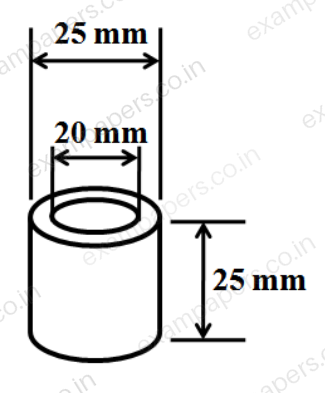
Hydrogenation of benzene is to be carried out using Ni (density = 910 kg/m³) as catalyst, cast in the form of non-porous hollow cylinders, as shown below. The reaction occurs on all the surfaces of the hollow cylinder. During an experiment, one such cylinder is suspended in the reactant stream. If the observed rate of reaction is 0.39 mol (m² of catalyst surface)⁻¹ min⁻¹, then the rate of reaction in mol (kg of catalyst)⁻¹ min⁻¹ is ____________ (rounded off to three decimal places).
Log in to check the answer
You can attempt this question now. Sign in to view the answer key, explanations and discussion.Log in to check answerQuestion 17
Open questionCHMCQ1 markNeeds review
The following reaction rate curve is shown for a reaction A → P. Here,
and
represent reaction rate and conversion, respectively. The feed is pure A and 90% conversion is desired. 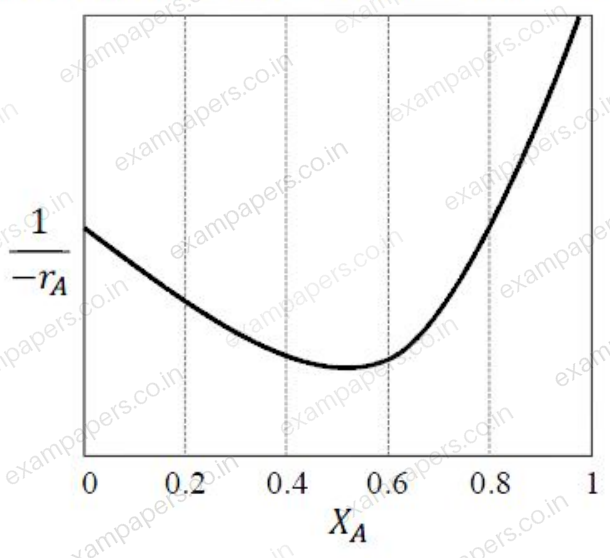
Which amongst the following reactor configurations gives the lowest total volume of the reactor(s)?
Your answerChoose one option.
Log in to check the answer
You can attempt this question now. Sign in to view the answer key, explanations and discussion.Log in to check answerQuestion 18
Open questionCHMCQ1 markNeeds review
Consider a first order catalytic reaction in a porous catalyst pellet.
Given
– characteristic length of the pellet;
– effective diffusivity;
– mass transfer coefficient;
– rate constant based on volume of the catalyst pellet;
– concentration of reactant on the pellet surface.The expression for Thiele modulus is
Your answerChoose one option.
Log in to check the answer
You can attempt this question now. Sign in to view the answer key, explanations and discussion.Log in to check answerQuestion 19
Open questionCHMCQ1 markNeeds review
For a solid-catalyzed gas phase reversible reaction, which of the following statements is ALWAYS TRUE?
Your answerChoose one option.
Log in to check the answer
You can attempt this question now. Sign in to view the answer key, explanations and discussion.Log in to check answerQuestion 46
Open questionCHNAT2 marksNeeds review
The C-curve measured during a pulse tracer experiment is shown below. In the figure,
is the concentration of the tracer measured at the reactor exit in mol/liter at time
seconds.
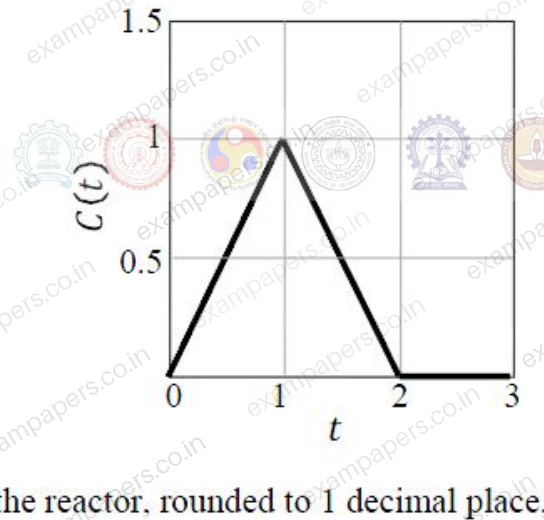
The mean residence time in the reactor, rounded to 1 decimal place, is _____ s.
Log in to check the answer
You can attempt this question now. Sign in to view the answer key, explanations and discussion.Log in to check answerQuestion 47
Open questionCHNAT2 marksNeeds review
The following liquid phase second-order reaction is carried out in an isothermal CSTR at steady state
where
is the concentration of the reactant in the CSTR. The reactor volume is 2 m
, the inlet flowrate is 0.5 m
/hr and the inlet concentration of the reactant is 1000 mol/m
.
The fractional conversion, rounded to 2 decimal places, is ______ .Log in to check the answer
You can attempt this question now. Sign in to view the answer key, explanations and discussion.Log in to check answerQuestion 48
Open questionCHNAT2 marksNeeds review
The reversible reaction of t-butyl alcohol (TBA) and ethanol (EtOH) to ethyl t-butyl ether (ETBE) is
The equilibrium constant for this reaction is
. Initially, 74 g of TBA is mixed with 100 g of aqueous solution containing 46 weight% ethanol. The molecular weights are: 74 g/mol for TBA, 46 g/mol for EtOH, 102 g/mol for ETBE, and 18 g/mol for water.
The mass of ETBE at equilibrium, rounded to 1 decimal place, is _____ g.Log in to check the answer
You can attempt this question now. Sign in to view the answer key, explanations and discussion.Log in to check answerQuestion 49
Open questionCHNAT2 marksNeeds review
The following gas-phase reaction is carried out in a constant-volume isothermal batch reactor
The reactants A and B as well as the product S are non-condensable gases. At the operating temperature, the saturation pressure of the product R is 40 kPa.
Initially, the batch reactor contains equimolar amounts of A and B (and no products) at a total pressure of 100 kPa. The initial concentrations of the reactants are
. The rate of reaction is given by
.
The time at which R just starts condensing, rounded to 1 decimal place, is ________ s.Log in to check the answer
You can attempt this question now. Sign in to view the answer key, explanations and discussion.Log in to check answer