
Chemical Engineering
GATE CH topic:fluid-mechanics-and-mechanical-operations PYQs
Build your understanding with focused practice from past exam papers.
Questions 31–40 of 77. Imported answers require independent review unless marked reviewed.
Question 52
Open questionCHNAT2 marksNeeds review
A cylindrical tank with a diameter of 500 mm contains water (density = 1 g·cm
) up to a height
. A 5 mm diameter round nozzle, whose center is 1 cm above the base of the tank, has its exit open to the atmosphere as shown in the schematic below. The pressure above the water level in the tank is maintained at 2 bar (absolute). Neglect all frictional and entry-exit losses. Use acceleration due to gravity as 10 m·s
and atmospheric pressure as 1 bar. The absolute value of initial
(in mm·s
) when
cm is equal to _______ (rounded off to two decimal places). 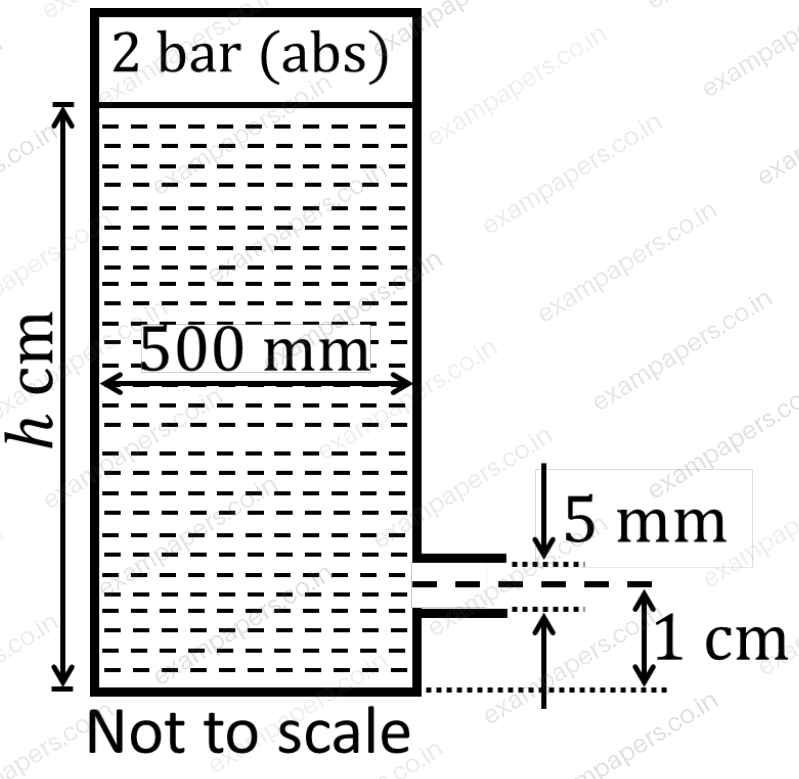
Log in to check the answer
You can attempt this question now. Sign in to view the answer key, explanations and discussion.Log in to check answerQuestion 53
Open questionCHNAT2 marksNeeds review
A large tank is filled with water (density = 1 g·cm
) up to a height of 5 m. A 100 μm diameter solid spherical particle (density = 0.8 g·cm
) is released at the bottom of the tank. The particle attains terminal velocity (
) after traveling to a certain height in the tank. Use acceleration due to gravity as 10 m·s
and water viscosity as 10
Pa·s. Neglect wall effects on the particle. If Stokes law is applicable, the absolute value of
(in mm·s
) is __________(rounded off to two decimal places).Log in to check the answer
You can attempt this question now. Sign in to view the answer key, explanations and discussion.Log in to check answerQuestion 16
Open questionCHMCQ1 markNeeds review
Consider turbulent flow in a pipe under isothermal conditions. Let
denote the radial coordinate and
denote the axial flow direction. On moving away from the wall towards the center of the pipe, the
-component of the Reynolds stressYour answerChoose one option.
Log in to check the answer
You can attempt this question now. Sign in to view the answer key, explanations and discussion.Log in to check answerQuestion 38
Open questionCHMCQ2 marksNeeds review
A horizontal cylindrical water jet of diameter
cm strikes a vertical solid plate with a hole of diameter
cm, as shown in the figure. A part of the jet passes through the hole and the rest is deflected along the plate. The density of water is 100 kg m
. If the speed of the jet is 20 m s
, the magnitude of the horizontal force, in N, required to hold the plate stationary is
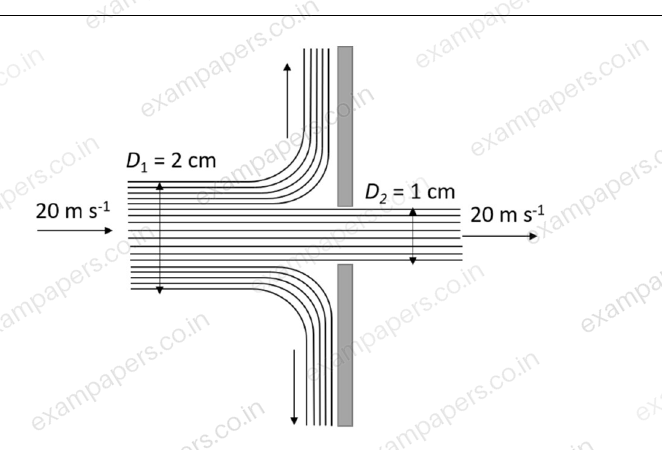
Your answerChoose one option.
Log in to check the answer
You can attempt this question now. Sign in to view the answer key, explanations and discussion.Log in to check answerQuestion 39
Open questionCHMCQ2 marksNeeds review
Consider a horizontal rod of radius
(
) in a stationary pipe of radius
. The rod is pulled coaxially at a constant velocity
as shown in the figure. The annular region is filled with a Newtonian incompressible fluid of viscosity
. The steady state fully developed axial velocity profile in the fluid is given by
, where
is the radial coordinate. Ignoring end effects, the magnitude of the pulling force per unit rod length is
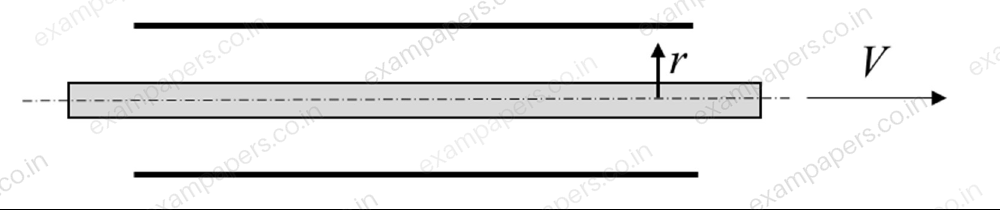
Your answerChoose one option.
Log in to check the answer
You can attempt this question now. Sign in to view the answer key, explanations and discussion.Log in to check answerQuestion 51
Open questionCHNAT2 marksNeeds review
Two reservoirs located at the same altitude are connected by a straight horizontal pipe of length 120 m and inner diameter 0.5 m, as shown in the figure. A pump transfers the liquid of density 800 kg m
at a flow rate of 1 m
s
from Reservoir-1 to Reservoir-2. The liquid levels in Reservoir-1 and Reservoir-2 are 2 m and 10 m, respectively. Assume that the reservoir cross-section areas are large enough to neglect the liquid velocity at the top of the reservoirs. All minor losses can be ignored. The acceleration due to gravity is 9.8 m s
. If the friction factor for the pipe-flow is 0.01, the required power of the pump is __________ kW (rounded off to one decimal place).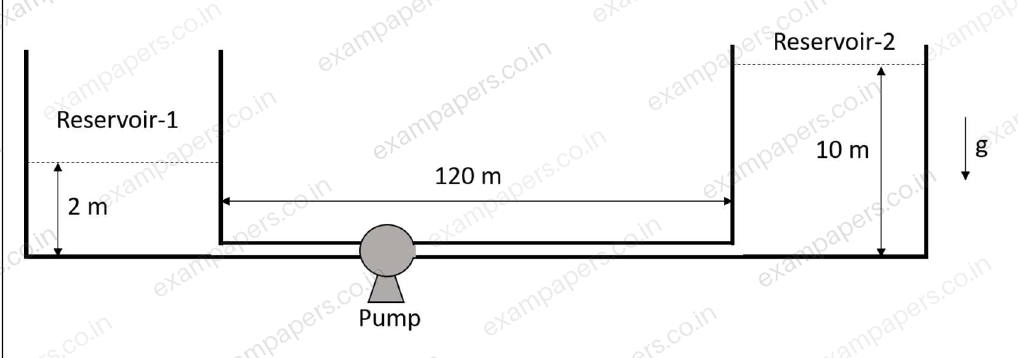
Log in to check the answer
You can attempt this question now. Sign in to view the answer key, explanations and discussion.Log in to check answerQuestion 52
Open questionCHNAT2 marksNeeds review
A venturi meter (venturi coefficient,
) is connected to a pipe of inner diameter 50 mm. Water (density 1000 kg m
) is flowing through the pipe. The pressure-drop measured across the venturi meter is 50 kPa. If the venturi throat diameter is 20 mm, the estimated flow rate of water is ______
m
s
(rounded off to two decimal places).Log in to check the answer
You can attempt this question now. Sign in to view the answer key, explanations and discussion.Log in to check answerQuestion 53
Open questionCHNAT2 marksNeeds review
In a constant-rate cake filtration operation, the collected filtrate volumes are 120 m
and 240 m
at 1 min and 2 min, respectively. Assume the cake resistance to be constant and the filter medium resistance to be negligible. If the pressure-drop across the cake is 10 kPa at 1 min, its value at 2 min is __________ kPa (rounded off to the nearest integer).Log in to check the answer
You can attempt this question now. Sign in to view the answer key, explanations and discussion.Log in to check answerQuestion 4
Open questionCHMCQ1 markNeeds review
A batch settling experiment is performed in a long column using a dilute dispersion containing equal number of particles of type A and type B in water (density 100 kg m
) at room temperature. Type A are spherical particles of diameter 30
m and density 1100 kg m
. Type B are spherical particles of diameter 10
m and density 1900 kg m
. Assuming that Stokes’ law is valid throughout the duration of the experiment, the settled bed wouldYour answerChoose one option.
Log in to check the answer
You can attempt this question now. Sign in to view the answer key, explanations and discussion.Log in to check answerQuestion 5
Open questionCHMCQ1 markNeeds review
A three-dimensional velocity field is given by
, where
are the unit vectors in
directions, respectively, describing a cartesian coordinate system. The coefficient
is a constant. If
describes an incompressible fluid flow, the value of
isYour answerChoose one option.
Log in to check the answer
You can attempt this question now. Sign in to view the answer key, explanations and discussion.Log in to check answer