
Chemical Engineering
GATE CH topic:heat-transfer PYQs
Build your understanding with focused practice from past exam papers.
Questions 31–40 of 57. Imported answers require independent review unless marked reviewed.
Question 8
Open questionCHMCQ1 markNeeds review
For a shell-and-tube heat exchanger, the clean overall heat transfer coefficient is calculated as 250 W m
K
for a specific process condition. It is expected that the heat exchanger may be fouled during the operation, and a fouling resistance of 0.01 m
K W
is prescribed. The dirt overall heat transfer coefficient is _____ W m
K
.Your answerChoose one option.
Log in to check the answer
You can attempt this question now. Sign in to view the answer key, explanations and discussion.Log in to check answerQuestion 43
Open questionCHNAT2 marksNeeds review
A straight fin of uniform circular cross section and adiabatic tip has an aspect ratio (length/diameter) of 4. If the Biot number (based on radius of the fin as the characteristic length) is 0.04, the efficiency is ________ % (round off to nearest integer).
Log in to check the answer
You can attempt this question now. Sign in to view the answer key, explanations and discussion.Log in to check answerQuestion 44
Open questionCHNAT2 marksNeeds review
A double-effect evaporator is used to concentrate a solution. Steam is sent to the first effect at 110 °C and the boiling point of the solution in the second effect is 63.3 °C. The overall heat transfer coefficient in the first effect and second effect are 200 W m
K
and 1500 W m
K
, respectively. The heat required to raise the temperature of the feed to the boiling point can be neglected. The heat flux in the two evaporators can be assumed to be equal.The temperature at which the solution boils in the first effect is ________ °C (round off to nearest integer).
Log in to check the answer
You can attempt this question now. Sign in to view the answer key, explanations and discussion.Log in to check answerQuestion 45
Open questionCHNAT2 marksNeeds review
Consider a solid slab of thickness 2L and uniform cross section A. The volumetric rate of heat generation within the slab is
(W m
). The slab loses heat by convection at both ends to air with heat transfer coefficient
. Assuming steady state, one-dimensional heat transfer, the temperature profile within the slab along the thickness is given by:
where
is the thermal conductivity of the slab and
is the surface temperature. If
K, ambient air temperature
K, and Biot number (based on L as the characteristic length) is 0.5, the maximum temperature in the slab is ________ K (round off to nearest integer).Log in to check the answer
You can attempt this question now. Sign in to view the answer key, explanations and discussion.Log in to check answerQuestion 18
Open questionCHMCQ1 markNeeds review
Ratio of momentum diffusivity to thermal diffusivity is
Your answerChoose one option.
Log in to check the answer
You can attempt this question now. Sign in to view the answer key, explanations and discussion.Log in to check answerQuestion 20
Open questionCHMCQ1 markNeeds review
Leidenfrost phenomenon refers to
Your answerChoose one option.
Log in to check the answer
You can attempt this question now. Sign in to view the answer key, explanations and discussion.Log in to check answerQuestion 35
Open questionCHMCQ2 marksNeeds review
A hollow cylinder of equal length and inner diameter (i.e.,
) is sealed at both ends with flat plate, as shown in the figure. Its inner surfaces,
,
, and
radiate energy.
denotes the fraction of radiation energy leaving the surface
which reaches the surface
. It is also known that
. Which one of the following is correct? 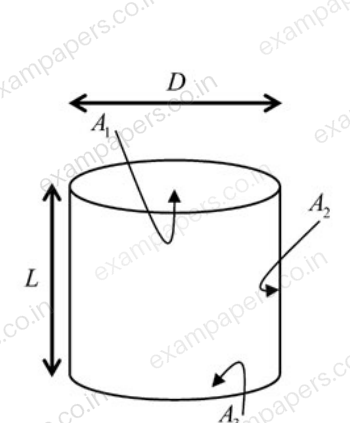
Your answerChoose one option.
Log in to check the answer
You can attempt this question now. Sign in to view the answer key, explanations and discussion.Log in to check answerQuestion 41
Open questionCHNAT2 marksNeeds review
A fluid is heated from 40 °C to 60 °C in a countercurrent, double pipe heat exchanger. Hot fluid enters at 100 °C and exits at 70 °C. The log mean temperature difference, i.e. LMTD (in °C), is __________ (round off to 2 decimal places).
Log in to check the answer
You can attempt this question now. Sign in to view the answer key, explanations and discussion.Log in to check answerQuestion 42
Open questionCHNAT2 marksNeeds review
Consider an infinitely long rectangular fin exposed to a surrounding fluid at a constant temperature
. The figure shows the fin.
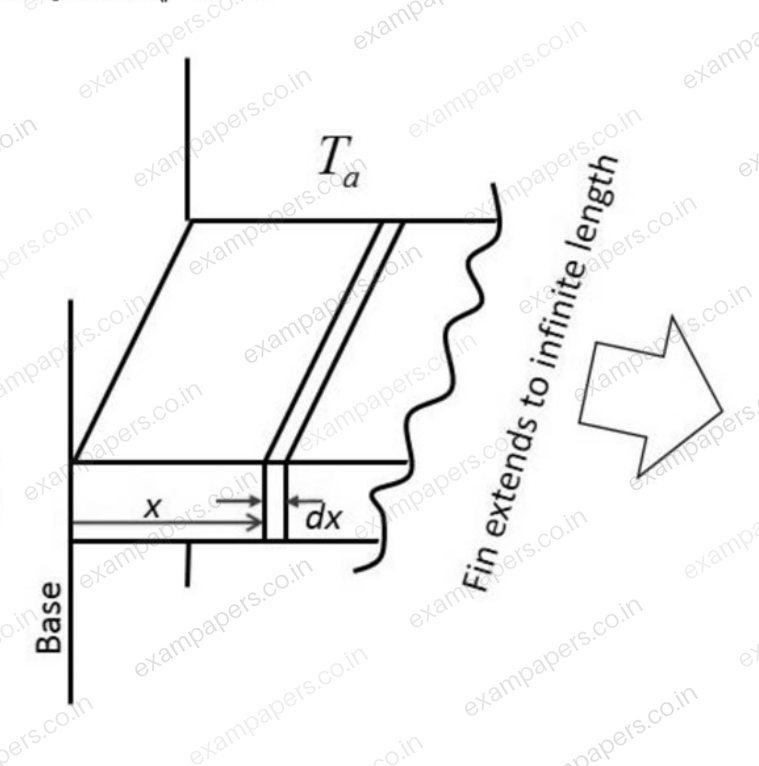
The steady state one dimensional energy balance on an element of the fin of thickness
at a distance
from its base yields
where
,
is the temperature of the fin at the distance
from its base in °C. The value of
is 0.04 cm
and the temperature at the base is
. The temperature (in °C) at
cm is ________ (round off to 1 decimal place).Log in to check the answer
You can attempt this question now. Sign in to view the answer key, explanations and discussion.Log in to check answerQuestion 45
Open questionCHNAT2 marksNeeds review
An aqueous suspension at 60 °C is fed to the first effect of a double effect forward feed evaporator with a mass flow rate of 1.25 kg s
. The sum of the rates of water evaporated from the first and second effects is 1.0 kg s
. Temperatures of the exit streams from the first and the second effects are 100 °C, and 60 °C, respectively. Consider the specific heat of the aqueous suspension, and the latent heat of phase change for water to be 4 kJ kg
K
and 2200 kJ kg
, respectively, over this temperature range. The steam economy (in kg per kg) is ________ (round off to 2 decimal places).Log in to check the answer
You can attempt this question now. Sign in to view the answer key, explanations and discussion.Log in to check answer