
Chemical Engineering
GATE CH topic:mass-transfer PYQs
Build your understanding with focused practice from past exam papers.
Questions 51–60 of 77. Imported answers require independent review unless marked reviewed.
Question 28
Open questionCHMCQ2 marksNeeds review
SO₂ from air is absorbed by pure water in a counter current packed column operating at constant pressure. The compositions and the flow rates of the streams are shown in the figure.
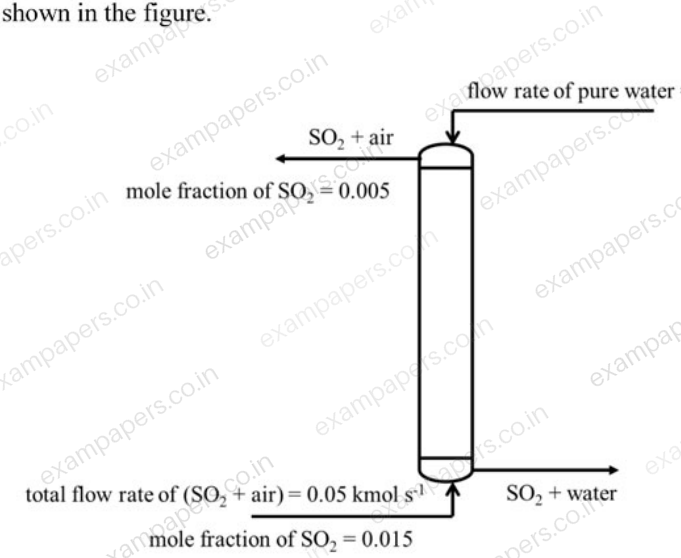
In addition, use the following data and assumptions
• Column operates under isothermal conditions
• At the operating temperature of the column,
, where
is the mole fraction of SO₂ in the gas that is in equilibrium with water containing SO₂ at a mole fraction of
• Solution is dilute and the operating line is linear
• Negligible amount of water evaporatesThe number of transfer units (NTU) for this column is
Your answerChoose one option.
Log in to check the answer
You can attempt this question now. Sign in to view the answer key, explanations and discussion.Log in to check answerQuestion 29
Open questionCHMCQ2 marksNeeds review
Two film theory applies for absorption of a solute from a gas mixture into a liquid solvent. The interfacial mass transfer coefficient (in mol m⁻² s⁻¹) for the gas side is 0.1 and for the liquid side is 3. The equilibrium relationship is
, where
and
are mole fractions of the solute in the liquid and gas phases, respectively. The ratio of the mass transfer resistance in the liquid film to the overall resistance isYour answerChoose one option.
Log in to check the answer
You can attempt this question now. Sign in to view the answer key, explanations and discussion.Log in to check answerQuestion 30
Open questionCHMCQ2 marksNeeds review
Consider the equilibrium data for methanol-water system at 1 bar given in the figure below.
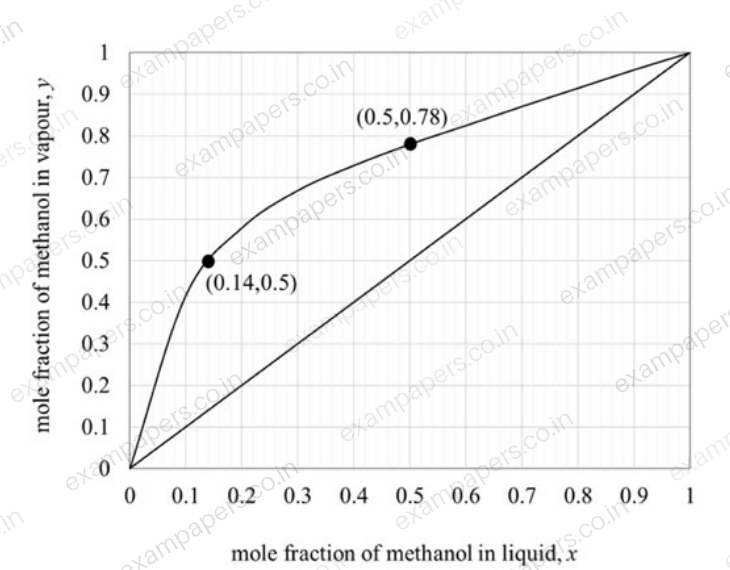
A distillation column operating at 1.0 bar is required to produce 92 mol % methanol. The feed is a saturated liquid. It is an equimolar mixture of methanol and water. The minimum reflux ratio is
Your answerChoose one option.
Log in to check the answer
You can attempt this question now. Sign in to view the answer key, explanations and discussion.Log in to check answerQuestion 34
Open questionCHMCQ2 marksNeeds review
Equilibrium data for a binary mixture of E and F at two different pressures is shown in the figure.
It is desired to process a feed containing 80 mol % E and 20 mol % F, and obtain a product with a purity of 99.5 mol % E. A sequence of two distillation columns, one operating at pressure
and another at
, is employed for this operation, as shown below.The mole fraction of E in the distillate obtained from column 1 is 0.9. If the column pressures
and
are in kPa, which one of the following is correct? 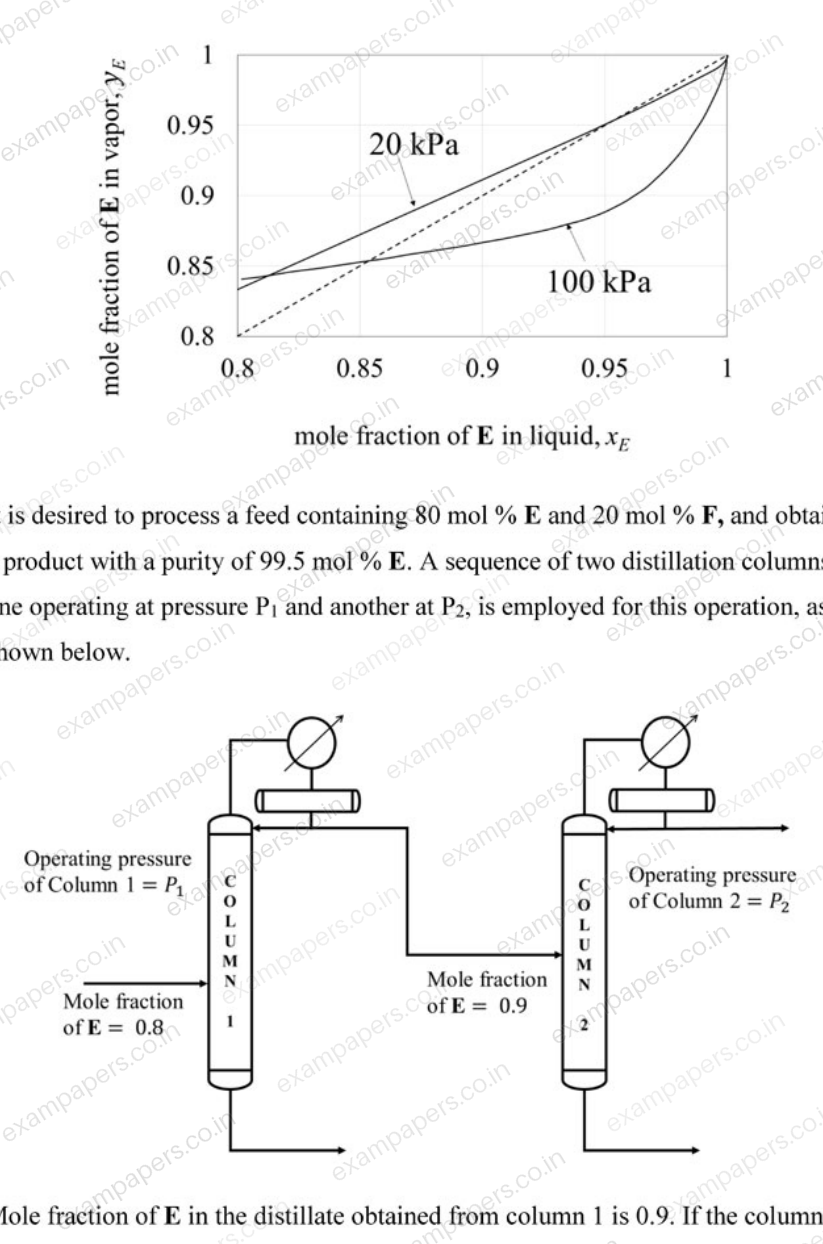
Your answerChoose one option.
Log in to check the answer
You can attempt this question now. Sign in to view the answer key, explanations and discussion.Log in to check answerQuestion 47
Open questionCHNAT2 marksNeeds review
Two ideal cross-current stages operate to extract P from a feed containing P and Q, as shown below.
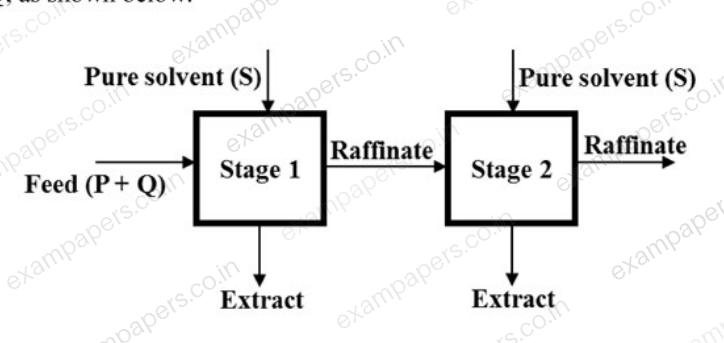
The mass flow rates of P and Q fed to Stage 1 are 1,000 kg h
and 10,000 kg h
, respectively. Pure solvent (S) is injected at mass flow rates of 5,000 kg h
and 15,000 kg h
to Stages 1 and 2, respectively. The components Q and S are immiscible. The equilibrium relation is given by
, where
is the mass of P per unit mass of Q in the raffinate, and
is the mass of P per unit mass of S in the extract, which is in equilibrium with the raffinate. The mass flow rate of P (in kg h
) in the raffinate from Stage 2 is ________ (round off to nearest integer).Log in to check the answer
You can attempt this question now. Sign in to view the answer key, explanations and discussion.Log in to check answerQuestion 48
Open questionCHNAT2 marksNeeds review
Consider a vertically falling film of water over an impermeable wall. The film is in contact with a static pool of non-reactive pure gas. The gas diffuses into the water film over the entire height of the falling film. The height of the film is 1.0 m, and its thickness is
m. The velocity of water, averaged over the film thickness, is 0.01 m s
. The gas concentration (in kg m
), averaged over the film thickness is
where
is the vertical position in meters measured from the top of the wall.In addition, use the following data and assumptions:
The flow is fully developed
The width of the film is much larger than the thickness of the film, and the dissolved gas concentration is invariant over this width
The solubility of the gas in water,
, is constantPure water enters at
The evaporation of water is negligible
The mass transfer coefficient on the liquid side (in mm s
), averaged over the entire height of the falling film is ________ (round off to 3 decimal places).Log in to check the answer
You can attempt this question now. Sign in to view the answer key, explanations and discussion.Log in to check answerQuestion 13
Open questionCHMCQ1 markNeeds review
The correct expression for the Colburn
-factor for mass transfer that relates Sherwood number (Sh), Reynolds number (Re) and Schmidt number (Sc) isYour answerChoose one option.
Log in to check the answer
You can attempt this question now. Sign in to view the answer key, explanations and discussion.Log in to check answerQuestion 14
Open questionCHMCQ1 markNeeds review
In the drying of non-dissolving solids at constant drying conditions, the internal movement of moisture in the solid has a dominant effect on the drying rate during
Your answerChoose one option.
Log in to check the answer
You can attempt this question now. Sign in to view the answer key, explanations and discussion.Log in to check answerQuestion 15
Open questionCHMCQ1 markNeeds review
Three distillation schemes for separating an equimolar, constant relative volatility ABC mixture into nearly pure components are shown. The usual simplifying assumptions such as constant molal overflow, negligible heat loss, ideal trays are valid. All the schemes are designed for minimum total reboiler duty. Given that the relative volatilities are in the ratio
, the correct option that arranges the optimally-designed schemes in ascending order of total reboiler duty is 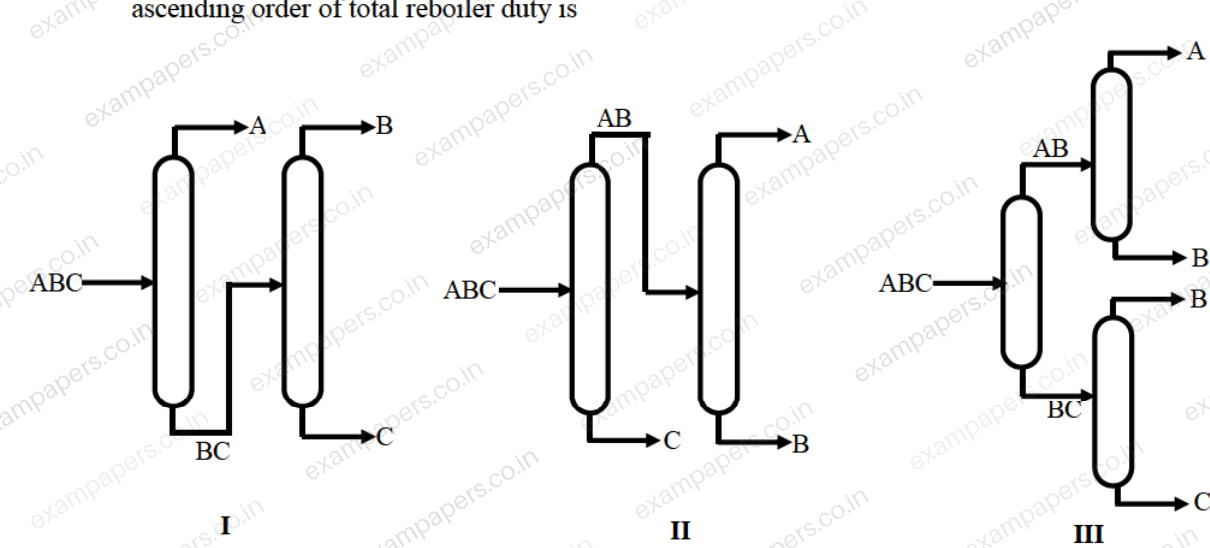
Your answerChoose one option.
Log in to check the answer
You can attempt this question now. Sign in to view the answer key, explanations and discussion.Log in to check answerQuestion 32
Open questionCHMCQ2 marksNeeds review
100 kg of a feed containing 50 wt.% of a solute C is contacted with 80 kg of a solvent containing 0.5 wt.% of C in a mixer-settler unit. From this operation, the resultant extract and raffinate phases contain 40 wt.% and 20 wt.% of C, respectively. If E and R denote the mass of the extract and raffinate phases, respectively, the ratio E/R is
Your answerChoose one option.
Log in to check the answer
You can attempt this question now. Sign in to view the answer key, explanations and discussion.Log in to check answer