
Chemical Engineering
GATE CH topic:process-calculations-thermodynamics PYQs
Build your understanding with focused practice from past exam papers.
Questions 11–20 of 79. Imported answers require independent review unless marked reviewed.
Question 16
Open questionCHMCQ1 markNeeds review
The boundary of a system does not allow exchange of either mass or energy (in the form of heat and/or work) with the surroundings. The system is termed
Your answerChoose one option.
Log in to check the answer
You can attempt this question now. Sign in to view the answer key, explanations and discussion.Log in to check answerQuestion 32
Open questionCHNAT1 markNeeds review
The following data is given for a ternary
gas mixture at 12 MPa and 308 K:Component → | | | |
|---|---|---|---|
| 0.55 | 0.20 | 0.25 |
| 0.75 | 0.80 | 0.95 |
: mole fraction of component
in the gas mixture
: fugacity coefficient of component
in the gas mixture at 12 MPa and 308 KThe fugacity of the gas mixture is ____ MPa (rounded off to 3 decimal places).
Log in to check the answer
You can attempt this question now. Sign in to view the answer key, explanations and discussion.Log in to check answerQuestion 33
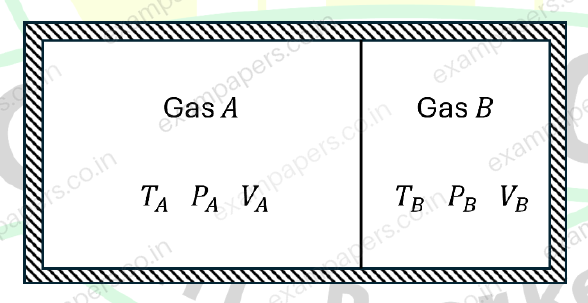
Open questionCHNAT1 markNeeds review
Ideal nonreacting gases
and
are contained inside a perfectly insulated chamber, separated by a thin partition, as shown in the figure. The partition is removed, and the two gases mix till final equilibrium is reached. The change in total entropy for the process is ____ J/K (rounded off to 1 decimal place).Given: Universal gas constant
J/(mol K)
K
atm
L
Log in to check the answer
You can attempt this question now. Sign in to view the answer key, explanations and discussion.Log in to check answerQuestion 48
Open questionCHNAT2 marksNeeds review
An ideal monoatomic gas is contained inside a cylinder-piston assembly connected to a Hooke spring as shown in the figure. The piston is frictionless and massless. The spring constant is 10 kN/m. At the initial equilibrium state (shown in the figure), the spring is unstretched. The gas is expanded reversibly by adding 362.5 J of heat. At the final equilibrium state, the piston presses against the stoppers. Neglecting the heat loss to the surroundings, the final equilibrium temperature of the gas is ____ K (rounded off to the nearest integer).
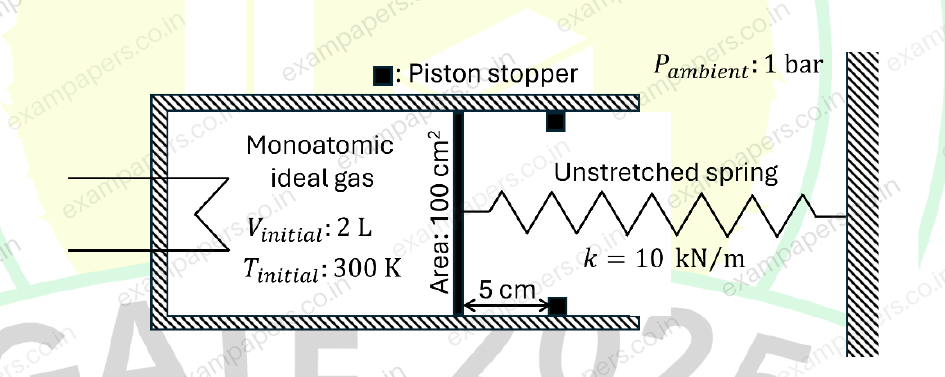
GIVEN: For a monoatomic ideal gas,
, where
J/(mol K)Log in to check the answer
You can attempt this question now. Sign in to view the answer key, explanations and discussion.Log in to check answerQuestion 57
Open questionCHNAT2 marksNeeds review
Components
and
form an azeotrope. The saturation vapour pressures of
and
at the boiling point are 87 kPa and 72.7 kPa, respectively. The azeotrope composition is ____ mol%
(rounded off to the nearest integer).GIVEN:
where
and
are the liquid phase mole fraction and activity coefficient of component
, respectively.Log in to check the answer
You can attempt this question now. Sign in to view the answer key, explanations and discussion.Log in to check answerQuestion 61
Open questionCHNAT2 marksNeeds review
Methanol is produced by the reversible, gas-phase hydrogenation of carbon monoxide as
and
are charged to a reactor and the reaction proceeds to equilibrium at 453 K and 2 atm. The reaction equilibrium constant, which depends only on the temperature, is 1.68 at the reaction conditions. The mole fraction of
in the product is 0.4. Assuming ideal gas behaviour, the mole fraction of methanol in the product is ____ (rounded off to 2 decimal places).Log in to check the answer
You can attempt this question now. Sign in to view the answer key, explanations and discussion.Log in to check answerQuestion 14
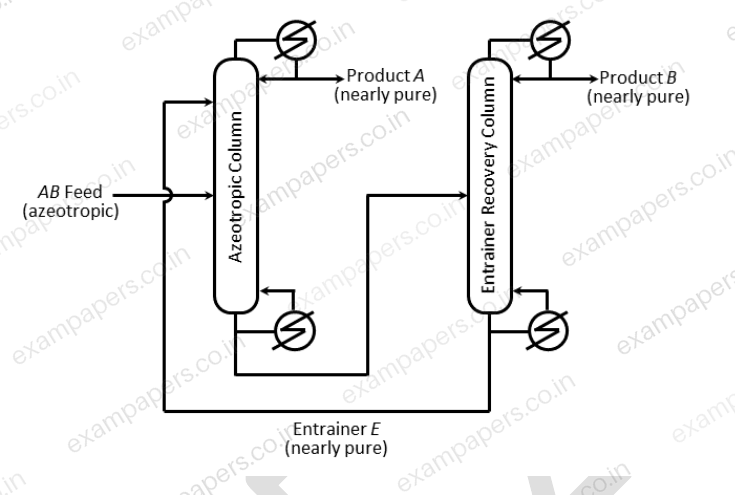
Open questionCHMCQ1 markNeeds review
A homogeneous azeotropic distillation process separates an azeotropic AB binary feed using a heavy entrainer, E, as shown in the figure. The loss of E in the two product streams is negligible so that E circulates around the process in a closed-circuit. For a distillation column with fully specified feed(s), given operating pressure, a single distillate stream and a single bottoms stream, the steady-state degrees of freedom equals 2. For the process in the figure with a fully specified AB feed stream and given column operating pressures, the steady-state degree of freedom equals
Your answerChoose one option.
Log in to check the answer
You can attempt this question now. Sign in to view the answer key, explanations and discussion.Log in to check answerQuestion 18
Open questionCHMCQ1 markNeeds review
Consider a vapour-liquid mixture of components A and B that obeys Raoult’s law. The vapour pressure of A is half that of B. The vapour phase concentrations of A and B are 3 mol m
and 6 mol m
, respectively. At equilibrium, the ratio of the liquid phase concentration of A to that of B isYour answerChoose one option.
Log in to check the answer
You can attempt this question now. Sign in to view the answer key, explanations and discussion.Log in to check answerQuestion 31
Open questionCHNAT1 markNeeds review
Consider the reaction
in a continuous flow reactor under steady-state conditions. The component flow rates at the reactor inlet are
,
,
. If the fractional conversion of
is 0.60, the outlet flow rate of
, in
, rounded off to the nearest integer, is ________Log in to check the answer
You can attempt this question now. Sign in to view the answer key, explanations and discussion.Log in to check answerQuestion 32
Open questionCHNAT1 markNeeds review
Consider a binary mixture of components
and
at temperature
and pressure
. Let
and
be the partial molar volumes of
and
, respectively. At a certain mole fraction of
,
,
The value of
, rounded off to 2 decimal places, is _______Log in to check the answer
You can attempt this question now. Sign in to view the answer key, explanations and discussion.Log in to check answer