
Chemical Engineering
GATE CH topic:process-calculations-thermodynamics PYQs
Build your understanding with focused practice from past exam papers.
Questions 61–70 of 79. Imported answers require independent review unless marked reviewed.
Question 38
Open questionCHNAT2 marksNeeds review
For a given binary system at constant temperature and pressure, the molar volume (in m³/mol) is given by:
, where
and
are the mole fractions of components A and B, respectively. The volume change of mixing
(in m³/mol) at
is ________ (rounded off to one decimal place).Log in to check the answer
You can attempt this question now. Sign in to view the answer key, explanations and discussion.Log in to check answerQuestion 39
Open questionCHNAT2 marksNeeds review
Consider a vessel containing steam at 180 °C. The initial steam quality is 0.5 and the initial volume of the vessel is 1 m³. The vessel loses heat at a constant rate
under isobaric conditions so that the quality of steam reduces to 0.1 after 10 hours. The thermodynamic properties of water at 180 °C are (subscript
: vapor phase; subscript
: liquid phase):
specific volume:
m³/kg,
m³/kg;
specific internal energy:
kJ/kg,
kJ/kg;
specific enthalpy:
kJ/kg,
kJ/kg.
The rate of heat loss
(in kJ/hour) is __________ (rounded off to the nearest integer).Log in to check the answer
You can attempt this question now. Sign in to view the answer key, explanations and discussion.Log in to check answerQuestion 40
Open questionCHNAT2 marksNeeds review
A fractionator recovers 95 mol % n-propane as the distillate from an equimolar mixture of n-propane and n-butane. The condensate is a saturated liquid at 55 °C. The Antoine equation is of the form,
, and the constants are provided below:Component | A | B | C |
|---|---|---|---|
n-propane | 9.1058 | 1872.46 | −25.16 |
n-butane | 9.0580 | 2154.90 | −34.42 |
Assuming Raoult’s law, the condenser pressure (in bar) is __________ (rounded off to one decimal place).
Log in to check the answer
You can attempt this question now. Sign in to view the answer key, explanations and discussion.Log in to check answerQuestion 53
Open questionCHNAT2 marksNeeds review
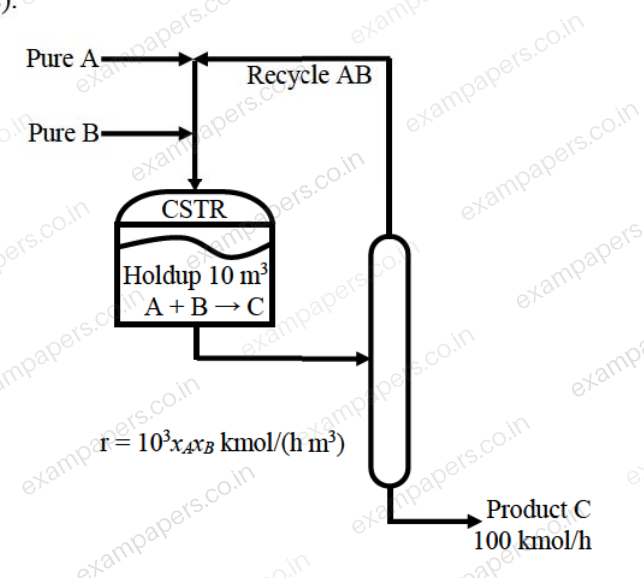
Consider the reactor-separator-recycle process operating under steady state conditions as shown in the figure. The reactor is an ideal Continuous-Stirred Tank Reactor (CSTR), where the reaction A + B → C occurs. Assume that there is no impurity in the product and recycle streams. Other relevant information are provided in the figure.
The mole fraction of B (
) in the reactor that minimizes the recycle rate is __________ (rounded off to two decimal places).Log in to check the answer
You can attempt this question now. Sign in to view the answer key, explanations and discussion.Log in to check answerQuestion 14
Open questionCHMCQ1 markNeeds review
Consider the following properties:
(P) temperature
(Q) specific gravity
(R) chemical potential
(S) volume
The option which lists ALL the intensive properties is
Your answerChoose one option.
Log in to check the answer
You can attempt this question now. Sign in to view the answer key, explanations and discussion.Log in to check answerQuestion 17
Open questionCHMCQ1 markNeeds review
The reactant (M) is converted into product (N) in the presence of catalyst in a fixed bed reactor. All the flow rates (F, G, H, P and R) in mol/s, and mole fraction of reactant (M) in these streams (x_F, x_G, x_H, x_P and x_R) are shown in the diagram.
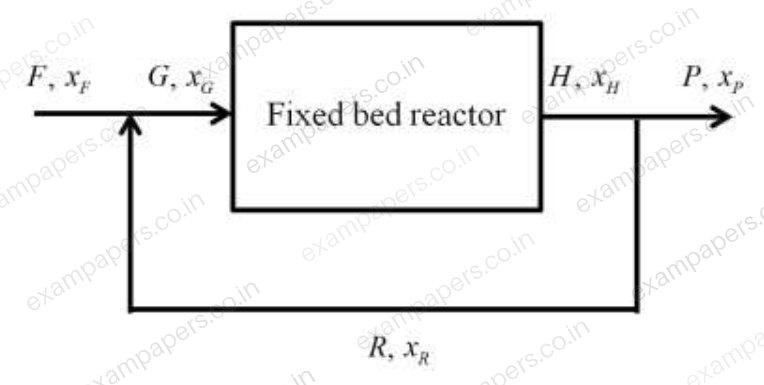
The overall fractional conversion is
Your answerChoose one option.
Log in to check the answer
You can attempt this question now. Sign in to view the answer key, explanations and discussion.Log in to check answerQuestion 24
Open questionCHNAT1 markNeeds review
The ammonia (NH₃) oxidation process occurs over a catalyst as
4 NH₃ + 5 O₂ → 6 H₂O + 4 NO
Air is supplied such that oxygen (O₂) is 20% in excess of that required for complete conversion of NH₃. The mole fraction of O₂ in inlet gas mixture (NH₃ + air) is ______ (rounded off to third decimal place).
Log in to check the answer
You can attempt this question now. Sign in to view the answer key, explanations and discussion.Log in to check answerQuestion 29
Open questionCHMCQ2 marksNeeds review
G denotes the Gibbs free energy of a binary mixture, nₜ denotes the total number of moles present in the system, μᵢ is the chemical potential of the iᵗʰ component (μᵢ ≠ 0 and μ₁ > μ₂) and xᵢ is the mole fraction of the iᵗʰ component. The correct variation of G/nₜ (in J/mol) at constant temperature and pressure is given by
Your answerChoose one option.
Log in to check the answer
You can attempt this question now. Sign in to view the answer key, explanations and discussion.Log in to check answerQuestion 48
Open questionCHNAT2 marksNeeds review
An azeotropic mixture of ethanol and water is to be separated in a distillation column using benzene as an entrainer. At the column operating conditions, two liquid phases are formed on a tray. The degree(s) of freedom of the system for the choice of intensive properties at equilibrium is(are) __________
Log in to check the answer
You can attempt this question now. Sign in to view the answer key, explanations and discussion.Log in to check answerQuestion 50
Open questionCHNAT2 marksNeeds review
In a closed piston-cylinder system, methane was observed to obey the following equation of state
where
m³/mol. The temperature and volume are 500 °C and 5 m³ respectively for 100 moles of methane. At this state of the system, the isobaric rate of change of temperature with volume (in °C/m³) is __________ (rounded off to second decimal place).Log in to check the answer
You can attempt this question now. Sign in to view the answer key, explanations and discussion.Log in to check answer