
Chemical Engineering
GATE CH year:2017 PYQs
Build your understanding with focused practice from past exam papers.
Questions 11–20 of 65. Imported answers require independent review unless marked reviewed.
Question 11
Open questionCHNAT1 markNeeds review
A gas bubble (gas density
kg/m³; bubble diameter
m) is rising vertically through water (density
kg/m³; viscosity
Pa.s). Force balance on the bubble leads to the following equation,
where
is the velocity of the bubble at any given time
. Assume that the volume of the rising bubble does not change. The value of
m/s².The terminal rise velocity of the bubble (in cm/s), rounded to 2 decimal places, is ______ cm/s.
Log in to check the answer
You can attempt this question now. Sign in to view the answer key, explanations and discussion.Log in to check answerQuestion 12
Open questionCHMCQ1 markNeeds review
The one-dimensional unsteady heat conduction equation is
where
– temperature,
– time,
– radial position,
– thermal conductivity,
– density, and
– specific heat.For the cylindrical coordinate system, the value of
in the above equation isYour answerChoose one option.
Log in to check the answer
You can attempt this question now. Sign in to view the answer key, explanations and discussion.Log in to check answerQuestion 13
Open questionCHNAT1 markNeeds review
In a heat exchanger, the inner diameter of a tube is 25 mm and its outer diameter is 30 mm. The overall heat transfer coefficient based on the inner area is 360 W/m²·°C. Then, the overall heat transfer coefficient based on the outer area, rounded to the nearest integer, is ______ W/m²·°C.
Log in to check the answer
You can attempt this question now. Sign in to view the answer key, explanations and discussion.Log in to check answerQuestion 14
Open questionCHMCQ1 markNeeds review
Which of the following conditions are valid at the plat point?
P) Density difference between the extract and raffinate phases is zero
Q) Interfacial tension between the extract and raffinate phases is zero
R) Composition difference between the extract and raffinate phases is zero
Your answerChoose one option.
Log in to check the answer
You can attempt this question now. Sign in to view the answer key, explanations and discussion.Log in to check answerQuestion 15
Open questionCHNAT1 markNeeds review
The composition of vapour entering a tray in a distillation column is 0.47. The average composition of the vapour leaving the tray is 0.53. The equilibrium composition of the vapour corresponding to the liquid leaving this tray is 0.52. All the compositions are expressed in mole fraction of the more volatile component.
The Murphree efficiency based on the vapour phase, rounded to the nearest integer, is ______ %.
Log in to check the answer
You can attempt this question now. Sign in to view the answer key, explanations and discussion.Log in to check answerQuestion 16
Open questionCHMCQ1 markNeeds review
Consider steady state mass transfer of a solute A from a gas phase to a liquid phase. The gas phase bulk and interface mole fractions are
and
, respectively. The liquid phase bulk and interface mole fractions are
and
, respectively. The ratio
is very close to zero.This implies that mass transfer resistance is
Your answerChoose one option.
Log in to check the answer
You can attempt this question now. Sign in to view the answer key, explanations and discussion.Log in to check answerQuestion 17
Open questionCHMCQ1 markNeeds review
The following reaction rate curve is shown for a reaction A → P. Here,
and
represent reaction rate and conversion, respectively. The feed is pure A and 90% conversion is desired. 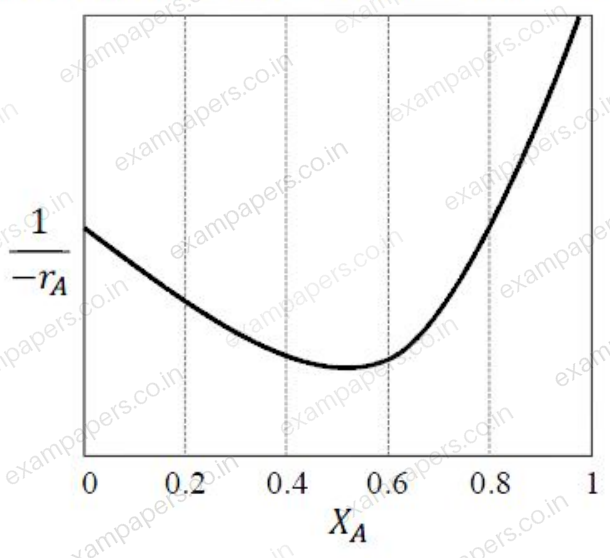
Which amongst the following reactor configurations gives the lowest total volume of the reactor(s)?
Your answerChoose one option.
Log in to check the answer
You can attempt this question now. Sign in to view the answer key, explanations and discussion.Log in to check answerQuestion 18
Open questionCHMCQ1 markNeeds review
Consider a first order catalytic reaction in a porous catalyst pellet.
Given
– characteristic length of the pellet;
– effective diffusivity;
– mass transfer coefficient;
– rate constant based on volume of the catalyst pellet;
– concentration of reactant on the pellet surface.The expression for Thiele modulus is
Your answerChoose one option.
Log in to check the answer
You can attempt this question now. Sign in to view the answer key, explanations and discussion.Log in to check answerQuestion 19
Open questionCHMCQ1 markNeeds review
For a solid-catalyzed gas phase reversible reaction, which of the following statements is ALWAYS TRUE?
Your answerChoose one option.
Log in to check the answer
You can attempt this question now. Sign in to view the answer key, explanations and discussion.Log in to check answerQuestion 20
Open questionCHMCQ1 markNeeds review
Match the variables in Group-1 with the instruments in Group-2.
Group-1
P) Temperature
Q) Liquid level
R) Vacuum
S) Concentration
Group-2
I) Capacitance probe
II) McLeod gauge
III) Chromatograph
IV) Thermistor
Choose the correct set of combinations.
Your answerChoose one option.
Log in to check the answer
You can attempt this question now. Sign in to view the answer key, explanations and discussion.Log in to check answer