
Chemical Engineering
GATE CH year:2022 PYQs
Build your understanding with focused practice from past exam papers.
Questions 21–30 of 65. Imported answers require independent review unless marked reviewed.
Question 21
Open questionCHMCQ1 markNeeds review
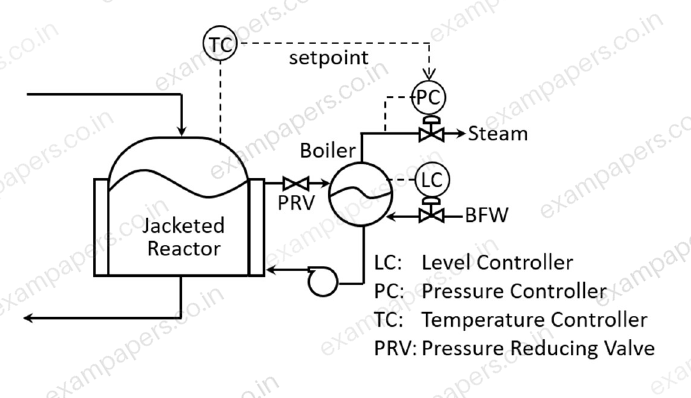
A control system on the jacket side of a reactor is shown in the figure. Pressurized water flows through the jacket to cool the reactor. The heated water flashes in the boiler. The exothermic reaction heat thus generates steam. Fresh boiler feed water (BFW) is added to make-up for the loss of water as steam. Assume that all control valves are air-to-open. The controller action, ‘direct’ or ‘reverse’, is defined with respect to the controller. Select the option that correctly specifies the action of the controllers.
Your answerChoose one option.
Log in to check the answer
You can attempt this question now. Sign in to view the answer key, explanations and discussion.Log in to check answerQuestion 22
Open questionCHMCQ1 markNeeds review
Liquid flowing through a heat exchanger (HX) is heated. A bypass stream is provided to control the temperature of the heated exit stream. From the given plumbing options, the one that provides the most effective temperature control for large disturbances while avoiding vaporization in the heat exchanger is
Your answerChoose one option.
Log in to check the answer
You can attempt this question now. Sign in to view the answer key, explanations and discussion.Log in to check answerQuestion 23
Open questionCHMCQ1 markNeeds review
The appropriate feedforward compensator,
, in the shown block diagram is 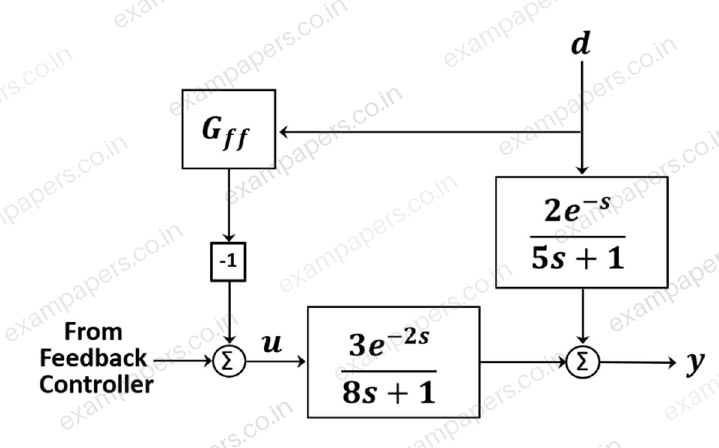
Your answerChoose one option.
Log in to check the answer
You can attempt this question now. Sign in to view the answer key, explanations and discussion.Log in to check answerQuestion 24
Open questionCHMCQ1 markNeeds review
Choose the option that correctly pairs the given measurement devices with the quantities they measure. The table lists: I — Bourdon Gauge; II — Orifice Plate meter; III — Pyrometer; IV — Colorimeter; V — Pirani Gauge. Quantities: A — Temperature; B — Concentration; C — Pressure; D — Flow rate; E — Liquid level.
Your answerChoose one option.
Log in to check the answer
You can attempt this question now. Sign in to view the answer key, explanations and discussion.Log in to check answerQuestion 25
Open questionCHMCQ1 markNeeds review
A simple distillation column is designed to separate an ideal binary mixture to specified distillate and bottoms purities at a given column pressure. If RRₘᵢₙ is the minimum reflux ratio for this separation, select the statement that is NOT CORRECT with regard to the variation in the total annualized cost (TAC) of the column with reflux ratio (RR).
Your answerChoose one option.
Log in to check the answer
You can attempt this question now. Sign in to view the answer key, explanations and discussion.Log in to check answerQuestion 26
Open questionCHMCQ1 markNeeds review
The reaction
is carried out isothermally on a porous catalyst. The intrinsic reaction rate is
, where
is the rate constant and
is the concentration of
. If the reaction is strong pore-diffusion controlled, the observed order of the reaction isYour answerChoose one option.
Log in to check the answer
You can attempt this question now. Sign in to view the answer key, explanations and discussion.Log in to check answerQuestion 27
Open questionCHMCQ1 markNeeds review
In an enzymatic reaction, an inhibitor (I) competes with the substrate (S) to bind with the enzyme (E), thereby reducing the rate of product (P) formation. The competitive inhibition follows the reaction mechanism shown below. Let [S] and [I] be the concentration of S and I, respectively, and
be the rate of consumption of S. Assuming pseudo-steady state, the correct plot of
vs
is 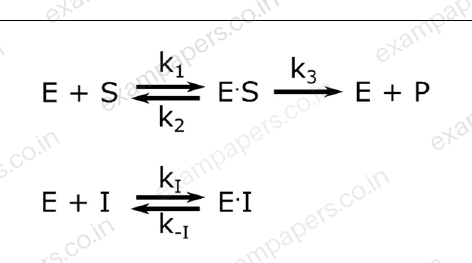
Your answerChoose one option.
Log in to check the answer
You can attempt this question now. Sign in to view the answer key, explanations and discussion.Log in to check answerQuestion 28
Open questionCHNAT1 markNeeds review
The area of a circular field is 25 m
. The radius,
, is to be determined using the Newton-Raphson iterative method. For an initial guess of
m, the revised estimate of
after one iteration is ________ m (rounded off to three decimal places).Log in to check the answer
You can attempt this question now. Sign in to view the answer key, explanations and discussion.Log in to check answerQuestion 29
Open questionCHNAT1 markNeeds review
5 moles of liquid benzene, 8 moles of liquid toluene and 7 moles of liquid xylene are mixed at 25 °C and 1 bar. Assuming the formation of an ideal solution and using the universal gas constant
J mol
K
, the total entropy change is ________ J K
(rounded off to one decimal place).Log in to check the answer
You can attempt this question now. Sign in to view the answer key, explanations and discussion.Log in to check answerQuestion 30
Open questionCHNAT1 markNeeds review
A perfectly insulated double pipe heat exchanger is operating at steady state. Saturated steam enters the inner pipe at 100 °C and leaves as saturated water at 100 °C. Cooling water enters the outer pipe at 75 °C and exits at 95 °C. The overall heat transfer coefficient is 1 kW m
K
and the heat transfer area is 1 m
. The average specific heat capacity of water at constant pressure is 4.2 kJ kg
K
. The required cooling water flow rate is ________ kg s
(rounded off to two decimal places).Log in to check the answer
You can attempt this question now. Sign in to view the answer key, explanations and discussion.Log in to check answer