
Chemistry
GATE CY exam:gate PYQs
Build your understanding with focused practice from past exam papers.
Questions 91–100 of 650. Imported answers require independent review unless marked reviewed.
Question 26
Open questionCYMSQ1 markNeeds review
Among the given options, the possible product(s) that can be obtained from the following reaction is/are
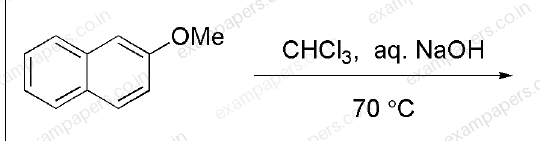
Your answerSelect all correct options. You can choose more than one.
Log in to check the answer
You can attempt this question now. Sign in to view the answer key, explanations and discussion.Log in to check answerQuestion 27
Open questionCYMSQ1 markNeeds review
Choose the correct option(s) with regard to mechanism of the following transformation.
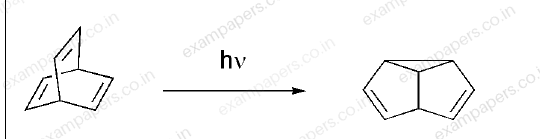
Your answerSelect all correct options. You can choose more than one.
Log in to check the answer
You can attempt this question now. Sign in to view the answer key, explanations and discussion.Log in to check answerQuestion 28
Open questionCYMSQ1 markNeeds review
Consider two non-interacting particles confined to a one-dimensional box with infinite potential barriers. Their wavefunctions are
and
and energies are
and
, respectively. The INCORRECT statement(s) about this system is/areYour answerSelect all correct options. You can choose more than one.
Log in to check the answer
You can attempt this question now. Sign in to view the answer key, explanations and discussion.Log in to check answerQuestion 29
Open questionCYMSQ1 markNeeds review
The thermodynamic criterion/criteria for a spontaneous process is/are
Your answerSelect all correct options. You can choose more than one.
Log in to check the answer
You can attempt this question now. Sign in to view the answer key, explanations and discussion.Log in to check answerQuestion 30
Open questionCYNAT1 markNeeds review
Xe and F
in 1:1 molar ratio when mixed in a closed flask and kept in the sunlight for a day, gave white crystals of a compound Q. Two equivalents of Q on reaction with one equivalent of AsF
gave an ionic compound X
Y
with the cation having two Xe atoms. The total number of lone pairs present on the cation X
is _____ (in integer).Log in to check the answer
You can attempt this question now. Sign in to view the answer key, explanations and discussion.Log in to check answerQuestion 31
Open questionCYNAT1 markNeeds review
The total number of hyperfine lines expected in the EPR spectrum of •CH
OH (radical) is ______ (in integer).
[Note: Consider all hydrogen atoms for calculation]Log in to check the answer
You can attempt this question now. Sign in to view the answer key, explanations and discussion.Log in to check answerQuestion 32
Open questionCYNAT1 markNeeds review
Partial hydrolysis of a pentapeptide yields all possible tripeptides and dipeptides. The dipeptides that are obtained upon hydrolysis are given below.
Val-Ala, Gln-His, Phe-Val and Ala-Gln
The total number of tripeptides obtained that contain ‘Ala’ as one of the amino acids is____ (in integer).
Log in to check the answer
You can attempt this question now. Sign in to view the answer key, explanations and discussion.Log in to check answerQuestion 33
Open questionCYNAT1 markNeeds review
The specific rotation of enantiomerically pure (S)-2-butanol is +14°. The specific rotation of enantiomeric mixture of 2-butanol obtained from an asymmetric reduction of 2-butanone is found to be +7°. The percentage of (R)-2-butanol present in the reaction mixture is ______ (in integer).
Log in to check the answer
You can attempt this question now. Sign in to view the answer key, explanations and discussion.Log in to check answerQuestion 34
Open questionCYNAT1 markNeeds review
The ratio of the fundamental vibrational frequencies
of two diatomic molecules
and
, considering their force constants to be the same, is_______ (rounded off to two decimal places).Log in to check the answer
You can attempt this question now. Sign in to view the answer key, explanations and discussion.Log in to check answerQuestion 35
Open questionCYNAT1 markNeeds review
The expressions for the vapour pressure of solid (
) and vapour pressure of liquid (
) phases of a pure substance, respectively, are
and
The triple point temperature of this substance is ____ K (in integer).
Log in to check the answer
You can attempt this question now. Sign in to view the answer key, explanations and discussion.Log in to check answer