
Chemistry
GATE CY exam:gate PYQs
Build your understanding with focused practice from past exam papers.
Questions 171–180 of 650. Imported answers require independent review unless marked reviewed.
Question 41
Open questionCYMCQ2 marksNeeds review
Fischer presentation of D-(-)-fructose is given below.
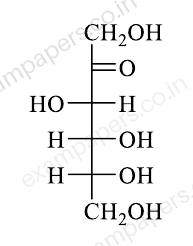
The correct structure of
-L-(+)-fructofuranose isYour answerChoose one option.
Log in to check the answer
You can attempt this question now. Sign in to view the answer key, explanations and discussion.Log in to check answerQuestion 42
Open questionCYMCQ2 marksNeeds review
The major products X and Y in the following reaction sequence are

Your answerChoose one option.
Log in to check the answer
You can attempt this question now. Sign in to view the answer key, explanations and discussion.Log in to check answerQuestion 43
Open questionCYMCQ2 marksNeeds review
The major products E and F in the following reaction sequence are

Your answerChoose one option.
Log in to check the answer
You can attempt this question now. Sign in to view the answer key, explanations and discussion.Log in to check answerQuestion 44
Open questionCYMCQ2 marksNeeds review
,
,
, and
are four Hückel molecular orbitals of benzene with orbital energies
,
,
, and
, respectively.
The correct order of the orbital energies is
(The six carbon atoms of benzene are denoted by A to F and
is the
orbital of
carbon of benzene.)Your answerChoose one option.
Log in to check the answer
You can attempt this question now. Sign in to view the answer key, explanations and discussion.Log in to check answerQuestion 45
Open questionCYMCQ2 marksNeeds review
Consider the following six vibrational modes:
symmetric stretching of CO₂, O-H symmetric stretching of H₂O, stretching of HCl, stretching of H₂, N-H symmetric stretching of NH₃, and bending of CO₂.
Among these modes, if k number of modes are IR active but Raman inactive, l number of modes are IR inactive but Raman active, and m number of modes are both IR and Raman active.
k, l, and m, respectively, are
Your answerChoose one option.
Log in to check the answer
You can attempt this question now. Sign in to view the answer key, explanations and discussion.Log in to check answerQuestion 46
Open questionCYMCQ2 marksNeeds review
The correct statement for a thermally initiated radical polymerization in a solution is:
(Assume: Steady-state and equal reactivity of the propagating radicals, termination reactions are only by combination, and no chain transfer reaction.
Given: Rp = rate of polymerization, DP = degree of polymerization, [I] = initiator concentration, and [M] = monomer concentration.)
Your answerChoose one option.
Log in to check the answer
You can attempt this question now. Sign in to view the answer key, explanations and discussion.Log in to check answerQuestion 47
Open questionCYMCQ2 marksNeeds review
If
and
are the molecular and molar translational partition functions of X₂, respectively, then
(N is the Avogadro number)
Your answerChoose one option.
Log in to check the answer
You can attempt this question now. Sign in to view the answer key, explanations and discussion.Log in to check answerQuestion 48
Open questionCYMSQ2 marksNeeds review
Among the following, the NMR active nucleus(nuclei) is (are)
Your answerSelect all correct options. You can choose more than one.
Log in to check the answer
You can attempt this question now. Sign in to view the answer key, explanations and discussion.Log in to check answerQuestion 49
Open questionCYMSQ2 marksNeeds review
The complex(es) that exhibit(s) optical isomerism is (are)
Your answerSelect all correct options. You can choose more than one.
Log in to check the answer
You can attempt this question now. Sign in to view the answer key, explanations and discussion.Log in to check answerQuestion 50
Open questionCYMSQ2 marksNeeds review
In aqueous solution of K₄[Fe(CN)₆], the allowed transition(s) is (are)
Your answerSelect all correct options. You can choose more than one.
Log in to check the answer
You can attempt this question now. Sign in to view the answer key, explanations and discussion.Log in to check answer