
Chemistry
GATE CY format:mcq PYQs
Build your understanding with focused practice from past exam papers.
Questions 121–130 of 394. Imported answers require independent review unless marked reviewed.
Question 26
Open questionCYMCQ1 markNeeds review
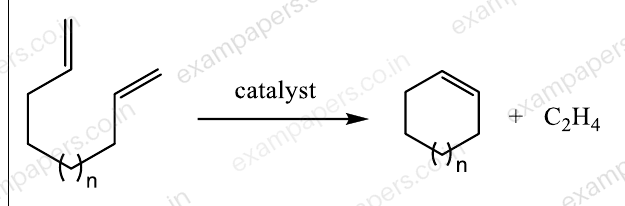
The organometal catalyst for the following transformation is
Your answerChoose one option.
Log in to check the answer
You can attempt this question now. Sign in to view the answer key, explanations and discussion.Log in to check answerQuestion 27
Open questionCYMCQ1 markNeeds review
Point group of naphthalene (C₁₀H₈) is
Your answerChoose one option.
Log in to check the answer
You can attempt this question now. Sign in to view the answer key, explanations and discussion.Log in to check answerQuestion 28
Open questionCYMCQ1 markNeeds review
The INCORRECT statement is
Your answerChoose one option.
Log in to check the answer
You can attempt this question now. Sign in to view the answer key, explanations and discussion.Log in to check answerQuestion 29
Open questionCYMCQ1 markNeeds review
For an ideal gas, the molecular partition function in the canonical ensemble, that is proportional to the system volume (V), is the
Your answerChoose one option.
Log in to check the answer
You can attempt this question now. Sign in to view the answer key, explanations and discussion.Log in to check answerQuestion 30
Open questionCYMCQ1 markNeeds review
Assertion (S): The total angular momentum for light atoms (low atomic number) is obtained by Russell-Saunders coupling, whereas jj-coupling is used for heavy atoms (high atomic number).
Reasoning (R): The spin-orbit interactions are weak in light atoms (low atomic number) and strong in heavy atoms (high atomic number).
The correct option is
Your answerChoose one option.
Log in to check the answer
You can attempt this question now. Sign in to view the answer key, explanations and discussion.Log in to check answerQuestion 36
Open questionCYMCQ2 marksNeeds review
A compound,
, has the following spectral data;
NMR (ppm): 9.16 (s), 6.89 (d,
Hz), 6.64 (d,
Hz), 1.53 (s)
NMR (ppm): 154.7, 140.9, 127.1, 114.4, 40.7, 30.7The structure of the compound is
Your answerChoose one option.
Log in to check the answer
You can attempt this question now. Sign in to view the answer key, explanations and discussion.Log in to check answerQuestion 37
Open questionCYMCQ2 marksNeeds review
The major product formed in the given reaction sequence is
Your answerChoose one option.
Log in to check the answer
You can attempt this question now. Sign in to view the answer key, explanations and discussion.Log in to check answerQuestion 38
Open questionCYMCQ2 marksNeeds review
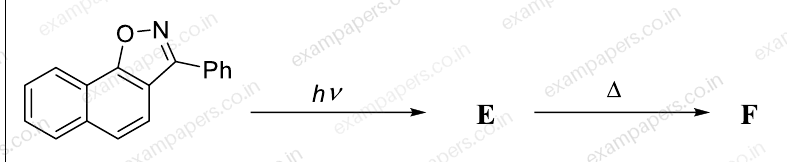
E and F in the given reaction scheme are
Your answerChoose one option.
Log in to check the answer
You can attempt this question now. Sign in to view the answer key, explanations and discussion.Log in to check answerQuestion 39
Open questionCYMCQ2 marksNeeds review
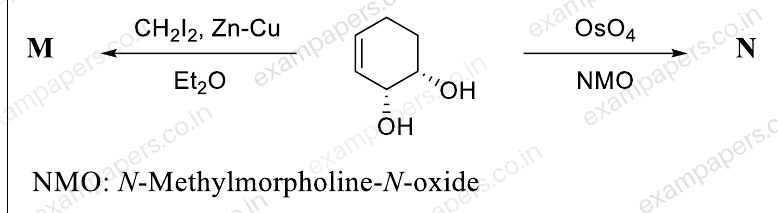
M and N in the given reaction scheme are
Your answerChoose one option.
Log in to check the answer
You can attempt this question now. Sign in to view the answer key, explanations and discussion.Log in to check answerQuestion 40
Open questionCYMCQ2 marksNeeds review
In the
H NMR spectrum, multiplicity of the signal (bold and underlined H atom) in the following species is(I) [HNi(OPEt
)
]
(II) Ph
Si(Me)H
(III) PH
(IV) (Cp*)
ZrH
(Cp* = pentamethylcyclopentadienyl)Your answerChoose one option.
Log in to check the answer
You can attempt this question now. Sign in to view the answer key, explanations and discussion.Log in to check answer