
Chemistry
GATE CY format:mcq PYQs
Build your understanding with focused practice from past exam papers.
Questions 81–90 of 394. Imported answers require independent review unless marked reviewed.
Question 18
Open questionCYMCQ1 markNeeds review
Critical micellar concentration of a surfactant is 0.008 M in water at 25 °C. If the aggregation number of the micelles is 80, the concentration of the micelles (in M) present in 0.088 M aqueous solution of the surfactant at 25 °C is
Your answerChoose one option.
Log in to check the answer
You can attempt this question now. Sign in to view the answer key, explanations and discussion.Log in to check answerQuestion 19
Open questionCYMCQ1 markNeeds review
The order and the number of classes present in a group with the irreducible representations A₁, A₂, B₁, B₂, E₁, and E₂, are, respectively,
Your answerChoose one option.
Log in to check the answer
You can attempt this question now. Sign in to view the answer key, explanations and discussion.Log in to check answerQuestion 20
Open questionCYMCQ1 markNeeds review
The molecule XY₂ is microwave active and its vibration-rotation spectrum shows only P and R transitions. In the correct structure,
Your answerChoose one option.
Log in to check the answer
You can attempt this question now. Sign in to view the answer key, explanations and discussion.Log in to check answerQuestion 36
Open questionCYMCQ2 marksNeeds review
Borax on treatment with NaOH and H₂O₂ forms X. The compound X on reaction with PhCN at 60 °C in methanol-water mixture gives Y as the major product. X and Y, respectively, are
Your answerChoose one option.
Log in to check the answer
You can attempt this question now. Sign in to view the answer key, explanations and discussion.Log in to check answerQuestion 37
Open questionCYMCQ2 marksNeeds review
In the EPR spectrum of an aqueous solution of VSO₄ at room temperature, the total number of hyperfine splitting signals is
Your answerChoose one option.
Log in to check the answer
You can attempt this question now. Sign in to view the answer key, explanations and discussion.Log in to check answerQuestion 38
Open questionCYMCQ2 marksNeeds review
The hapticity of allyl and Cp and the ligation mode of NO in the thermodynamically stable complexes [(ηˣ-allyl)Ru(CO)₂(NO)] and [(ηʸ-Cp)Ru(CO)₂(NO)], respectively, are (The hapticity of allyl and Cp are denoted by ηˣ and ηʸ, respectively.)
Your answerChoose one option.
Log in to check the answer
You can attempt this question now. Sign in to view the answer key, explanations and discussion.Log in to check answerQuestion 39
Open questionCYMCQ2 marksNeeds review
In the following reactions, the structures of I, II, and III, respectively, are
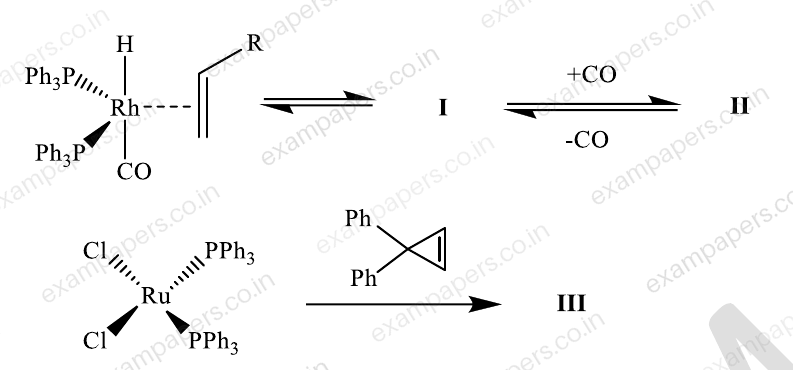
Your answerChoose one option.
Log in to check the answer
You can attempt this question now. Sign in to view the answer key, explanations and discussion.Log in to check answerQuestion 40
Open questionCYMCQ2 marksNeeds review
Consider the following
H-NMR (400 MHz, DMSO-d
) data of a compound:
in ppm: 3.85 (s, 6H), 6.73 (t, J = 2.2 Hz, 1H), 7.1 (d, J = 2.2 Hz, 2H), and 13.05 (brs, 1H).The compound is
Your answerChoose one option.
Log in to check the answer
You can attempt this question now. Sign in to view the answer key, explanations and discussion.Log in to check answerQuestion 41
Open questionCYMCQ2 marksNeeds review
Fischer presentation of D-(-)-fructose is given below.
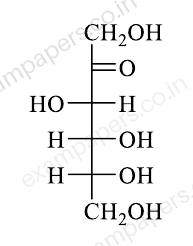
The correct structure of
-L-(+)-fructofuranose isYour answerChoose one option.
Log in to check the answer
You can attempt this question now. Sign in to view the answer key, explanations and discussion.Log in to check answerQuestion 42
Open questionCYMCQ2 marksNeeds review
The major products X and Y in the following reaction sequence are

Your answerChoose one option.
Log in to check the answer
You can attempt this question now. Sign in to view the answer key, explanations and discussion.Log in to check answer