
Chemistry
GATE CY format:nat PYQs
Build your understanding with focused practice from past exam papers.
Questions 111–120 of 166. Imported answers require independent review unless marked reviewed.
Question 19
Open questionCYNAT1 markNeeds review
The total number of α and β particles emitted in the following radioactive decay is ________.
²³⁸₉₂U → ²¹⁰₈₂Pb
Log in to check the answer
You can attempt this question now. Sign in to view the answer key, explanations and discussion.Log in to check answerQuestion 20
Open questionCYNAT1 markNeeds review
An ideal gas occupies an unknown volume V liters (L) at a pressure of 12 atm. The gas is expanded isothermally against a constant external pressure of 2 atm so that its final volume becomes 3 L. The work involved for this expansion process is ________ cal. (Round off to two decimal places)
(Gas constant R = 0.082 L atm mol⁻¹ K⁻¹ = 2 cal mol⁻¹ K⁻¹)
Log in to check the answer
You can attempt this question now. Sign in to view the answer key, explanations and discussion.Log in to check answerQuestion 21
Open questionCYNAT1 markNeeds review
The entropy change for the melting of ‘x’ moles of ice (heat of fusion is 80 cal g⁻¹) at 273 K and 1 atm pressure is 28.80 cal K⁻¹. The value of ‘x’ is ______. (Round off to two decimal places)
(Molecular weight of water =18 g/mol)
Log in to check the answer
You can attempt this question now. Sign in to view the answer key, explanations and discussion.Log in to check answerQuestion 22
Open questionCYNAT1 markNeeds review
Consider a two-state system at thermal equilibrium having energies 0 and 2kᵦT for which the degeneracies are 1 and 2, respectively. The value of the partition function at the same absolute temperature T is __________. (Round off to two decimal places)
(kᵦ is the Boltzmann constant)
Log in to check the answer
You can attempt this question now. Sign in to view the answer key, explanations and discussion.Log in to check answerQuestion 23
Open questionCYNAT1 markNeeds review
Consider a system of three identical and distinguishable non-interacting particles and three available nondegenerate single particle energy levels having energies 0, ε and 2ε. The system is in contact with a heat bath of temperature T K. A total energy of 2ε is shared by these three particles. The number of ways the particles can be distributed is __________.
Log in to check the answer
You can attempt this question now. Sign in to view the answer key, explanations and discussion.Log in to check answerQuestion 24
Open questionCYNAT1 markNeeds review
In a 400 MHz ¹H NMR spectrometer, a proton resonates at 1560 Hz higher than that of tetramethylsilane. The chemical shift value of this proton is ____________ ppm. (Round off to one decimal place)
(Chemical shift of tetramethylsilane is fixed at zero ppm)
Log in to check the answer
You can attempt this question now. Sign in to view the answer key, explanations and discussion.Log in to check answerQuestion 25
Open questionCYNAT1 markNeeds review
Gas phase bond length and dipole moment of a compound (MX) is 3 Å and 10.8 D, respectively. The ionic character in gas phase MX is __________%. (Round off to one decimal place)
(1D = 3.336 × 10⁻³⁰ C m)
Log in to check the answer
You can attempt this question now. Sign in to view the answer key, explanations and discussion.Log in to check answerQuestion 45
Open questionCYNAT2 marksNeeds review
The number of possible optically active isomer(s) for the following complex is ________.
[(en)₂Co(N₂)(H₂)Co(en)₂]⁴⁺
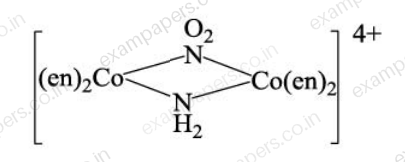
en = ethylenediamine
Log in to check the answer
You can attempt this question now. Sign in to view the answer key, explanations and discussion.Log in to check answerQuestion 46
Open questionCYNAT2 marksNeeds review
The specific rotation of optically pure (R)-2-bromobutane is −112.00. A given sample of 2-bromobutane exhibited a specific rotation of −82.88. The percentage of (S)-(+)-enantiomer present in this sample is ________.
Log in to check the answer
You can attempt this question now. Sign in to view the answer key, explanations and discussion.Log in to check answerQuestion 47
Open questionCYNAT2 marksNeeds review
Consider the following two parallel irreversible first order reactions at temperature T,
P → Q (k₁)
P → R (k₂)
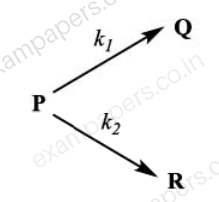
where k₁ and k₂ are the rate constants and their values are 5 × 10⁻² and 15 × 10⁻² min⁻¹, respectively, at temperature T. If the initial concentration of the reactant ‘P’ is 4 mol L⁻¹, then the concentration of product ‘R’ after 10 min of reaction is ______ mol L⁻¹. (Round off to two decimal places)
(Assume only P is present at the beginning of the reaction.)
Log in to check the answer
You can attempt this question now. Sign in to view the answer key, explanations and discussion.Log in to check answer