
Chemistry
GATE CY format:nat PYQs
Build your understanding with focused practice from past exam papers.
Questions 141–150 of 166. Imported answers require independent review unless marked reviewed.
Question 47
Open questionCYNAT2 marksNeeds review
The enthalpy of vaporization of a liquid at its boiling point (Tᵦ = 200 K) is 15.3 kJ mol⁻¹. If the molar volumes of the liquid and the vapour at 200 K are 110 and 12000 cm³ mol⁻¹ respectively, then the slope
of the liquid-vapour boundary is ________ kPa K⁻¹. (Up to two decimal places. Note: 1 Pa = 1 J m⁻³)Log in to check the answer
You can attempt this question now. Sign in to view the answer key, explanations and discussion.Log in to check answerQuestion 48
Open questionCYNAT2 marksNeeds review
In a molecule XY, let
and
denote normalized atomic orbitals of atoms X and Y, respectively. A normalized molecular orbital of XY is given by
. The value of the overlap integral of
and
is ________________. (Up to two decimal places)Log in to check the answer
You can attempt this question now. Sign in to view the answer key, explanations and discussion.Log in to check answerQuestion 49
Open questionCYNAT2 marksNeeds review
The absorption maxima of two dyes X and Y are 520 and 460 nm, respectively. The absorbance data of these dyes measured in a 1 cm path length cell are given in the table below.
Dye solution | Absorbance at 460 nm | Absorbance at 520 nm |
|---|---|---|
X (9 mM) | 0.144 | 0.765 |
Y (12 mM) | 0.912 | 0.168 |
Mixture of X and Y | 0.700 | 0.680 |
The concentration of Y in the mixture is ________ mM. (Up to two decimal places)
Log in to check the answer
You can attempt this question now. Sign in to view the answer key, explanations and discussion.Log in to check answerQuestion 50
Open questionCYNAT2 marksNeeds review
The π electrons in benzene can be modeled as particles in a ring that follow Pauli’s exclusion principle. Given that the radius of benzene is 1.4 Å, the longest wavelength of light that is absorbed during an electronic transition in benzene is __________ nm. (Up to one decimal place. Use mₑ = 9.1×10⁻³¹ kg, h = 6.6×10⁻³⁴ J s, c = 3.0×10⁸ m s⁻¹)
Log in to check the answer
You can attempt this question now. Sign in to view the answer key, explanations and discussion.Log in to check answerQuestion 51
Open questionCYNAT2 marksNeeds review
The spacing between the two adjacent lines of the microwave spectrum of H³⁵Cl is 6.35 × 10¹¹ Hz. Given that the bond length of D³⁵Cl is 5% greater than that of H³⁵Cl, the corresponding spacing for D³⁵Cl is ______ × 10¹¹ Hz. (Up to two decimal places)
Log in to check the answer
You can attempt this question now. Sign in to view the answer key, explanations and discussion.Log in to check answerQuestion 52
Open questionCYNAT2 marksNeeds review
For a diatomic vibrating rotor, in vibrational level
and rotational level J, the sum of the rotational and vibrational energies is 11493.6 cm⁻¹. Its equilibrium oscillation frequency is 2998.3 cm⁻¹, anharmonicity constant is 0.0124 and rotational constant under rigid rotor approximation is 9.716 cm⁻¹. The value of J is ____________. (Up to nearest integer)Log in to check the answer
You can attempt this question now. Sign in to view the answer key, explanations and discussion.Log in to check answerQuestion 53
Open questionCYNAT2 marksNeeds review
Number of carbonyl groups present in the final product of the following reaction sequence is __________.
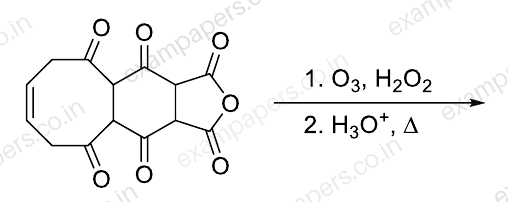
Log in to check the answer
You can attempt this question now. Sign in to view the answer key, explanations and discussion.Log in to check answerQuestion 54
Open questionCYNAT2 marksNeeds review
A tetrapeptide, made up of natural amino acids, has alanine as the N-terminal residue which is coupled to a chiral amino acid. Upon complete hydrolysis, the tetrapeptide gives glycine, alanine, phenylalanine and leucine. The number of possible sequences of the tetrapeptide is _____.
Log in to check the answer
You can attempt this question now. Sign in to view the answer key, explanations and discussion.Log in to check answerQuestion 55
Open questionCYNAT2 marksNeeds review
The strongest band observed in the IR spectrum of the final product of the following reaction appears, approximately, at _____ × 100 cm⁻¹. (Up to one decimal place)
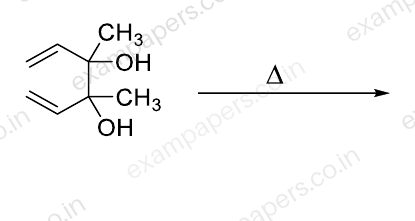
Log in to check the answer
You can attempt this question now. Sign in to view the answer key, explanations and discussion.Log in to check answerQuestion 4
Open questionCYNAT1 markNeeds review
The rate constant of a reaction is 1.25 × 10⁻⁴ mol L⁻¹ s⁻¹. If the initial concentration of the reactant is 0.250 mol L⁻¹, the total time (in seconds) required for complete conversion is ______.
Log in to check the answer
You can attempt this question now. Sign in to view the answer key, explanations and discussion.Log in to check answer