
Chemistry
GATE CY format:nat PYQs
Build your understanding with focused practice from past exam papers.
Questions 31–40 of 166. Imported answers require independent review unless marked reviewed.
Question 30
Open questionCYNAT1 markNeeds review
The crystal field stabilization energy of
with
value of 21600 cm
is
cm
. The value of
is ___.
(rounded off to the nearest integer)Log in to check the answer
You can attempt this question now. Sign in to view the answer key, explanations and discussion.Log in to check answerQuestion 31
Open questionCYNAT1 markNeeds review
The number of metal-metal bond(s) in the complex
is
and in
is
. The value of
is ___.
(Assume 18 electron rule is followed.)
(Answer in integer)Log in to check the answer
You can attempt this question now. Sign in to view the answer key, explanations and discussion.Log in to check answerQuestion 32
Open questionCYNAT1 markNeeds review
H NMR spectrum of a mixture containing CH
Br (
mol) and (CH
)
CBr (
mol) shows two singlets at 2.7 ppm and 1.8 ppm, with the relative ratio of 3:1 (integration value), respectively. The value of
is ____.
(rounded off to the nearest integer)Log in to check the answer
You can attempt this question now. Sign in to view the answer key, explanations and discussion.Log in to check answerQuestion 33
Open questionCYNAT1 markNeeds review
The value of
in atomic unit of energy is _____.
(
: charge of electron;
: Bohr radius;
: permittivity of vacuum)
(rounded off to the nearest integer)Log in to check the answer
You can attempt this question now. Sign in to view the answer key, explanations and discussion.Log in to check answerQuestion 34
Open questionCYNAT1 markNeeds review
The partial vapor pressure of 0.1 mol solution of B in liquid A is 60 kPa at 300 K. The partial vapor pressure (in kPa) of a solution containing B with mole fraction of 0.1 in liquid A at 300 K is ____.
(Assume the solute B obeys Henry’s law. The molar mass of A is 80 g mol
.)
(rounded off to three decimal places)Log in to check the answer
You can attempt this question now. Sign in to view the answer key, explanations and discussion.Log in to check answerQuestion 35
Open questionCYNAT1 markNeeds review
Consider the following two parallel irreversible first-order reactions, where
at 300 K. After complete conversion of R at 300 K, the concentration of P1 in the reaction mixture was 15 mol L
. The initial concentration of R (in mol L
) was ____.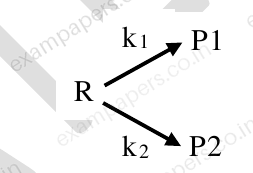
(
and
are the rate constants)
(rounded off to one decimal place)Log in to check the answer
You can attempt this question now. Sign in to view the answer key, explanations and discussion.Log in to check answerQuestion 58
Open questionCYNAT2 marksNeeds review
ΔS° (in J mol⁻¹ K⁻¹) for the given reaction at 298 K is ______.
[Cu(H₂O)₆]²⁺ + en → [Cu(H₂O)₄(en)]²⁺ + 2H₂O
(Given: log K₁ = 10.6, where K₁ is the equilibrium constant, ΔH° = −54 kJ mol⁻¹ and R = 8.314 J mol⁻¹ K⁻¹)
(rounded off to two decimal places)
Log in to check the answer
You can attempt this question now. Sign in to view the answer key, explanations and discussion.Log in to check answerQuestion 59
Open questionCYNAT2 marksNeeds review
The turnover frequency (in h⁻¹) of a reaction where 5 mol% of a catalyst is required for 90% conversion in 3 h is ____.
(rounded off to the nearest integer)
Log in to check the answer
You can attempt this question now. Sign in to view the answer key, explanations and discussion.Log in to check answerQuestion 60
Open questionCYNAT2 marksNeeds review
In thermogravimetric analysis, 12.45 mg of CuSO₄·5H₂O was subjected to heating under N₂ atmosphere. At a particular temperature, there was a weight loss of 3.6 mg. The number of water molecule(s) lost per formula unit is ____.
(Given molar mass (in g mol⁻¹) of H = 1.0, O = 16.0, S = 32.0, and Cu = 63.5)
(rounded off to the nearest integer)
Log in to check the answer
You can attempt this question now. Sign in to view the answer key, explanations and discussion.Log in to check answerQuestion 61
Open questionCYNAT2 marksNeeds review
In the given reaction sequence, the amount of R produced (in g) is ____.
Benzene (7.8 g)
P
Q
R(Given: molar mass (in g mol⁻¹) of H = 1, C = 12, N = 14, O = 16, and S = 32)
(rounded off to two decimal places)
Log in to check the answer
You can attempt this question now. Sign in to view the answer key, explanations and discussion.Log in to check answer