
Chemistry
GATE CY kind:question PYQs
Build your understanding with focused practice from past exam papers.
Questions 571–580 of 650. Imported answers require independent review unless marked reviewed.
Question 41
Open questionCYMCQ2 marksNeeds review
The reaction of PCl₃ with PhLi in 1:3 molar ratio yields X as one of the products, which on further treatment with CH₃I gives Y. The reaction of Y with n-BuLi gives product Z. The products X, Y and Z, respectively, are
Your answerChoose one option.
Log in to check the answer
You can attempt this question now. Sign in to view the answer key, explanations and discussion.Log in to check answerQuestion 42
Open questionCYMCQ2 marksNeeds review
The reaction of equimolar quantities of Fe(CO)₅ and OH⁻ gives a complex species X which on further reaction with MnO₂ gives species Y. X and Y, respectively, are
Your answerChoose one option.
Log in to check the answer
You can attempt this question now. Sign in to view the answer key, explanations and discussion.Log in to check answerQuestion 43
Open questionCYNAT2 marksNeeds review
The rate constant of a first order reaction, X → Y, is 1.6 × 10⁻³ s⁻¹ at 300 K. Given that the activation energy of the reaction is 28 kJ mol⁻¹ and assuming Arrhenius behavior for the temperature dependence, the total time required to obtain 90% of Y at 350 K is__________ s. (Up to one decimal place. Use R = 8.31 J K⁻¹ mol⁻¹)
Log in to check the answer
You can attempt this question now. Sign in to view the answer key, explanations and discussion.Log in to check answerQuestion 44
Open questionCYNAT2 marksNeeds review
The molar conductivity of a 0.01 M weak acid (HX) at 298 K, measured in a conductivity cell with cell constant of 0.4 cm⁻¹, is 64 S cm² mol⁻¹. The limiting molar conductivities at infinite dilution of H⁺ and X⁻ at 298 K are 350 and 410 S cm² mol⁻¹, respectively. Ignoring activity coefficients, the pKₐ of HX at 298 K is __________. (Up to two decimal places)
Log in to check the answer
You can attempt this question now. Sign in to view the answer key, explanations and discussion.Log in to check answerQuestion 45
Open questionCYNAT2 marksNeeds review
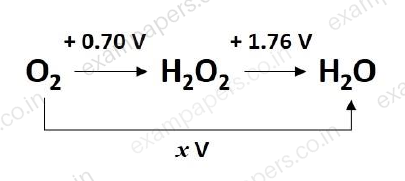
The Latimer diagram of oxygen is given below. The value of x is ______ V. (Up to two decimal places)
Log in to check the answer
You can attempt this question now. Sign in to view the answer key, explanations and discussion.Log in to check answerQuestion 46
Open questionCYNAT2 marksNeeds review
At temperature T, the canonical partition function of a harmonic oscillator with fundamental frequency (ν) is given by
For
, the probability of finding the harmonic oscillator in its ground vibrational state is ________. (Up to two decimal places)Log in to check the answer
You can attempt this question now. Sign in to view the answer key, explanations and discussion.Log in to check answerQuestion 47
Open questionCYNAT2 marksNeeds review
The enthalpy of vaporization of a liquid at its boiling point (Tᵦ = 200 K) is 15.3 kJ mol⁻¹. If the molar volumes of the liquid and the vapour at 200 K are 110 and 12000 cm³ mol⁻¹ respectively, then the slope
of the liquid-vapour boundary is ________ kPa K⁻¹. (Up to two decimal places. Note: 1 Pa = 1 J m⁻³)Log in to check the answer
You can attempt this question now. Sign in to view the answer key, explanations and discussion.Log in to check answerQuestion 48
Open questionCYNAT2 marksNeeds review
In a molecule XY, let
and
denote normalized atomic orbitals of atoms X and Y, respectively. A normalized molecular orbital of XY is given by
. The value of the overlap integral of
and
is ________________. (Up to two decimal places)Log in to check the answer
You can attempt this question now. Sign in to view the answer key, explanations and discussion.Log in to check answerQuestion 49
Open questionCYNAT2 marksNeeds review
The absorption maxima of two dyes X and Y are 520 and 460 nm, respectively. The absorbance data of these dyes measured in a 1 cm path length cell are given in the table below.
Dye solution | Absorbance at 460 nm | Absorbance at 520 nm |
|---|---|---|
X (9 mM) | 0.144 | 0.765 |
Y (12 mM) | 0.912 | 0.168 |
Mixture of X and Y | 0.700 | 0.680 |
The concentration of Y in the mixture is ________ mM. (Up to two decimal places)
Log in to check the answer
You can attempt this question now. Sign in to view the answer key, explanations and discussion.Log in to check answerQuestion 50
Open questionCYNAT2 marksNeeds review
The π electrons in benzene can be modeled as particles in a ring that follow Pauli’s exclusion principle. Given that the radius of benzene is 1.4 Å, the longest wavelength of light that is absorbed during an electronic transition in benzene is __________ nm. (Up to one decimal place. Use mₑ = 9.1×10⁻³¹ kg, h = 6.6×10⁻³⁴ J s, c = 3.0×10⁸ m s⁻¹)
Log in to check the answer
You can attempt this question now. Sign in to view the answer key, explanations and discussion.Log in to check answer