
Chemistry
GATE CY purpose:exam-prep PYQs
Build your understanding with focused practice from past exam papers.
Questions 281–290 of 650. Imported answers require independent review unless marked reviewed.
Question 21
Open questionCYMCQ1 markNeeds review
The pure vibrational spectrum of a hypothetical diatomic molecule shows three peaks with the following intensity at three different temperatures.
Peak | 300 K | 600 K | 900 K |
|---|---|---|---|
I | 1.0 | 1.0 | 1.0 |
II | 0.1 | 0.1 | 0.1 |
III | 0.02 | 0.04 | 0.06 |
The CORRECT statement is
Your answerChoose one option.
Log in to check the answer
You can attempt this question now. Sign in to view the answer key, explanations and discussion.Log in to check answerQuestion 22
Open questionCYMCQ1 markNeeds review
The point group of SF
isYour answerChoose one option.
Log in to check the answer
You can attempt this question now. Sign in to view the answer key, explanations and discussion.Log in to check answerQuestion 23
Open questionCYMCQ1 markNeeds review
A point originally at
was subjected to a symmetry operation
that shifted the point to
. Subsequently, the point at
was subjected to another symmetry operation
that shifted this point to
. The symmetry operators
and
are, respectively,Your answerChoose one option.
Log in to check the answer
You can attempt this question now. Sign in to view the answer key, explanations and discussion.Log in to check answerQuestion 24
Open questionCYMCQ1 markNeeds review
Adsorption of a gas with pressure
on a solid obeys the Langmuir adsorption isotherm. For a fixed fractional coverage, the correct relation between
and
at a fixed temperature is[
,
and
are the rate constants for adsorption and desorption, respectively. Assume non-dissociative adsorption.]Your answerChoose one option.
Log in to check the answer
You can attempt this question now. Sign in to view the answer key, explanations and discussion.Log in to check answerQuestion 25
Open questionCYMCQ1 markNeeds review
The temperature dependence of the rate constant for a second-order chemical reaction obeys the Arrhenius equation. The SI unit of the ‘pre-exponential factor’ is
Your answerChoose one option.
Log in to check the answer
You can attempt this question now. Sign in to view the answer key, explanations and discussion.Log in to check answerQuestion 26
Open questionCYMSQ1 markNeeds review
The CORRECT reagent(s) for the given reaction is(are)
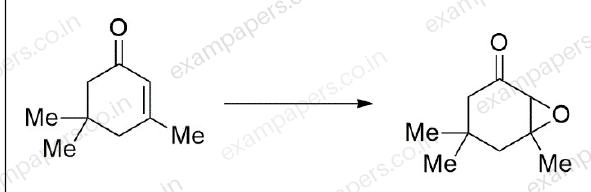
Your answerSelect all correct options. You can choose more than one.
Log in to check the answer
You can attempt this question now. Sign in to view the answer key, explanations and discussion.Log in to check answerQuestion 27
Open questionCYMSQ1 markNeeds review
The CORRECT statement(s) about the
H NMR spectra of compounds P and Q is(are) 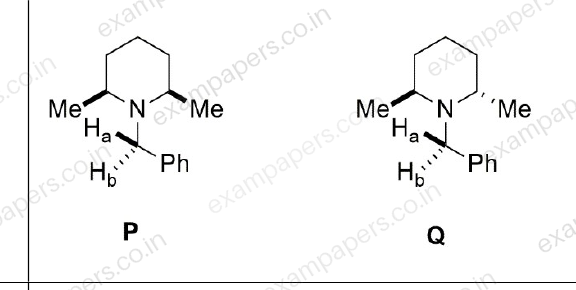
Your answerSelect all correct options. You can choose more than one.
Log in to check the answer
You can attempt this question now. Sign in to view the answer key, explanations and discussion.Log in to check answerQuestion 28
Open questionCYMSQ1 markNeeds review
The CORRECT statement(s) about thallium halides is(are)
Your answerSelect all correct options. You can choose more than one.
Log in to check the answer
You can attempt this question now. Sign in to view the answer key, explanations and discussion.Log in to check answerQuestion 29
Open questionCYMSQ1 markNeeds review
The CORRECT statement(s) about the spectral line broadening in atomic spectra is(are)
Your answerSelect all correct options. You can choose more than one.
Log in to check the answer
You can attempt this question now. Sign in to view the answer key, explanations and discussion.Log in to check answerQuestion 30
Open questionCYMSQ1 markNeeds review
Match the CORRECT option(s) from column A with column B according to the metal centre present in the active site of metalloenzyme.
A | | B | |
|---|---|---|---|
P | Cu | I | B -coenzyme |
Q | Mo | II | Carboxypeptidase |
R | Co | III | Nitrate reductase |
S | Zn | IV | Cytochrome P-450 |
| | V | Tyrosinase |
Your answerSelect all correct options. You can choose more than one.
Log in to check the answer
You can attempt this question now. Sign in to view the answer key, explanations and discussion.Log in to check answer