
Chemistry
GATE CY topic:chemical-reactions PYQs
Build your understanding with focused practice from past exam papers.
Questions 101–110 of 650. Imported answers require independent review unless marked reviewed.
Question 36
Open questionCYMCQ2 marksNeeds review
The reaction that proceeds through an oxidative addition followed by a reductive elimination is
[Given: Atomic numbers Ni = 28, Ta = 73, Zr = 40, Pt = 78]
Your answerChoose one option.
Log in to check the answer
You can attempt this question now. Sign in to view the answer key, explanations and discussion.Log in to check answerQuestion 37
Open questionCYMCQ2 marksNeeds review
The homogeneous catalyst whose metal ion does NOT undergo either oxidation or reduction in any of the steps during the hydrogenation of terminal olefins is
Your answerChoose one option.
Log in to check the answer
You can attempt this question now. Sign in to view the answer key, explanations and discussion.Log in to check answerQuestion 38
Open questionCYMCQ2 marksNeeds review
The given zirconocene compound, (η⁵-Cp)₂ZrEt₂, when heated in the presence of an equimolar amount of PMe₃ results in the formation of a compound X which obeys the 18 electron rule. The reaction also resulted in the release of a saturated hydrocarbon.
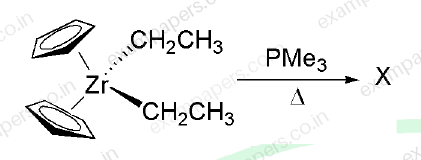
[Given: Atomic number of Zr = 40]
The structure of compound X is
Your answerChoose one option.
Log in to check the answer
You can attempt this question now. Sign in to view the answer key, explanations and discussion.Log in to check answerQuestion 39
Open questionCYMCQ2 marksNeeds review
The ¹H NMR spectrum of the given iridium complex at room temperature gave a single signal at 2.6 ppm, and its ³¹P NMR spectrum gave a single signal at 23.0 ppm. When the spectra were recorded at lower temperatures, both these signals split into a complex pattern. The intra-molecular dynamic processes shown by this molecule are
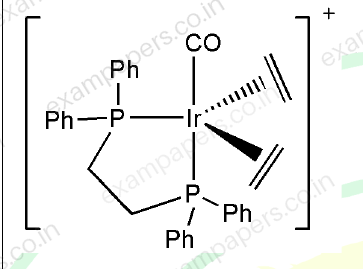
Your answerChoose one option.
Log in to check the answer
You can attempt this question now. Sign in to view the answer key, explanations and discussion.Log in to check answerQuestion 40
Open questionCYMCQ2 marksNeeds review
The effective magnetic moment,
value for
taking into account for spin-orbit coupling is closest to[Given: Atomic number of Cr = 24, spin-orbit coupling constant
, and
]Your answerChoose one option.
Log in to check the answer
You can attempt this question now. Sign in to view the answer key, explanations and discussion.Log in to check answerQuestion 41
Open questionCYMCQ2 marksNeeds review
The major products X and Y formed in the following reaction sequences are
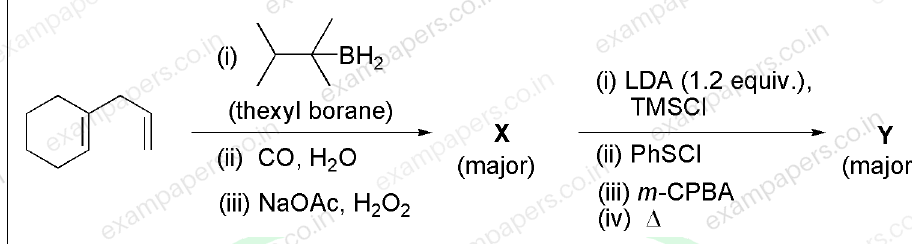
Your answerChoose one option.
Log in to check the answer
You can attempt this question now. Sign in to view the answer key, explanations and discussion.Log in to check answerQuestion 42
Open questionCYMCQ2 marksNeeds review
Compound K displayed a strong band at 1680 cm
in its IR spectrum. Its
H-NMR spectral data are as follows:
(ppm) 7.30 (d, J = 7.2 Hz, 2H), 6.8 (d, J = 7.2 Hz, 2H), 3.8 (septet, J = 7.0 Hz, 1H), 2.2 (s, 3H), 1.9 (d, J = 7.0 Hz, 6H). The correct structure of compound K isYour answerChoose one option.
Log in to check the answer
You can attempt this question now. Sign in to view the answer key, explanations and discussion.Log in to check answerQuestion 43
Open questionCYMCQ2 marksNeeds review
The major product formed in the following reaction sequences is
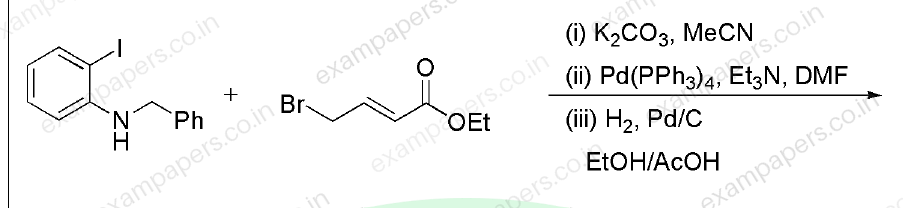
Your answerChoose one option.
Log in to check the answer
You can attempt this question now. Sign in to view the answer key, explanations and discussion.Log in to check answerQuestion 44
Open questionCYMCQ2 marksNeeds review
In the following asymmetric transformation, the key aldol reaction involves the attack of
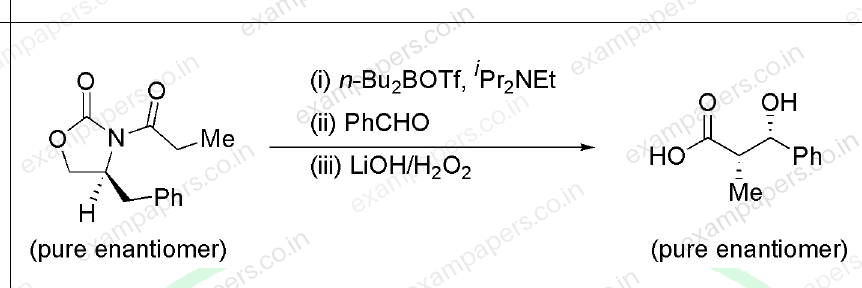
Your answerChoose one option.
Log in to check the answer
You can attempt this question now. Sign in to view the answer key, explanations and discussion.Log in to check answerQuestion 45
Open questionCYMCQ2 marksNeeds review
The correct option with regard to the following statements is
(a) Time-independent Schrödinger equation can be exactly solved for Be
.(b) For a particle confined in a one-dimensional box of length
with infinite potential barriers, the trial variation function
is not an acceptable trial wavefunction for
.(c) Wavefunctions for system of Fermions must be anti-symmetric with respect to exchange of any two Fermions in the system.
(d) Born-Oppenheimer approximation can be used to separate the vibrational and rotational motion of a molecule.
Your answerChoose one option.
Log in to check the answer
You can attempt this question now. Sign in to view the answer key, explanations and discussion.Log in to check answer