
Chemistry
GATE CY topic:chemical-sciences PYQs
Build your understanding with focused practice from past exam papers.
Questions 361–370 of 650. Imported answers require independent review unless marked reviewed.
Question 26
Open questionCYMCQ2 marksNeeds review
The geometry and the number of unpaired electrons in tetrakis(1-norbornyl)Co
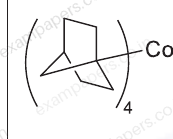
respectively, are:
Your answerChoose one option.
Log in to check the answer
You can attempt this question now. Sign in to view the answer key, explanations and discussion.Log in to check answerQuestion 27
Open questionCYMCQ2 marksNeeds review
The yellow color of an aqueous solution of K₂CrO₄ changes to red-orange upon the addition of a few drops of HCl. The red-orange complex, the oxidation state of its central element(s), and the origin of its color, respectively, are:
Your answerChoose one option.
Log in to check the answer
You can attempt this question now. Sign in to view the answer key, explanations and discussion.Log in to check answerQuestion 28
Open questionCYMCQ2 marksNeeds review
The shapes of the compounds ClF₃, XeOF₂, N₃⁻ and XeO₃F₂ respectively, are:
Your answerChoose one option.
Log in to check the answer
You can attempt this question now. Sign in to view the answer key, explanations and discussion.Log in to check answerQuestion 29
Open questionCYMCQ2 marksNeeds review
The metal borides that contain isolated boron atoms are:
Your answerChoose one option.
Log in to check the answer
You can attempt this question now. Sign in to view the answer key, explanations and discussion.Log in to check answerQuestion 30
Open questionCYMCQ2 marksNeeds review
The major product formed in the following reaction
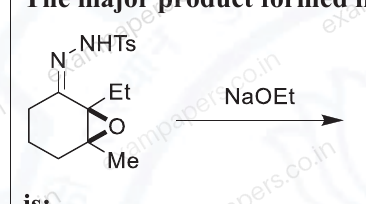
is:
Your answerChoose one option.
Log in to check the answer
You can attempt this question now. Sign in to view the answer key, explanations and discussion.Log in to check answerQuestion 31
Open questionCYMCQ2 marksNeeds review
The major product formed in the following reaction
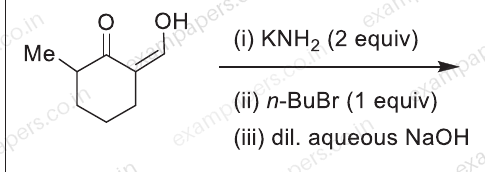
is:
Your answerChoose one option.
Log in to check the answer
You can attempt this question now. Sign in to view the answer key, explanations and discussion.Log in to check answerQuestion 32
Open questionCYMCQ2 marksNeeds review
The major product formed in the following reaction [starting material: 1,2-diphenylbenzocyclobutene; methyl acrylate, CO₂Me, heat] is:
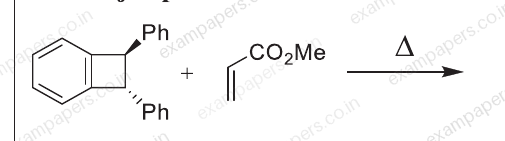
Your answerChoose one option.
Log in to check the answer
You can attempt this question now. Sign in to view the answer key, explanations and discussion.Log in to check answerQuestion 33
Open questionCYMCQ2 marksNeeds review
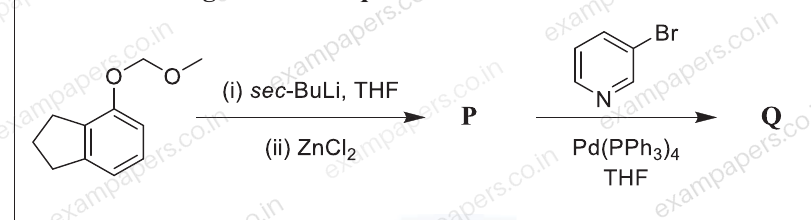
In the following reaction sequence [indanyl methyl ether treated with (i) sec-BuLi, THF; (ii) ZnCl₂ to give P; then 2-bromopyridine, Pd(PPh₃)₄, THF to give Q], the major products P and Q, respectively, are:
Your answerChoose one option.
Log in to check the answer
You can attempt this question now. Sign in to view the answer key, explanations and discussion.Log in to check answerQuestion 34
Open questionCYMCQ2 marksNeeds review
In an electrochemical cell, Ag⁺ ions in AgNO₃ are reduced to Ag metal at the cathode and Cu is oxidized to Cu²⁺ at the anode. A current of 0.7 A is passed through the cell for 10 min. The mass (in grams) of silver deposited and copper dissolved, respectively, are:
[Faraday Constant = 96,485 C mol⁻¹, Atomic Weight of Ag = 107.9, Atomic Weight of Cu = 63.55]
Your answerChoose one option.
Log in to check the answer
You can attempt this question now. Sign in to view the answer key, explanations and discussion.Log in to check answerQuestion 35
Open questionCYMCQ2 marksNeeds review
Among the following
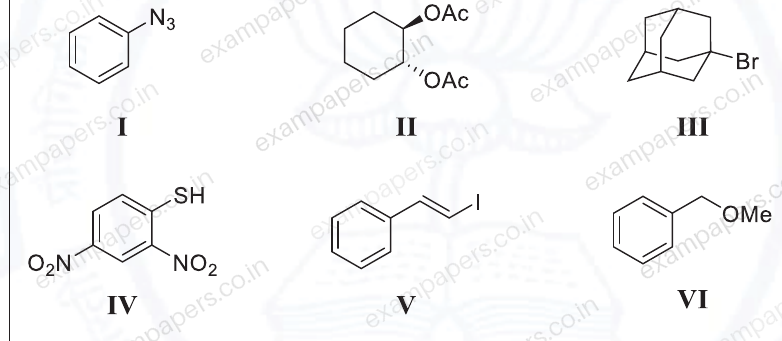
the compounds which can be prepared by nucleophilic substitution reaction are:
Your answerChoose one option.
Log in to check the answer
You can attempt this question now. Sign in to view the answer key, explanations and discussion.Log in to check answer