
Chemistry
GATE CY topic:chemistry PYQs
Build your understanding with focused practice from past exam papers.
Questions 301–310 of 650. Imported answers require independent review unless marked reviewed.
Question 41
Open questionCYMCQ2 marksNeeds review
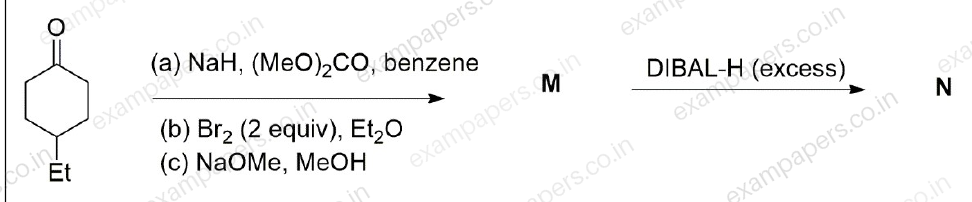
The major products M and N in the given reaction sequence are
Your answerChoose one option.
Log in to check the answer
You can attempt this question now. Sign in to view the answer key, explanations and discussion.Log in to check answerQuestion 42
Open questionCYMCQ2 marksNeeds review
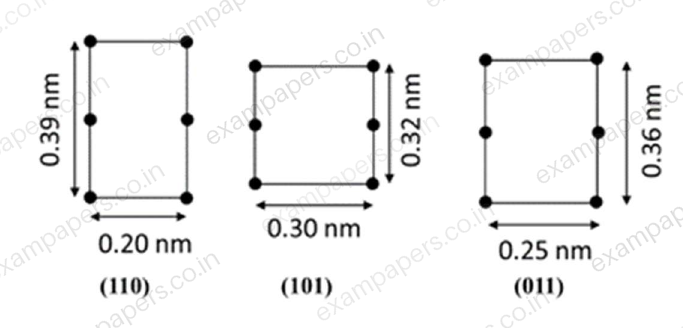
Three different crystallographic planes of a unit cell of a metal are given below (solid circles represent atom). The crystal system of the unit cell is
Your answerChoose one option.
Log in to check the answer
You can attempt this question now. Sign in to view the answer key, explanations and discussion.Log in to check answerQuestion 43
Open questionCYMCQ2 marksNeeds review
The number of equivalents of H₂S gas released from the active site of rubredoxin, 2-iron ferredoxin, and 4-iron ferredoxin when treated with mineral acid, respectively, are
Your answerChoose one option.
Log in to check the answer
You can attempt this question now. Sign in to view the answer key, explanations and discussion.Log in to check answerQuestion 44
Open questionCYMCQ2 marksNeeds review
The number of νₛ=₀ stretching vibration band(s) observed in the IR spectrum of the high-spin [Mn(dmso)₆]³⁺ complex (dmso: dimethylsulfoxide) is
Your answerChoose one option.
Log in to check the answer
You can attempt this question now. Sign in to view the answer key, explanations and discussion.Log in to check answerQuestion 45
Open questionCYMCQ2 marksNeeds review
The rate constants in the given self-exchange electron transfer reactions at a certain temperature follow
[Fe(H₂O)₆]²⁺ + [Fe*(H₂O)₆]³⁺ ⟶ [Fe(H₂O)₆]³⁺ + [Fe*(H₂O)₆]²⁺
[Fe(bpy)₃]²⁺ + [Fe*(bpy)₃]³⁺ ⟶ [Fe(bpy)₃]³⁺ + [Fe*(bpy)₃]²⁺
(bpy = bipyridyl)
[Co(NH₃)₆]²⁺ + [Co*(NH₃)₆]³⁺ ⟶ [Co(NH₃)₆]³⁺ + [Co*(NH₃)₆]²⁺
indicates a radioactive isotope
Your answerChoose one option.
Log in to check the answer
You can attempt this question now. Sign in to view the answer key, explanations and discussion.Log in to check answerQuestion 46
Open questionCYMCQ2 marksNeeds review
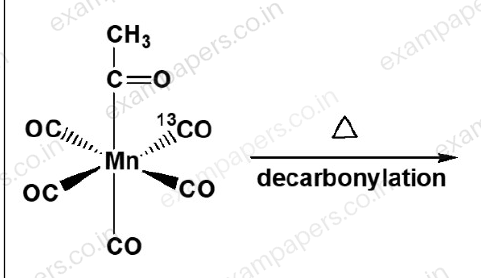
The CORRECT distribution of the products in the following reaction is
CH₃C(=O)Mn(CO)₅, with one ¹³CO ligand, heated (△), decarbonylation.
Your answerChoose one option.
Log in to check the answer
You can attempt this question now. Sign in to view the answer key, explanations and discussion.Log in to check answerQuestion 47
Open questionCYMCQ2 marksNeeds review
The addition of K₄[Fe(CN)₆] to a neutral aqueous solution of the cationic species of a metal produces a brown precipitate that is insoluble in dilute acid. The cationic species is
Your answerChoose one option.
Log in to check the answer
You can attempt this question now. Sign in to view the answer key, explanations and discussion.Log in to check answerQuestion 48
Open questionCYMCQ2 marksNeeds review
The electronic spectrum of a Ni(II) octahedral complex shows four d-d bands, labelled as P, Q, R, and S. Match the bands corresponding to the transitions.
Band | λmax, nm (ε, M⁻¹ cm⁻¹) | Transition |
|---|---|---|
P | 1000 (50) | I: ³A₂g(F) → ³T₁g(P) |
Q | 770 (8) | II: ³A₂g(F) → ³T₁g(F) |
R | 630 (55) | III: ³A₂g(F) → ³T₂g(F) |
S | 375 (110) | IV: ³A₂g(F) → ¹E_g(D) |
The matching choices are:
Your answerChoose one option.
Log in to check the answer
You can attempt this question now. Sign in to view the answer key, explanations and discussion.Log in to check answerQuestion 49
Open questionCYMCQ2 marksNeeds review
In the following table, the left column represents the rigid-rotor type and the right column shows a set of molecules.
Label | Rigid rotor type | Label | Molecule |
|---|---|---|---|
P | Symmetric rotor (oblate) | 1 | SiH₄ |
Q | Symmetric rotor (prolate) | 2 | CH₃Cl |
R | Spherical rotor | 3 | C₆H₆ |
S | Asymmetric rotor | 4 | CH₃OH |
| | 5 | CO₂ |
The CORRECT match is
Your answerChoose one option.
Log in to check the answer
You can attempt this question now. Sign in to view the answer key, explanations and discussion.Log in to check answerQuestion 50
Open questionCYMCQ2 marksNeeds review
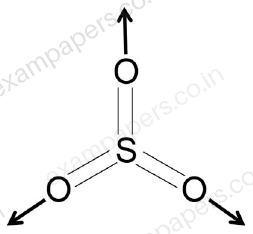
The CORRECT statement regarding the following three normal modes of vibration of
is(I)
(II)
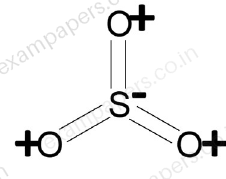
“+” and “−” indicate out-of-plane motion.
(III)
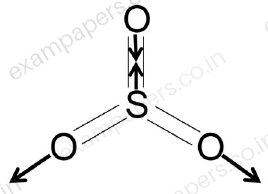
Your answerChoose one option.
Log in to check the answer
You can attempt this question now. Sign in to view the answer key, explanations and discussion.Log in to check answer