
Chemistry
GATE CY topic:equilibrium PYQs
Build your understanding with focused practice from past exam papers.
Questions 31–40 of 68. Imported answers require independent review unless marked reviewed.
Question 65
Open questionCYNAT2 marksNeeds review
The change in entropy of the surroundings (in J K
, rounded off to two decimal places) to convert 1 mol of supercooled water at 263 K to ice at 263 K at 1 bar is [Consider:
at 273 K = 6.0 kJ mol
, and the molar heat capacity of water is higher than that of ice by 37.0 J K
mol
in the temperature range of 263 K to 273 K]Log in to check the answer
You can attempt this question now. Sign in to view the answer key, explanations and discussion.Log in to check answerQuestion 11
Open questionCYMCQ1 markNeeds review
The equilibrium constant for the reaction
3 NO (g) ⇌ N₂O (g) + NO₂ (g)
at 25 °C is closest to:
[ΔG° = −104.18 kJ; R = 8.314 J mol⁻¹ K⁻¹]
Your answerChoose one option.
Log in to check the answer
You can attempt this question now. Sign in to view the answer key, explanations and discussion.Log in to check answerQuestion 15
Open questionCYMSQ1 markNeeds review
The phase diagram of CO₂ is shown below:
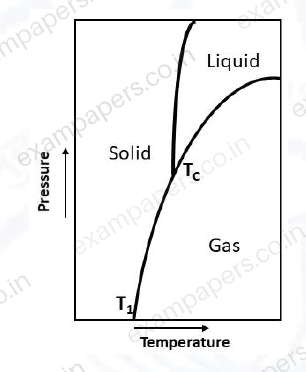
The correct statement(s) about CO₂ is/are:
Your answerSelect all correct options. You can choose more than one.
Log in to check the answer
You can attempt this question now. Sign in to view the answer key, explanations and discussion.Log in to check answerQuestion 19
Open questionCYNAT1 markNeeds review
A reversible heat engine absorbs 20 kJ of heat from a source at 500 K and dissipates it to the reservoir at 400 K. The efficiency of the heat engine is ______ %.
Log in to check the answer
You can attempt this question now. Sign in to view the answer key, explanations and discussion.Log in to check answerQuestion 22
Open questionCYNAT1 markNeeds review
The change in enthalpy (ΔH) for the reaction
2 P (s) + 3 Br₂ (l) → 2 PBr₃ (l)
is −243 kJ. In this reaction, if the amount of phosphorus consumed is 3.1 g, the change in enthalpy (rounded off to two decimal places) is ______ kJ.
[Atomic Wt. of P = 31]
Log in to check the answer
You can attempt this question now. Sign in to view the answer key, explanations and discussion.Log in to check answerQuestion 24
Open questionCYNAT1 markNeeds review
A 5 V battery delivers a steady current of 1.5 A for a period of 2 h. The total charge that has passed through the circuit is ______ Coulombs.
Log in to check the answer
You can attempt this question now. Sign in to view the answer key, explanations and discussion.Log in to check answerQuestion 34
Open questionCYMCQ2 marksNeeds review
In an electrochemical cell, Ag⁺ ions in AgNO₃ are reduced to Ag metal at the cathode and Cu is oxidized to Cu²⁺ at the anode. A current of 0.7 A is passed through the cell for 10 min. The mass (in grams) of silver deposited and copper dissolved, respectively, are:
[Faraday Constant = 96,485 C mol⁻¹, Atomic Weight of Ag = 107.9, Atomic Weight of Cu = 63.55]
Your answerChoose one option.
Log in to check the answer
You can attempt this question now. Sign in to view the answer key, explanations and discussion.Log in to check answerQuestion 40
Open questionCYMCQ2 marksNeeds review
Hexane and heptane are completely miscible. At 25 °C, the vapor pressures of hexane and heptane are 0.198 atm and 0.06 atm, respectively. The mole fractions of hexane and heptane in the vapor phase for a solution containing 4 M hexane and 6 M heptane, respectively, are:
Your answerChoose one option.
Log in to check the answer
You can attempt this question now. Sign in to view the answer key, explanations and discussion.Log in to check answerQuestion 51
Open questionCYNAT2 marksNeeds review
The vapor pressure of toluene (Mol. Wt. = 92) is 0.13 atm at 25 °C. If 6 g of a hydrocarbon is dissolved in 92 g of toluene, the vapor pressure drops to 0.12 atm. The molar mass of the hydrocarbon (rounded off to the nearest integer) is ________.
Log in to check the answer
You can attempt this question now. Sign in to view the answer key, explanations and discussion.Log in to check answerQuestion 52
Open questionCYNAT2 marksNeeds review
The reaction
CO (g) + Cl₂ (g) ⇌ COCl₂ (g)
at 500 °C, with initial pressures of 0.7 bar of CO and 1.0 bar of Cl₂, is allowed to reach equilibrium. The partial pressure of COCl₂ (g) at equilibrium is 0.15 bar. The equilibrium constant for this reaction at 500 °C (rounded off to two decimal places) is ______________.
Log in to check the answer
You can attempt this question now. Sign in to view the answer key, explanations and discussion.Log in to check answer