
Chemistry
GATE CY topic:organic-synthesis PYQs
Build your understanding with focused practice from past exam papers.
Questions 61–70 of 116. Imported answers require independent review unless marked reviewed.
Question 3
Open questionCYMCQ1 markNeeds review
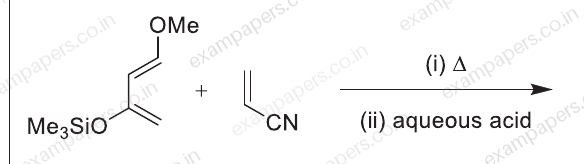
The major product formed in the following reaction [a methoxy- and trimethylsilyl-substituted diene reacts with acrylonitrile; (i) Δ, (ii) aqueous acid] is:
Your answerChoose one option.
Log in to check the answer
You can attempt this question now. Sign in to view the answer key, explanations and discussion.Log in to check answerQuestion 4
Open questionCYMCQ1 markNeeds review
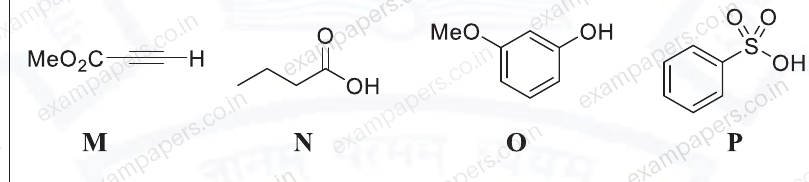
The least acidic among the following compounds [M: methyl propiolate; N: a carboxylic acid; O: methoxy-substituted phenol; P: benzenesulfonic acid] is:
Your answerChoose one option.
Log in to check the answer
You can attempt this question now. Sign in to view the answer key, explanations and discussion.Log in to check answerQuestion 6
Open questionCYMCQ1 markNeeds review
The reagent(s) required for the conversion of hex-3-yne to (E)-hex-3-ene is/are:
Your answerChoose one option.
Log in to check the answer
You can attempt this question now. Sign in to view the answer key, explanations and discussion.Log in to check answerQuestion 30
Open questionCYMCQ2 marksNeeds review
The major product formed in the following reaction
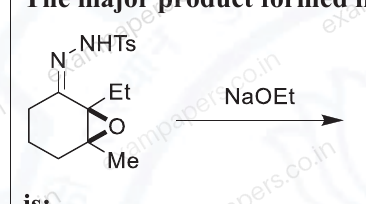
is:
Your answerChoose one option.
Log in to check the answer
You can attempt this question now. Sign in to view the answer key, explanations and discussion.Log in to check answerQuestion 31
Open questionCYMCQ2 marksNeeds review
The major product formed in the following reaction
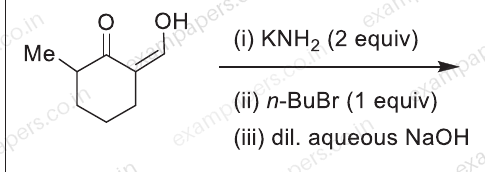
is:
Your answerChoose one option.
Log in to check the answer
You can attempt this question now. Sign in to view the answer key, explanations and discussion.Log in to check answerQuestion 33
Open questionCYMCQ2 marksNeeds review
In the following reaction sequence [indanyl methyl ether treated with (i) sec-BuLi, THF; (ii) ZnCl₂ to give P; then 2-bromopyridine, Pd(PPh₃)₄, THF to give Q], the major products P and Q, respectively, are:
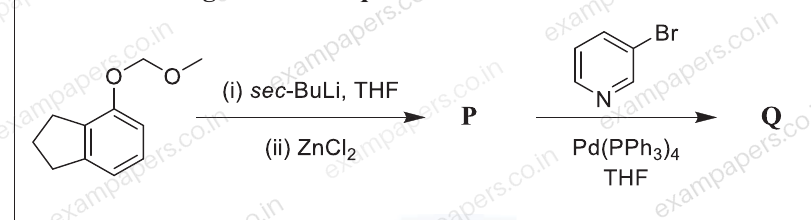
Your answerChoose one option.
Log in to check the answer
You can attempt this question now. Sign in to view the answer key, explanations and discussion.Log in to check answerQuestion 36
Open questionCYMCQ2 marksNeeds review
In the following reaction
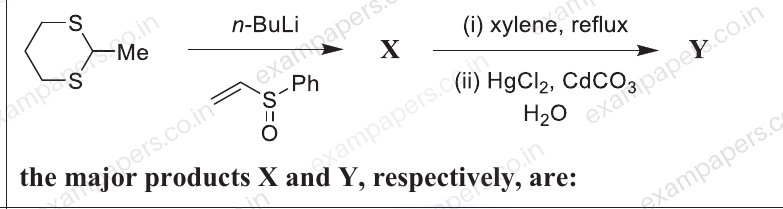
the major products X and Y, respectively, are:
Your answerChoose one option.
Log in to check the answer
You can attempt this question now. Sign in to view the answer key, explanations and discussion.Log in to check answerQuestion 37
Open questionCYMCQ2 marksNeeds review
The major products P and Q formed in the following reactions [two reaction schemes shown], respectively, are:
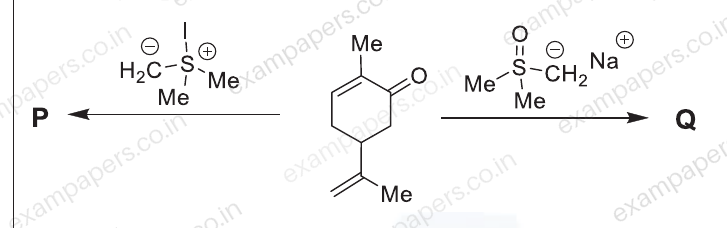
Your answerChoose one option.
Log in to check the answer
You can attempt this question now. Sign in to view the answer key, explanations and discussion.Log in to check answerQuestion 39
Open questionCYMCQ2 marksNeeds review
The major product formed in the following reaction [substrate shown; (i) LDA (1.1 equiv), (ii) PhCH₂Br (1.1 equiv), (iii) LiAlH₄ (3 equiv)] is:
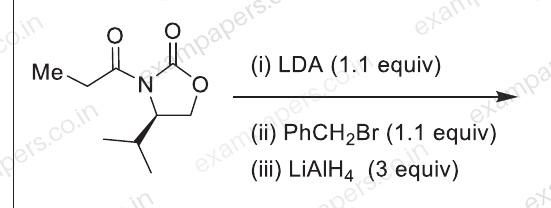
Your answerChoose one option.
Log in to check the answer
You can attempt this question now. Sign in to view the answer key, explanations and discussion.Log in to check answerQuestion 1
Open questionCYMCQ1 markNeeds review
Among the following, the suitable reagents for the given transformation is:
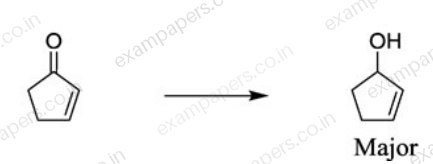
Your answerChoose one option.
Log in to check the answer
You can attempt this question now. Sign in to view the answer key, explanations and discussion.Log in to check answer