
Chemistry
GATE CY topic:organometalics PYQs
Build your understanding with focused practice from past exam papers.
How to practice topic:organometalics
Attempt a question, record the concept and assumptions, then check the available answer. Rework mistakes after revising the relevant concepts. Topic tags can overlap; review the question context.
Questions 1–10 of 33. Imported answers require independent review unless marked reviewed.
Question 21
Open questionCYMSQ1 markNeeds review
The Vaska’s complex trans-IrCl(CO)(PPh₃)₂ shows a band at 1967 cm⁻¹ for the νCO stretching vibration in its infrared spectrum. The complex(es) that will show an increase in the νCO stretching vibration from 1967 cm⁻¹ is/are
Your answerSelect all correct options. You can choose more than one.
Log in to check the answer
You can attempt this question now. Sign in to view the answer key, explanations and discussion.Log in to check answerQuestion 36
Open questionCYMCQ2 marksNeeds review
The reaction that proceeds through an oxidative addition followed by a reductive elimination is
[Given: Atomic numbers Ni = 28, Ta = 73, Zr = 40, Pt = 78]
Your answerChoose one option.
Log in to check the answer
You can attempt this question now. Sign in to view the answer key, explanations and discussion.Log in to check answerQuestion 37
Open questionCYMCQ2 marksNeeds review
The homogeneous catalyst whose metal ion does NOT undergo either oxidation or reduction in any of the steps during the hydrogenation of terminal olefins is
Your answerChoose one option.
Log in to check the answer
You can attempt this question now. Sign in to view the answer key, explanations and discussion.Log in to check answerQuestion 38
Open questionCYMCQ2 marksNeeds review
The given zirconocene compound, (η⁵-Cp)₂ZrEt₂, when heated in the presence of an equimolar amount of PMe₃ results in the formation of a compound X which obeys the 18 electron rule. The reaction also resulted in the release of a saturated hydrocarbon.
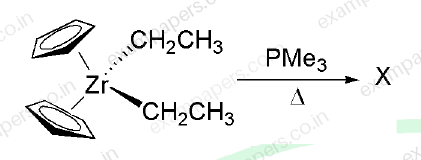
[Given: Atomic number of Zr = 40]
The structure of compound X is
Your answerChoose one option.
Log in to check the answer
You can attempt this question now. Sign in to view the answer key, explanations and discussion.Log in to check answerQuestion 39
Open questionCYMCQ2 marksNeeds review
The ¹H NMR spectrum of the given iridium complex at room temperature gave a single signal at 2.6 ppm, and its ³¹P NMR spectrum gave a single signal at 23.0 ppm. When the spectra were recorded at lower temperatures, both these signals split into a complex pattern. The intra-molecular dynamic processes shown by this molecule are
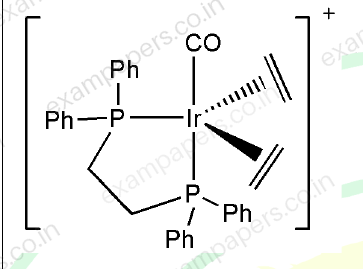
Your answerChoose one option.
Log in to check the answer
You can attempt this question now. Sign in to view the answer key, explanations and discussion.Log in to check answerQuestion 11
Open questionCYMCQ1 markNeeds review
Among the following, the compound with the lowest CO stretching frequency is
Your answerChoose one option.
Log in to check the answer
You can attempt this question now. Sign in to view the answer key, explanations and discussion.Log in to check answerQuestion 31
Open questionCYNAT1 markNeeds review
The number of metal-metal bond(s) in the complex
is
and in
is
. The value of
is ___.
(Assume 18 electron rule is followed.)
(Answer in integer)Log in to check the answer
You can attempt this question now. Sign in to view the answer key, explanations and discussion.Log in to check answerQuestion 38
Open questionCYMCQ2 marksNeeds review
The hapticity of allyl and Cp and the ligation mode of NO in the thermodynamically stable complexes [(ηˣ-allyl)Ru(CO)₂(NO)] and [(ηʸ-Cp)Ru(CO)₂(NO)], respectively, are (The hapticity of allyl and Cp are denoted by ηˣ and ηʸ, respectively.)
Your answerChoose one option.
Log in to check the answer
You can attempt this question now. Sign in to view the answer key, explanations and discussion.Log in to check answerQuestion 39
Open questionCYMCQ2 marksNeeds review
In the following reactions, the structures of I, II, and III, respectively, are
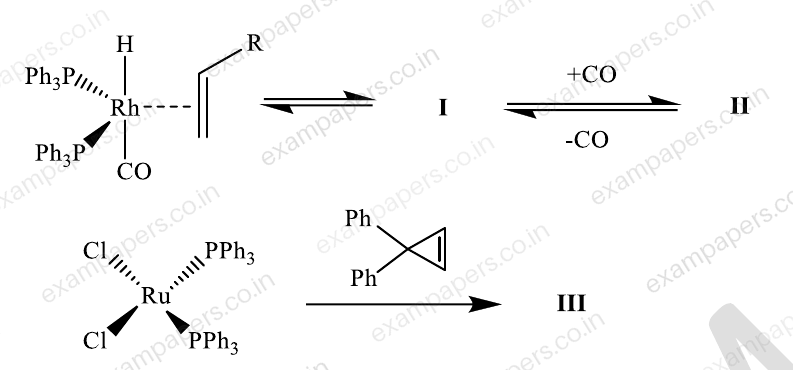
Your answerChoose one option.
Log in to check the answer
You can attempt this question now. Sign in to view the answer key, explanations and discussion.Log in to check answerQuestion 21
Open questionCYMCQ1 markNeeds review
Wacker oxidation of alkenes is catalyzed by a combination of
Your answerChoose one option.
Log in to check the answer
You can attempt this question now. Sign in to view the answer key, explanations and discussion.Log in to check answer