
Chemistry
GATE CY topic:transition-elements PYQs
Build your understanding with focused practice from past exam papers.
Questions 21–30 of 43. Imported answers require independent review unless marked reviewed.
Question 48
Open questionCYMCQ2 marksNeeds review
The electronic spectrum of a Ni(II) octahedral complex shows four d-d bands, labelled as P, Q, R, and S. Match the bands corresponding to the transitions.
Band | λmax, nm (ε, M⁻¹ cm⁻¹) | Transition |
|---|---|---|
P | 1000 (50) | I: ³A₂g(F) → ³T₁g(P) |
Q | 770 (8) | II: ³A₂g(F) → ³T₁g(F) |
R | 630 (55) | III: ³A₂g(F) → ³T₂g(F) |
S | 375 (110) | IV: ³A₂g(F) → ¹E_g(D) |
The matching choices are:
Your answerChoose one option.
Log in to check the answer
You can attempt this question now. Sign in to view the answer key, explanations and discussion.Log in to check answerQuestion 12
Open questionCYMCQ1 markNeeds review
The reaction of NiBr₂ with two equivalents of PPh₃ in CS₂ at −78 °C gives a red-colored diamagnetic complex, [NiBr₂(PPh₃)₂]. This transforms to a green-colored paramagnetic complex with the same molecular formula at 25 °C. The geometry and the number of unpaired electrons in the green-colored complex, respectively, are:
Your answerChoose one option.
Log in to check the answer
You can attempt this question now. Sign in to view the answer key, explanations and discussion.Log in to check answerQuestion 13
Open questionCYMCQ1 markNeeds review
The rate of the substitution reaction of [Co(CN)₅Cl]³⁻ with OH⁻ to give [Co(CN)₅(OH)]³⁻
Your answerChoose one option.
Log in to check the answer
You can attempt this question now. Sign in to view the answer key, explanations and discussion.Log in to check answerQuestion 14
Open questionCYMCQ1 markNeeds review
The Δ₀ of
[Cr(H₂O)₆]³⁺, [CrF₆]³⁻ and [Cr(CN)₆]³⁻
follows the order:
Your answerChoose one option.
Log in to check the answer
You can attempt this question now. Sign in to view the answer key, explanations and discussion.Log in to check answerQuestion 25
Open questionCYNAT1 markNeeds review
The spin-only magnetic moment of [Co(H₂O)₆]²⁺ (rounded off to one decimal place) is ______ BM.
Log in to check the answer
You can attempt this question now. Sign in to view the answer key, explanations and discussion.Log in to check answerQuestion 26
Open questionCYMCQ2 marksNeeds review
The geometry and the number of unpaired electrons in tetrakis(1-norbornyl)Co
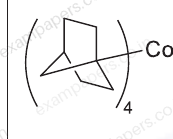
respectively, are:
Your answerChoose one option.
Log in to check the answer
You can attempt this question now. Sign in to view the answer key, explanations and discussion.Log in to check answerQuestion 27
Open questionCYMCQ2 marksNeeds review
The yellow color of an aqueous solution of K₂CrO₄ changes to red-orange upon the addition of a few drops of HCl. The red-orange complex, the oxidation state of its central element(s), and the origin of its color, respectively, are:
Your answerChoose one option.
Log in to check the answer
You can attempt this question now. Sign in to view the answer key, explanations and discussion.Log in to check answerQuestion 42
Open questionCYMCQ2 marksNeeds review
The correct order of increasing intensity (molar absorptivity) of the UV-visible absorption bands for the ions [Ti(H₂O)₆]³⁺, [Mn(H₂O)₆]²⁺, [CrO₄]²⁻, and [NiCl₄]²⁻ is:
Your answerChoose one option.
Log in to check the answer
You can attempt this question now. Sign in to view the answer key, explanations and discussion.Log in to check answerQuestion 18
Open questionCYNAT1 markNeeds review
The maximum number of microstates for
electronic configuration is ______Log in to check the answer
You can attempt this question now. Sign in to view the answer key, explanations and discussion.Log in to check answerQuestion 34
Open questionCYMCQ2 marksNeeds review
In the electronic absorption spectrum of an aqueous solution of [Ni(NH₃)₆]²⁺, a very weak band is observed between the bands due to the transitions ³A₂g → ³T₂g and ³A₂g → ³T₁g(F). The transition responsible for the very weak band is (Given: atomic number of Ni is 28)
Your answerChoose one option.
Log in to check the answer
You can attempt this question now. Sign in to view the answer key, explanations and discussion.Log in to check answer