
Chemistry
GATE CY topic:transition-elements PYQs
Build your understanding with focused practice from past exam papers.
Questions 31–40 of 43. Imported answers require independent review unless marked reviewed.
Question 5
Open questionCYMCQ1 markNeeds review
The Δₒ value of [Ni(H₂O)₆]²⁺ is 850 cm⁻¹. The Δₒ values for [NiCl₆]⁴⁻ and [Ni(NH₃)₆]²⁺ compared to [Ni(H₂O)₆]²⁺ are
Your answerChoose one option.
Log in to check the answer
You can attempt this question now. Sign in to view the answer key, explanations and discussion.Log in to check answerQuestion 26
Open questionCYMCQ2 marksNeeds review
The experimentally observed magnetic moment values, which match well with the spin-only values for the pair of aqueous ions is
(Atomic number: Cr = 24, Co = 27, Gd = 64, Tb = 65, Dy = 66 and Lu = 71)
Your answerChoose one option.
Log in to check the answer
You can attempt this question now. Sign in to view the answer key, explanations and discussion.Log in to check answerQuestion 43
Open questionCYMCQ2 marksNeeds review
The rate of the following redox reaction is slowest when X is
Your answerChoose one option.
Log in to check the answer
You can attempt this question now. Sign in to view the answer key, explanations and discussion.Log in to check answerQuestion 44
Open questionCYMCQ2 marksNeeds review
A complex is composed of one chromium ion, three bromides and six water molecules. Upon addition of excess AgNO₃, 1.0 g aqueous solution of the complex gave 0.94 g of AgBr. The molecular formula of the complex is
(Atomic weight: Cr = 52, Br = 80, Ag = 108, O = 16 and H = 1)
Your answerChoose one option.
Log in to check the answer
You can attempt this question now. Sign in to view the answer key, explanations and discussion.Log in to check answerQuestion 45
Open questionCYNAT2 marksNeeds review
The number of possible optically active isomer(s) for the following complex is ________.
[(en)₂Co(N₂)(H₂)Co(en)₂]⁴⁺
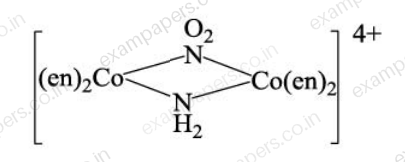
en = ethylenediamine
Log in to check the answer
You can attempt this question now. Sign in to view the answer key, explanations and discussion.Log in to check answerQuestion 14
Open questionCYMCQ1 markNeeds review
The water exchange rates for the complex ions follow the order
Your answerChoose one option.
Log in to check the answer
You can attempt this question now. Sign in to view the answer key, explanations and discussion.Log in to check answerQuestion 15
Open questionCYMCQ1 markNeeds review
The lowest energy
transition of the complexes follow the orderYour answerChoose one option.
Log in to check the answer
You can attempt this question now. Sign in to view the answer key, explanations and discussion.Log in to check answerQuestion 16
Open questionCYMCQ1 markNeeds review
The symmetry label of valence p orbitals of a metal ion in an octahedral ligand field is
Your answerChoose one option.
Log in to check the answer
You can attempt this question now. Sign in to view the answer key, explanations and discussion.Log in to check answerQuestion 36
Open questionCYMCQ2 marksNeeds review
Spectroscopic ground state term symbols of cobalt ions in [Co(H₂O)₆]²⁺ and [CoCl₄]²⁻, respectively, are
Your answerChoose one option.
Log in to check the answer
You can attempt this question now. Sign in to view the answer key, explanations and discussion.Log in to check answerQuestion 38
Open questionCYMCQ2 marksNeeds review
Second-order rate constant for the reaction between [Co(NH₃)₅X]ⁿ⁺ (n = 3 for X = NH₃ and H₂O; n = 2 for X = Cl⁻) and [Cr(H₂O)₆]²⁺ at room temperature varies with the X as
Your answerChoose one option.
Log in to check the answer
You can attempt this question now. Sign in to view the answer key, explanations and discussion.Log in to check answer