
Chemistry
GATE CY year:2017 PYQs
Build your understanding with focused practice from past exam papers.
Questions 21–30 of 65. Imported answers require independent review unless marked reviewed.
Question 21
Open questionCYMCQ1 markNeeds review
The major product obtained in the following reaction is
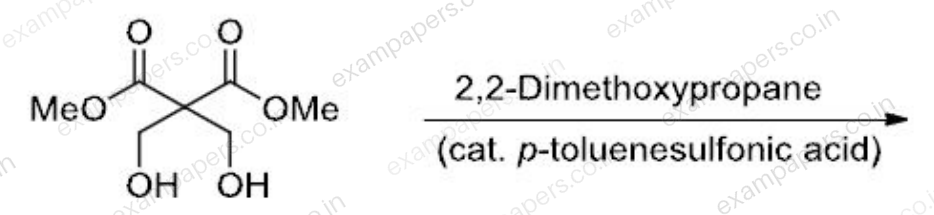
Your answerChoose one option.
Log in to check the answer
You can attempt this question now. Sign in to view the answer key, explanations and discussion.Log in to check answerQuestion 22
Open questionCYMCQ1 markNeeds review
In the two step reaction sequence given below, the starting bis-sulfone acts as
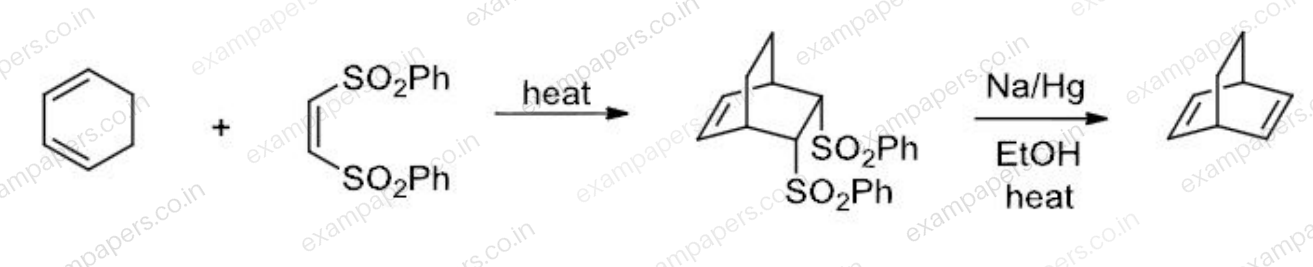
Your answerChoose one option.
Log in to check the answer
You can attempt this question now. Sign in to view the answer key, explanations and discussion.Log in to check answerQuestion 23
Open questionCYMCQ1 markNeeds review
The major product formed in the following photochemical reaction is

Your answerChoose one option.
Log in to check the answer
You can attempt this question now. Sign in to view the answer key, explanations and discussion.Log in to check answerQuestion 24
Open questionCYMCQ1 markNeeds review
The product formed in the following reaction is
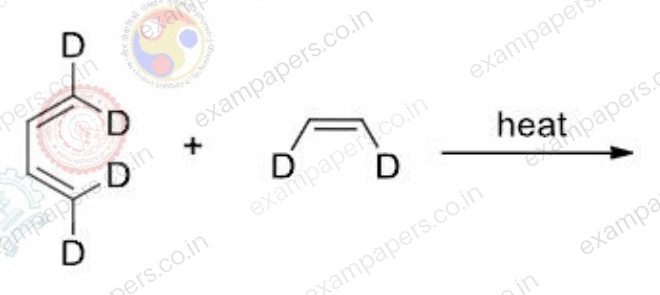
Your answerChoose one option.
Log in to check the answer
You can attempt this question now. Sign in to view the answer key, explanations and discussion.Log in to check answerQuestion 25
Open questionCYNAT1 markNeeds review
The number of possible stereoisomers for cyclononene is __________
Log in to check the answer
You can attempt this question now. Sign in to view the answer key, explanations and discussion.Log in to check answerQuestion 26
Open questionCYNAT2 marksNeeds review
The mobility of a univalent ion in aqueous solution is
at 300 K. Its diffusion coefficient at 300 K is
. The value of X is __________ (up to two decimal places)Log in to check the answer
You can attempt this question now. Sign in to view the answer key, explanations and discussion.Log in to check answerQuestion 27
Open questionCYNAT2 marksNeeds review
For the following consecutive first order reactions
the time (in seconds) required for Y to reach its maximum concentration (assuming only X is present at time
) is __________ (up to two decimal places)Log in to check the answer
You can attempt this question now. Sign in to view the answer key, explanations and discussion.Log in to check answerQuestion 28
Open questionCYNAT2 marksNeeds review
Under physiological conditions, the conversion of CO
to bicarbonate ion by carbonic anhydrase enzyme (MW = 30,000 g mol
) has a turnover number of
s
. The minimum amount of enzyme (in μg) required to convert 0.44 g of CO
to bicarbonate ions in 100 seconds is __________ (up to two decimal places)Log in to check the answer
You can attempt this question now. Sign in to view the answer key, explanations and discussion.Log in to check answerQuestion 29
Open questionCYNAT2 marksNeeds review
Assume 1,3,5-hexatriene to be a linear molecule and model the π electrons as particles in a one-dimensional box of length 0.70 nm. The wavelength (in nm) corresponding to the transition from the ground-state to the first excited-state is __________
Log in to check the answer
You can attempt this question now. Sign in to view the answer key, explanations and discussion.Log in to check answerQuestion 30
Open questionCYNAT2 marksNeeds review
The standard Gibbs free energy change of the reaction shown below is −2.7 kJ mol
.Sn(s) + Pb
= Sn
+ Pb(s)Given that
is −0.126 V, the value of
in V is __________ (up to two decimal places)Log in to check the answer
You can attempt this question now. Sign in to view the answer key, explanations and discussion.Log in to check answer