
Chemistry
GATE CY year:2017 PYQs
Build your understanding with focused practice from past exam papers.
Questions 41–50 of 65. Imported answers require independent review unless marked reviewed.
Question 41
Open questionCYMCQ2 marksNeeds review
For the following three alkenes, 1, 2 and 3, the rates of hydrogenation using Wilkinson’s catalyst at 25 °C vary in the order
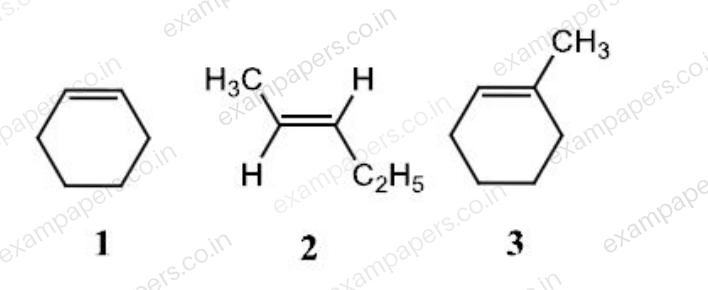
1: cyclohexene; 2: alkene with CH₃ and C₂H₅ substituents on one alkene carbon and H on the other; 3: methyl-substituted cyclohexene
Your answerChoose one option.
Log in to check the answer
You can attempt this question now. Sign in to view the answer key, explanations and discussion.Log in to check answerQuestion 42
Open questionCYNAT2 marksNeeds review
undergoes
decay to
of its initial amount in 15 days. The time required for its decay to
of its initial amount is ______ days (up to two decimal places).Log in to check the answer
You can attempt this question now. Sign in to view the answer key, explanations and discussion.Log in to check answerQuestion 43
Open questionCYMCQ2 marksNeeds review
The metal ion and the macrocyclic skeleton present in the green pigment of plants, respectively, are
Your answerChoose one option.
Log in to check the answer
You can attempt this question now. Sign in to view the answer key, explanations and discussion.Log in to check answerQuestion 44
Open questionCYMCQ2 marksNeeds review
The spinel structure of
has cubic close packed arrangement of oxide ions. The fractions of the octahedral and tetrahedral sites occupied by cations, respectively, areYour answerChoose one option.
Log in to check the answer
You can attempt this question now. Sign in to view the answer key, explanations and discussion.Log in to check answerQuestion 45
Open questionCYNAT2 marksNeeds review
The diffusion limiting current (
) at a dropping mercury electrode for an aqueous Mg(II) solution of concentration ‘c’ (mol L
) is 300 μA. If ‘c’ is increased by 0.1 mol L
,
increases to 900 μA. The value of ‘c’ (in mol L
) is ______ (up to two decimal places).Log in to check the answer
You can attempt this question now. Sign in to view the answer key, explanations and discussion.Log in to check answerQuestion 46
Open questionCYMCQ2 marksNeeds review
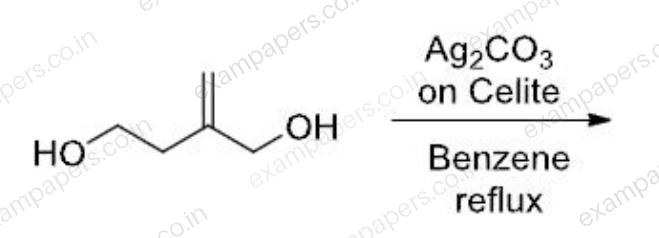
The major product formed in the following reaction is
Your answerChoose one option.
Log in to check the answer
You can attempt this question now. Sign in to view the answer key, explanations and discussion.Log in to check answerQuestion 47
Open questionCYMCQ2 marksNeeds review
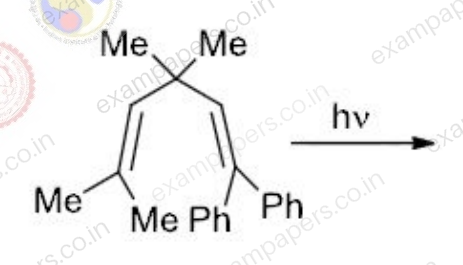
The product formed in the following photochemical reaction is
Your answerChoose one option.
Log in to check the answer
You can attempt this question now. Sign in to view the answer key, explanations and discussion.Log in to check answerQuestion 48
Open questionCYMCQ2 marksNeeds review
Among the following decahydroquinoline toluenesulfonates (Ts), the one that yields 9-methylamino-E-non-5-enal as a major product upon aqueous solvolysis is
Your answerChoose one option.
Log in to check the answer
You can attempt this question now. Sign in to view the answer key, explanations and discussion.Log in to check answerQuestion 49
Open questionCYMCQ2 marksNeeds review
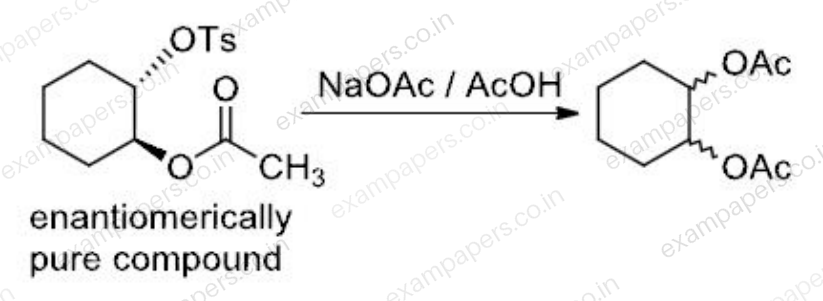
The product obtained in the following solvolysis reaction is
Your answerChoose one option.
Log in to check the answer
You can attempt this question now. Sign in to view the answer key, explanations and discussion.Log in to check answerQuestion 50
Open questionCYMCQ2 marksNeeds review
The spectroscopic data for an organic compound with molecular formula C₁₀H₁₂O₂ are given below. IR band around 1750 cm⁻¹, ¹H NMR δ 7.3 (m, 5H), 5.85 (q, 1H, J = 7.2 Hz), 2.05 (s, 3H), 1.5 (d, 3H, J = 7.2 Hz) ppm. The compound is
Your answerChoose one option.
Log in to check the answer
You can attempt this question now. Sign in to view the answer key, explanations and discussion.Log in to check answer