
Chemistry
GATE CY year:2018 PYQs
Build your understanding with focused practice from past exam papers.
Questions 11–20 of 65. Imported answers require independent review unless marked reviewed.
Question 1
Open questionCYMCQ1 markNeeds review
The major product formed in the following reaction is
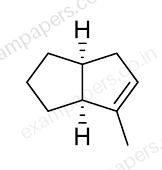
Your answerChoose one option.
Log in to check the answer
You can attempt this question now. Sign in to view the answer key, explanations and discussion.Log in to check answerQuestion 2
Open questionCYMCQ1 markNeeds review
The major product formed in the following reaction is
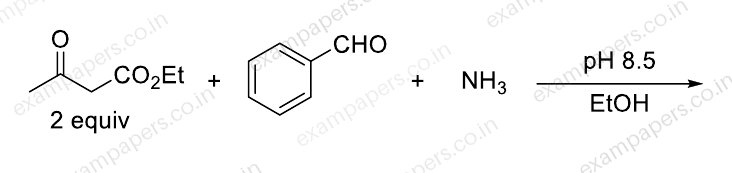
Your answerChoose one option.
Log in to check the answer
You can attempt this question now. Sign in to view the answer key, explanations and discussion.Log in to check answerQuestion 3
Open questionCYMCQ1 markNeeds review
The major product of the following intramolecular cycloaddition reaction is
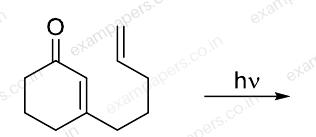
Your answerChoose one option.
Log in to check the answer
You can attempt this question now. Sign in to view the answer key, explanations and discussion.Log in to check answerQuestion 4
Open questionCYMCQ1 markNeeds review
The major product of the following reaction is
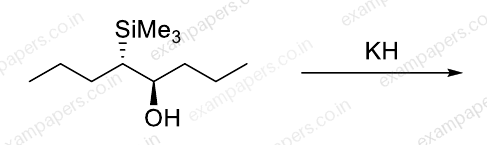
Your answerChoose one option.
Log in to check the answer
You can attempt this question now. Sign in to view the answer key, explanations and discussion.Log in to check answerQuestion 5
Open questionCYMCQ1 markNeeds review
The major product formed in the following reaction sequence is
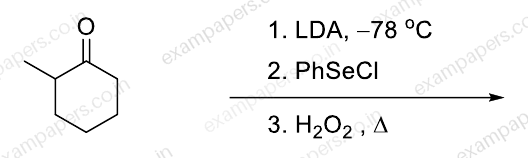
Your answerChoose one option.
Log in to check the answer
You can attempt this question now. Sign in to view the answer key, explanations and discussion.Log in to check answerQuestion 6
Open questionCYMCQ1 markNeeds review
The major product formed in the following reaction sequence is
Starting material and reagents:
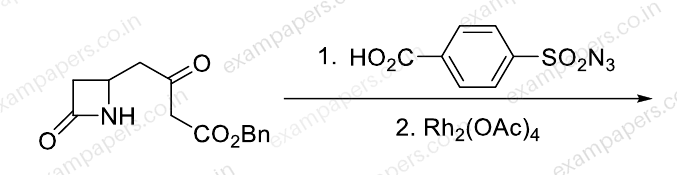
Your answerChoose one option.
Log in to check the answer
You can attempt this question now. Sign in to view the answer key, explanations and discussion.Log in to check answerQuestion 7
Open questionCYMCQ1 markNeeds review
The spherical harmonic function,
, with appropriate values of l and m, is an eigenfunction of
operator. The corresponding eigenvalue isYour answerChoose one option.
Log in to check the answer
You can attempt this question now. Sign in to view the answer key, explanations and discussion.Log in to check answerQuestion 8
Open questionCYMCQ1 markNeeds review
Consider the operators,
and
, where
and
are the position and linear momentum operators, respectively. The commutator,
, is equal toYour answerChoose one option.
Log in to check the answer
You can attempt this question now. Sign in to view the answer key, explanations and discussion.Log in to check answerQuestion 9
Open questionCYMCQ1 markNeeds review
The temperature derivative of electrochemical cell potential E at constant pressure,
, is given byYour answerChoose one option.
Log in to check the answer
You can attempt this question now. Sign in to view the answer key, explanations and discussion.Log in to check answerQuestion 10
Open questionCYMCQ1 markNeeds review
For an ionic micelle-forming surfactant near its critical micelle concentration (CMC), the dependence of molar conductivity and surface tension on surfactant concentration is best represented by
Your answerChoose one option.
Log in to check the answer
You can attempt this question now. Sign in to view the answer key, explanations and discussion.Log in to check answer