
Chemistry
GATE CY year:2019 PYQs
Build your understanding with focused practice from past exam papers.
Questions 51–60 of 65. Imported answers require independent review unless marked reviewed.
Question 41
Open questionCYMCQ2 marksNeeds review
In the following reaction sequence, the products P and Q are
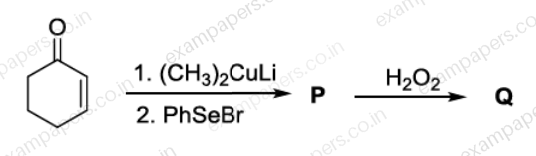
Your answerChoose one option.
Log in to check the answer
You can attempt this question now. Sign in to view the answer key, explanations and discussion.Log in to check answerQuestion 42
Open questionCYMCQ2 marksNeeds review
The major product formed in the following reaction is
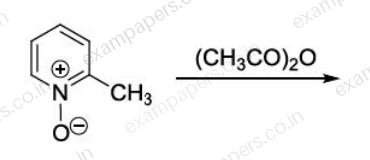
Your answerChoose one option.
Log in to check the answer
You can attempt this question now. Sign in to view the answer key, explanations and discussion.Log in to check answerQuestion 43
Open questionCYMCQ2 marksNeeds review
The rate of the following redox reaction is slowest when X is
Your answerChoose one option.
Log in to check the answer
You can attempt this question now. Sign in to view the answer key, explanations and discussion.Log in to check answerQuestion 44
Open questionCYMCQ2 marksNeeds review
A complex is composed of one chromium ion, three bromides and six water molecules. Upon addition of excess AgNO₃, 1.0 g aqueous solution of the complex gave 0.94 g of AgBr. The molecular formula of the complex is
(Atomic weight: Cr = 52, Br = 80, Ag = 108, O = 16 and H = 1)
Your answerChoose one option.
Log in to check the answer
You can attempt this question now. Sign in to view the answer key, explanations and discussion.Log in to check answerQuestion 45
Open questionCYNAT2 marksNeeds review
The number of possible optically active isomer(s) for the following complex is ________.
[(en)₂Co(N₂)(H₂)Co(en)₂]⁴⁺
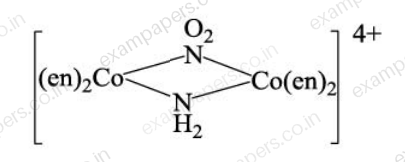
en = ethylenediamine
Log in to check the answer
You can attempt this question now. Sign in to view the answer key, explanations and discussion.Log in to check answerQuestion 46
Open questionCYNAT2 marksNeeds review
The specific rotation of optically pure (R)-2-bromobutane is −112.00. A given sample of 2-bromobutane exhibited a specific rotation of −82.88. The percentage of (S)-(+)-enantiomer present in this sample is ________.
Log in to check the answer
You can attempt this question now. Sign in to view the answer key, explanations and discussion.Log in to check answerQuestion 47
Open questionCYNAT2 marksNeeds review
Consider the following two parallel irreversible first order reactions at temperature T,
P → Q (k₁)
P → R (k₂)
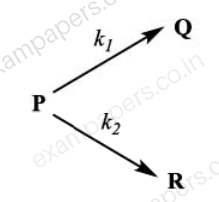
where k₁ and k₂ are the rate constants and their values are 5 × 10⁻² and 15 × 10⁻² min⁻¹, respectively, at temperature T. If the initial concentration of the reactant ‘P’ is 4 mol L⁻¹, then the concentration of product ‘R’ after 10 min of reaction is ______ mol L⁻¹. (Round off to two decimal places)
(Assume only P is present at the beginning of the reaction.)
Log in to check the answer
You can attempt this question now. Sign in to view the answer key, explanations and discussion.Log in to check answerQuestion 48
Open questionCYNAT2 marksNeeds review
Consider the following equilibrium
At 298 K, the standard molar Gibbs energies of formation, ΔfG°, of SO₂(g) and SO₃(g) are −300 and −371 kJ mol⁻¹, respectively. The value of the equilibrium constant, Kₚ, at this temperature is ______ × 10¹⁰. (Round off to the nearest integer)
(Gas constant R = 8.31 J mol⁻¹ K⁻¹)
Log in to check the answer
You can attempt this question now. Sign in to view the answer key, explanations and discussion.Log in to check answerQuestion 49
Open questionCYNAT2 marksNeeds review
Consider the electrochemical cell
M(s)|M₂(s)|M₂(aq)|M(s)
where ‘M’ is a metal. At 298 K, the standard reduction potentials are E°M²⁺(aq)/M(s) = −0.12 V, E°M₂(s)/M(s) = 0.36 V and the temperature coefficient is (∂E°cell/∂T)ₚ = 1.5 × 10⁻⁴ V K⁻¹. At this temperature the standard enthalpy change for the overall cell reaction, ΔrH°, is ______ kJ mol⁻¹. (Round off to two decimal places)
(Faraday constant F = 96500 C mol⁻¹)
Log in to check the answer
You can attempt this question now. Sign in to view the answer key, explanations and discussion.Log in to check answerQuestion 50
Open questionCYNAT2 marksNeeds review
The normal boiling point of a compound (X) is 350 K (heat of vaporization, ΔvapH = 30 kJ mol⁻¹). The pressure required to boil ‘X’ at 300 K is ______ Torr. (Round off to two decimal places)
(Ignore the temperature variation of ΔvapH; Gas constant R = 8.31 J mol⁻¹ K⁻¹ and 1 atm = 760 Torr)
Log in to check the answer
You can attempt this question now. Sign in to view the answer key, explanations and discussion.Log in to check answer