
Electronics and Communication Engineering
GATE ECE BJT and MOSFET amplifiers PYQs
Build your understanding with focused practice from past exam papers.
Questions 31–33 of 33. Imported answers require independent review unless marked reviewed.
Question 41
Open questionECNAT2 marksNeeds review
For the DC analysis of the Common-Emitter amplifier shown, neglect the base current and assume that the emitter and collector currents are equal. Given that
,
, and the BJT output resistance
is practically infinite. Under these conditions, the midband voltage gain magnitude,
, is ____________. 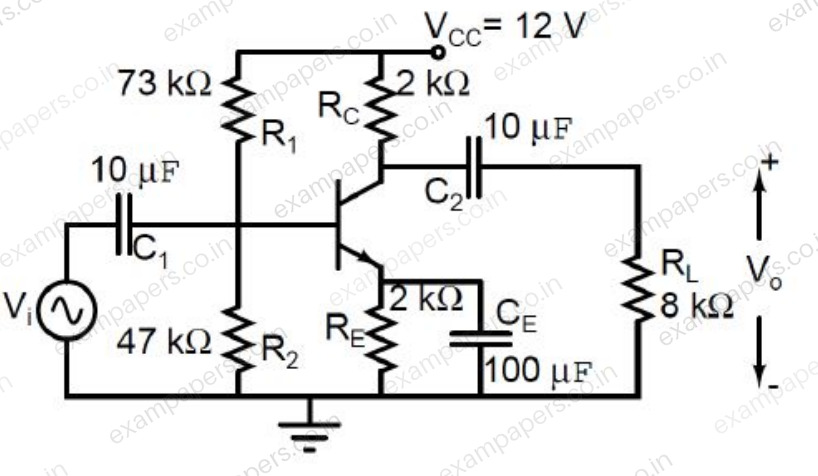
Log in to check the answer
You can attempt this question now. Sign in to view the answer key, explanations and discussion.Log in to check answerQuestion 41
Open questionECNAT2 marksNeeds review
In the circuit shown, transistors Q1 and Q2 are biased at a collector current of 2.6 mA. Assuming that transistor current gains are sufficiently large to assume collector current equal to emitter current and thermal voltage of 26 mV, the magnitude of voltage gain
in the mid-band frequency range is ______ (up to second decimal place). 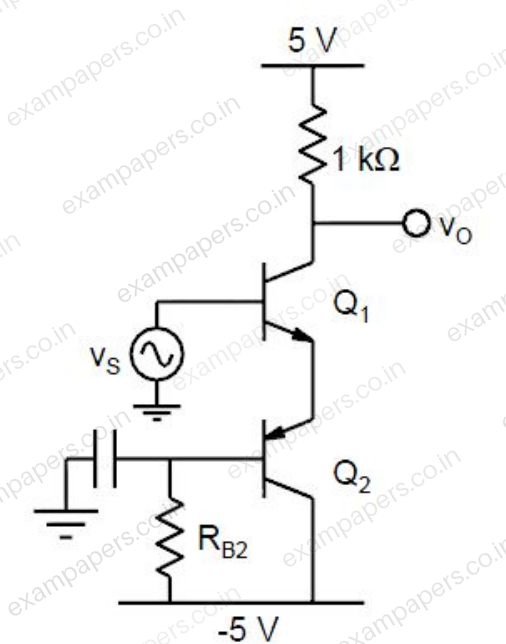
Log in to check the answer
You can attempt this question now. Sign in to view the answer key, explanations and discussion.Log in to check answerQuestion 42
Open questionECNAT2 marksNeeds review
In the voltage reference circuit shown in the figure, the op-amp is ideal and the transistors Q₁, Q₂, ..., Q₃ are identical in all respects and have infinitely large values of common-emitter current gain (β). The collector current (
) of the transistors is related to their base-emitter voltage (
) by the relation
, where
is the saturation current. Assume that the voltage
shown in the figure is 0.7 V and the thermal voltage
. 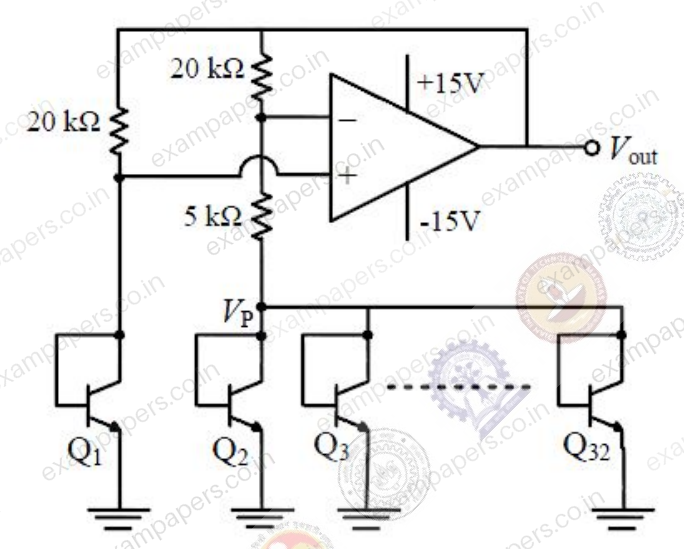
The output voltage
(in volts) is ______Log in to check the answer
You can attempt this question now. Sign in to view the answer key, explanations and discussion.Log in to check answer