
Electronics and Communication Engineering
GATE ECE concept:power-spectral-density PYQs
Build your understanding with focused practice from past exam papers.
How to practice concept:power-spectral-density
Attempt a question, record the concept and assumptions, then check the available answer. Rework mistakes after revising the relevant concepts. Topic tags can overlap; review the question context.
Questions 1–8 of 8. Imported answers require independent review unless marked reviewed.
Question 20
Open questionECMCQ1 markNeeds review
A white Gaussian noise
with zero mean and power spectral density
, when applied to a first-order RC low pass filter produces an output
. At a particular time
, the variance of the random variable
is ______.Your answerChoose one option.
Log in to check the answer
You can attempt this question now. Sign in to view the answer key, explanations and discussion.Log in to check answerQuestion 30
Open questionECMSQ1 markNeeds review
For a real signal, which of the following is/are valid power spectral density/densities?
Your answerSelect all correct options. You can choose more than one.
Log in to check the answer
You can attempt this question now. Sign in to view the answer key, explanations and discussion.Log in to check answerQuestion 59
Open questionECNAT2 marksNeeds review
Let
be a white Gaussian noise with power spectral density
W/Hz. If
is input to an LTI system with impulse response
. The average power of the system output is ________ W (rounded off to two decimal places).Log in to check the answer
You can attempt this question now. Sign in to view the answer key, explanations and discussion.Log in to check answerQuestion 23
Open questionECMCQ1 markNeeds review
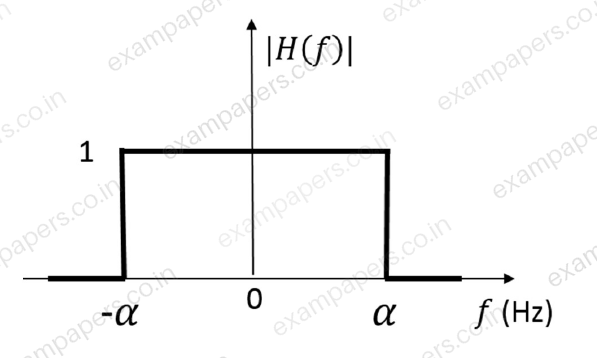
The frequency response
of a linear time-invariant system has magnitude as shown in the figure.Statement I: The system is necessarily a pure delay system for inputs which are bandlimited to
.Statement II: For any wide-sense stationary input process with power spectral density
, the output power spectral density
obeys
for
.Which one of the following combinations is true?
Your answerChoose one option.
Log in to check the answer
You can attempt this question now. Sign in to view the answer key, explanations and discussion.Log in to check answerQuestion 24
Open questionECNAT1 markNeeds review
The random variable
and
is a real white Gaussian noise process with two-sided power spectral density
W/Hz, for all
. The variance of Y is ______.Log in to check the answer
You can attempt this question now. Sign in to view the answer key, explanations and discussion.Log in to check answerQuestion 45
Open questionECNAT2 marksNeeds review
Let a random process
be described as
, where
is a white noise process with power spectral density
. The filter
has a magnitude response given by
for
, and zero elsewhere.
is a stationary random process, uncorrelated with
, with power spectral density as shown in the figure. The power in
, in watts, is equal to ______ W (rounded off to two decimal places). 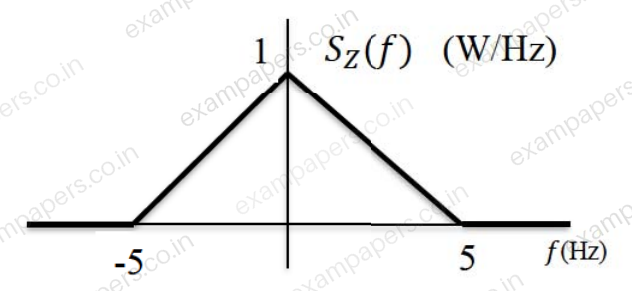
Log in to check the answer
You can attempt this question now. Sign in to view the answer key, explanations and discussion.Log in to check answerQuestion 28
Open questionECMCQ2 marksNeeds review
Consider a white Gaussian noise process
with two-sided power spectral density
W/Hz as input to a filter with impulse response
(where t is in seconds) resulting in output Y(t). The power in Y(t) in watts isYour answerChoose one option.
Log in to check the answer
You can attempt this question now. Sign in to view the answer key, explanations and discussion.Log in to check answerQuestion 51
Open questionECMCQ2 marksNeeds review
Let
be a wide sense stationary random process with the power spectral density
as shown in Figure (a), where
is in Hertz (Hz).
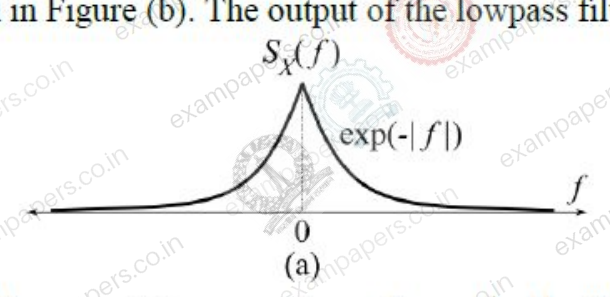
The random process
is input to an ideal lowpass filter with the frequency response
as shown in Figure (b).
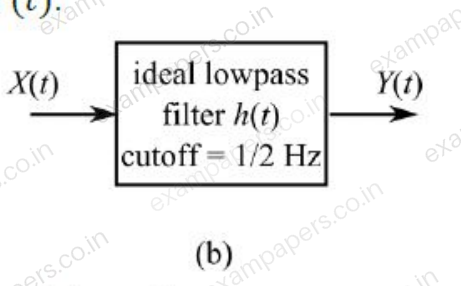
The output of the lowpass filter is
.Let
be the expectation operator and consider the following statements:I.
II.
III.
Select the correct option:
Your answerChoose one option.
Log in to check the answer
You can attempt this question now. Sign in to view the answer key, explanations and discussion.Log in to check answer