
Electronics and Communication Engineering
GATE ECE Digital communications PYQs
Build your understanding with focused practice from past exam papers.
Questions 11–20 of 26. Imported answers require independent review unless marked reviewed.
Question 64
Open questionECNAT2 marksNeeds review
Consider a real valued source whose samples are independent and identically distributed random variables with the probability density function,
, as shown in the figure.Consider a 1 bit quantizer that maps positive samples to value
and others to value
. If
and
are the respective choices for
and
that minimize the mean square quantization error, then
________ (rounded off to two decimal places). 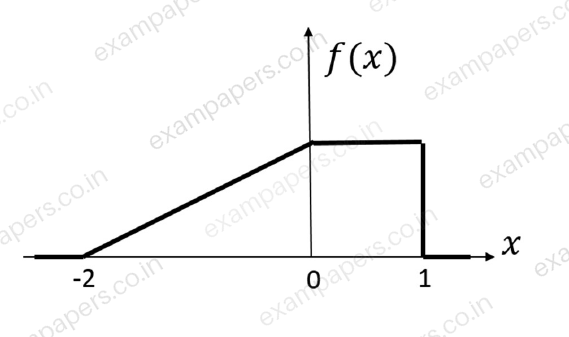
Log in to check the answer
You can attempt this question now. Sign in to view the answer key, explanations and discussion.Log in to check answerQuestion 23
Open questionECNAT1 markNeeds review
A speech signal, band limited to 4 kHz, is sampled at 1.25 times the Nyquist rate. The speech samples, assumed to be statistically independent and uniformly distributed in the range −5 V to +5 V, are subsequently quantized in an 8-bit uniform quantizer and transmitted over a voice-grade AWGN telephone channel. If the ratio of transmitted signal power to channel noise power is 26 dB, the minimum channel bandwidth required to ensure reliable transmission of the signal with arbitrarily small probability of transmission error (rounded off to two decimal places) is ______ kHz.
Log in to check the answer
You can attempt this question now. Sign in to view the answer key, explanations and discussion.Log in to check answerQuestion 24
Open questionECNAT1 markNeeds review
A 4 kHz sinusoidal message signal having amplitude 4 V is fed to a delta modulator (DM) operating at a sampling rate of 32 kHz. The minimum step size required to avoid slope overload noise in the DM (rounded off to two decimal places) is ______ V.
Log in to check the answer
You can attempt this question now. Sign in to view the answer key, explanations and discussion.Log in to check answerQuestion 34
Open questionECMCQ2 marksNeeds review
A digital transmission system uses a (7, 4) systematic linear Hamming code for transmitting data over a noisy channel. If three of the message-codeword pairs in this code
, where
is the codeword corresponding to the
message
, are known to be (1100; 0101100), (1110; 0011110) and (0110; 1000110), then which of the following is a valid codeword in this code?Your answerChoose one option.
Log in to check the answer
You can attempt this question now. Sign in to view the answer key, explanations and discussion.Log in to check answerQuestion 52
Open questionECNAT2 marksNeeds review
A message signal having peak-to-peak value of 2 V, root mean square value of 1 V and bandwidth of 5 kHz is sampled and fed to a pulse code modulation (PCM) system that uses a uniform quantizer. The PCM output is transmitted over a channel that can support a maximum transmission rate of 50 kbps. Assuming that the quantization error is uniformly distributed, the maximum signal to quantization noise ratio that can be obtained by the PCM system (rounded off to two decimal places) is ______.
Log in to check the answer
You can attempt this question now. Sign in to view the answer key, explanations and discussion.Log in to check answerQuestion 53
Open questionECNAT2 marksNeeds review
Consider a polar non-return to zero (NRZ) waveform, using +2 V and −2 V for representing binary ‘1’ and ‘0’ respectively, is transmitted in the presence of additive zero-mean white Gaussian noise with variance 0.4 V
. If the a priori probability of transmission of a binary ‘1’ is 0.4, the optimum threshold voltage for a maximum a posteriori (MAP) receiver (rounded off to two decimal places) is _____ V.Log in to check the answer
You can attempt this question now. Sign in to view the answer key, explanations and discussion.Log in to check answerQuestion 12
Open questionECMCQ1 markNeeds review
A digital communication system transmits a block of
bits. The probability of error in decoding a bit is
. The error event of each bit is independent of the error events of the other bits. The received block is declared erroneous if at least one of its bits is decoded wrongly. The probability that the received block is erroneous isYour answerChoose one option.
Log in to check the answer
You can attempt this question now. Sign in to view the answer key, explanations and discussion.Log in to check answerQuestion 48
Open questionECNAT2 marksNeeds review
In a digital communication system, a symbol S randomly chosen from the set {s₁, s₂, s₃, s₄} is transmitted. It is given that s₁ = −3, s₂ = −1, s₃ = +1 and s₄ = +2. The received symbol is Y = S + W. W is a zero-mean unit-variance Gaussian random variable and is independent of S. P_i is the conditional probability of symbol error for the maximum likelihood (ML) decoding when the transmitted symbol S = s_i. The index i for which the conditional symbol error probability P_i is the highest is ______.
Log in to check the answer
You can attempt this question now. Sign in to view the answer key, explanations and discussion.Log in to check answerQuestion 34
Open questionECMCQ2 marksNeeds review
A single bit, equally likely to be 0 and 1, is to be sent across an additive white Gaussian noise (AWGN) channel with power spectral density
. Binary signaling, with
and
, is used for the transmission, along with an optimal receiver that minimizes the bit-error probability.
Let
form an orthonormal signal set.
If we choose
and
, we would obtain a certain bit-error probability
.
If we keep
, but take
, for what value of
would we obtain the same bit-error probability
?Your answerChoose one option.
Log in to check the answer
You can attempt this question now. Sign in to view the answer key, explanations and discussion.Log in to check answerQuestion 46
Open questionECNAT2 marksNeeds review
A voice signal
is in the frequency range 5 kHz to 15 kHz. The signal is amplitude-modulated to generate an AM signal
, where
kHz. The AM signal
is to be digitized and archived. This is done by first sampling
at 1.2 times the Nyquist frequency, and then quantizing each sample using a 256-level quantizer. Finally, each quantized sample is binary coded using
bits, where
is the minimum number of bits required for the encoding. The rate, in Megabits per second (rounded off to 2 decimal places), of the resulting stream of coded bits is ______ Mbps.Log in to check the answer
You can attempt this question now. Sign in to view the answer key, explanations and discussion.Log in to check answer