
Electronics and Communication Engineering
GATE ECE Discrete-time signals PYQs
Build your understanding with focused practice from past exam papers.
Questions 11–20 of 28. Imported answers require independent review unless marked reviewed.
Question 5
Open questionECMCQ1 markNeeds review
Consider two 16-point sequences
and
. Let the linear convolution of
and
be denoted by
, while
denotes the 16-point inverse discrete Fourier transform (IDFT) of the product of the 16-point discrete Fourier transforms (DFTs) of
and
. The value(s) of
for which
is/areYour answerChoose one option.
Log in to check the answer
You can attempt this question now. Sign in to view the answer key, explanations and discussion.Log in to check answerQuestion 40
Open questionECNAT2 marksNeeds review
For a unit step input
, a discrete-time LTI system produces an output signal
. Let
be the output of the system for an input
. The value of
is ________.Log in to check the answer
You can attempt this question now. Sign in to view the answer key, explanations and discussion.Log in to check answerQuestion 41
Open questionECNAT2 marksNeeds review
Consider the signals
and
, where
is the unit step sequence. Let
and
be the discrete-time Fourier transform of
and
, respectively. The value of the integral
(rounded off to one decimal place) is ________.
Log in to check the answer
You can attempt this question now. Sign in to view the answer key, explanations and discussion.Log in to check answerQuestion 5
Open questionECMCQ1 markNeeds review
The output
of a discrete-time system for an input
is
The unit impulse response of the system is
Your answerChoose one option.
Log in to check the answer
You can attempt this question now. Sign in to view the answer key, explanations and discussion.Log in to check answerQuestion 14
Open questionECMCQ1 markNeeds review
Which one of the following pole-zero plots corresponds to the transfer function of an LTI system characterized by the input-output difference equation given below?
Your answerChoose one option.
Log in to check the answer
You can attempt this question now. Sign in to view the answer key, explanations and discussion.Log in to check answerQuestion 29
Open questionECMCQ2 marksNeeds review
A finite duration discrete-time signal
is obtained by sampling the continuous-time signal
at sampling instants
,
. The 8-point discrete Fourier transform (DFT) of
is defined as
Which one of the following statements is TRUE?Your answerChoose one option.
Log in to check the answer
You can attempt this question now. Sign in to view the answer key, explanations and discussion.Log in to check answerQuestion 53
Open questionECNAT2 marksNeeds review
The transfer function of a stable discrete-time LTI system is
, where
and
are real numbers. The value of
(rounded off to one decimal place) with
, for which the magnitude response of the system is constant over all frequencies, is __________ .Log in to check the answer
You can attempt this question now. Sign in to view the answer key, explanations and discussion.Log in to check answerQuestion 3
Open questionECMCQ1 markNeeds review
Let
be the z-transform of a real-valued discrete-time signal
. If
has a zero at
, and
has a total of four zeros, which one of the following plots represents all the zeros correctly?Your answerChoose one option.
Log in to check the answer
You can attempt this question now. Sign in to view the answer key, explanations and discussion.Log in to check answerQuestion 28
Open questionECMCQ2 marksNeeds review
Consider a six-point decimation-in-time Fast Fourier Transform (FFT) algorithm, for which the signal-flow graph corresponding to
is shown in the figure. Let
. In the figure, what should be the values of the coefficients
in terms of
so that
is obtained correctly? 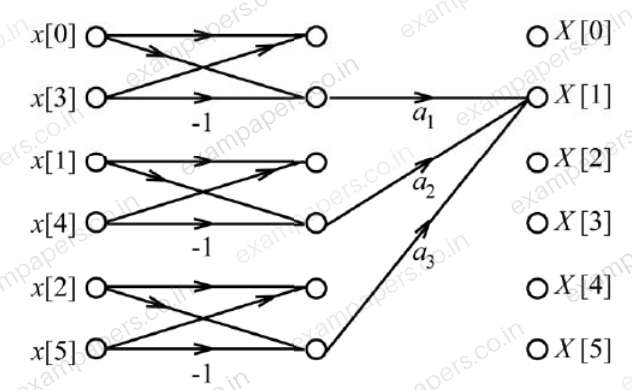
Your answerChoose one option.
Log in to check the answer
You can attempt this question now. Sign in to view the answer key, explanations and discussion.Log in to check answerQuestion 29
Open questionECMCQ2 marksNeeds review
It is desired to find a three-tap causal filter which gives zero signal as an output to an input of the form
,
where
and
are arbitrary real numbers. The desired three-tap filter is given by
and
for
or
.
What are the values of the filter taps
and
if the output is
for all
, when
is as given above? 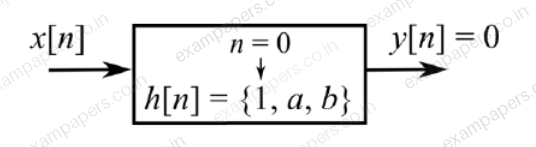
Your answerChoose one option.
Log in to check the answer
You can attempt this question now. Sign in to view the answer key, explanations and discussion.Log in to check answer