
Electronics and Communication Engineering
GATE ECE format:mcq PYQs
Build your understanding with focused practice from past exam papers.
Questions 141–150 of 426. Imported answers require independent review unless marked reviewed.
Question 21
Open questionECMCQ1 markNeeds review
In the circuit shown below,
and
are bias voltages. Based on input and output impedances, the circuit behaves as a 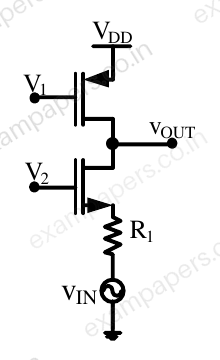
Your answerChoose one option.
Log in to check the answer
You can attempt this question now. Sign in to view the answer key, explanations and discussion.Log in to check answerQuestion 22
Open questionECMCQ1 markNeeds review
A cascade of common-source amplifiers in a unity gain feedback configuration oscillates when
Your answerChoose one option.
Log in to check the answer
You can attempt this question now. Sign in to view the answer key, explanations and discussion.Log in to check answerQuestion 23
Open questionECMCQ1 markNeeds review
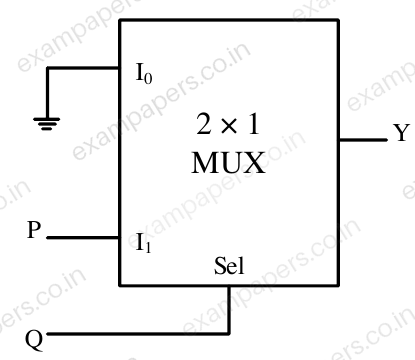
In the circuit shown below, P and Q are the inputs. The logical function realized by the circuit shown below is
Your answerChoose one option.
Log in to check the answer
You can attempt this question now. Sign in to view the answer key, explanations and discussion.Log in to check answerQuestion 24
Open questionECMCQ1 markNeeds review
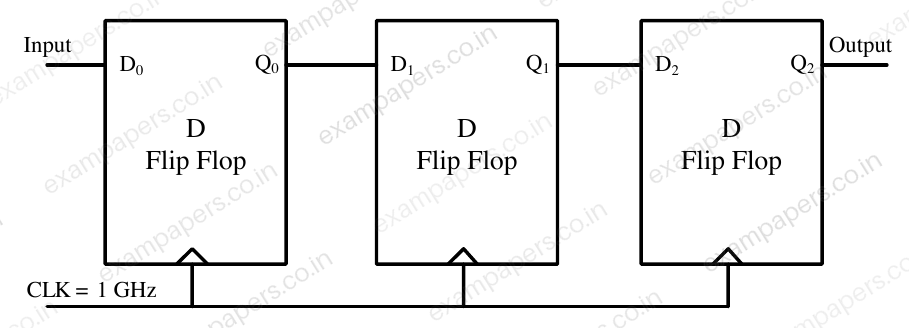
The synchronous sequential circuit shown below works at a clock frequency of 1 GHz. The throughput, in Mbits/s, and the latency, in ns, respectively, are
Your answerChoose one option.
Log in to check the answer
You can attempt this question now. Sign in to view the answer key, explanations and discussion.Log in to check answerQuestion 25
Open questionECMCQ1 markNeeds review
The open loop transfer function of a unity negative feedback system is
, where
,
and
are positive constants. The phase crossover frequency, in rad/s, isYour answerChoose one option.
Log in to check the answer
You can attempt this question now. Sign in to view the answer key, explanations and discussion.Log in to check answerQuestion 26
Open questionECMCQ1 markNeeds review
Consider a system with input
and output
. The system isYour answerChoose one option.
Log in to check the answer
You can attempt this question now. Sign in to view the answer key, explanations and discussion.Log in to check answerQuestion 27
Open questionECMCQ1 markNeeds review
Let
be a strictly band-limited signal with bandwidth
and energy
. Assuming
, the energy in the signal
isYour answerChoose one option.
Log in to check the answer
You can attempt this question now. Sign in to view the answer key, explanations and discussion.Log in to check answerQuestion 28
Open questionECMCQ1 markNeeds review
The Fourier transform
of
isNote:
Your answerChoose one option.
Log in to check the answer
You can attempt this question now. Sign in to view the answer key, explanations and discussion.Log in to check answerQuestion 29
Open questionECMCQ1 markNeeds review
In the table shown below, match the signal type with its spectral characteristics.
Signal type | Spectral characteristics |
|---|---|
(i) Continuous, aperiodic | (a) Continuous, aperiodic |
(ii) Continuous, periodic | (b) Continuous, periodic |
(iii) Discrete, aperiodic | (c) Discrete, aperiodic |
(iv) Discrete, periodic | (d) Discrete, periodic |
Your answerChoose one option.
Log in to check the answer
You can attempt this question now. Sign in to view the answer key, explanations and discussion.Log in to check answerQuestion 36
Open questionECMCQ2 marksNeeds review
A random variable
, distributed normally as
, undergoes the transformation
, given in the figure. The form of the probability density function of
is(In the options given below,
,
,
are non-zero constants and
is piece-wise continuous function)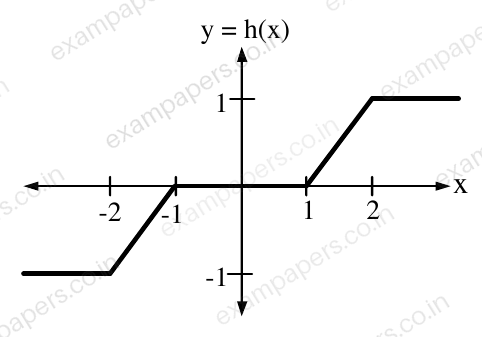
Your answerChoose one option.
Log in to check the answer
You can attempt this question now. Sign in to view the answer key, explanations and discussion.Log in to check answer