
Electronics and Communication Engineering
GATE ECE Probability and Statistics PYQs
Build your understanding with focused practice from past exam papers.
How to practice Probability and Statistics
Attempt a question, record the concept and assumptions, then check the available answer. Rework mistakes after revising the relevant concepts. Topic tags can overlap; review the question context.
Questions 1–10 of 17. Imported answers require independent review unless marked reviewed.
Question 38
Open questionECMCQ2 marksNeeds review
Let X, N, Y and Z be random variables. The variables X and N are independent of each other. X is uniformly distributed between -1 and 1; N follows Normal distribution with zero mean and unity variance. Y and Z are defined as,
and
. Which of the following pairs represents the values of correlation between X and Y and that between X and Z?Your answerChoose one option.
Log in to check the answer
You can attempt this question now. Sign in to view the answer key, explanations and discussion.Log in to check answerQuestion 13
Open questionECMCQ1 markNeeds review
A pot contains two red balls and two blue balls. Two balls are drawn from this pot randomly without replacement.
What is the probability that the two balls drawn have different colours?
Your answerChoose one option.
Log in to check the answer
You can attempt this question now. Sign in to view the answer key, explanations and discussion.Log in to check answerQuestion 58
Open questionECNAT2 marksNeeds review
Two fair dice (with faces labeled 1, 2, 3, 4, 5, and 6) are rolled. Let the random variable
denote the sum of the outcomes obtained.The expectation of
is ______ (rounded off to two decimal places).Log in to check the answer
You can attempt this question now. Sign in to view the answer key, explanations and discussion.Log in to check answerQuestion 33
Open questionECNAT1 markNeeds review
Suppose X and Y are independent and identically distributed random variables that are distributed uniformly in the interval [0,1]. The probability that X ≥ Y is ______ .
Log in to check the answer
You can attempt this question now. Sign in to view the answer key, explanations and discussion.Log in to check answerQuestion 36
Open questionECMCQ2 marksNeeds review
A random variable
, distributed normally as
, undergoes the transformation
, given in the figure. The form of the probability density function of
is(In the options given below,
,
,
are non-zero constants and
is piece-wise continuous function)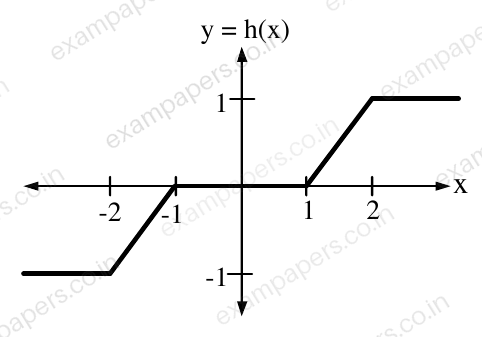
Your answerChoose one option.
Log in to check the answer
You can attempt this question now. Sign in to view the answer key, explanations and discussion.Log in to check answerQuestion 3
Open questionECMCQ1 markNeeds review
Two continuous random variables
and
are related as
Let
and
denote the variances of
and
, respectively. The variances are related asYour answerChoose one option.
Log in to check the answer
You can attempt this question now. Sign in to view the answer key, explanations and discussion.Log in to check answerQuestion 27
Open questionECMCQ2 marksNeeds review
A box contains the following three coins.
I. A fair coin with head on one face and tail on the other face.
II. A coin with heads on both the faces.
III. A coin with tails on both the faces.
A coin is picked randomly from the box and tossed. Out of the two remaining coins in the box, one coin is then picked randomly and tossed. If the first toss results in a head, the probability of getting a head in the second toss is
Your answerChoose one option.
Log in to check the answer
You can attempt this question now. Sign in to view the answer key, explanations and discussion.Log in to check answerQuestion 51
Open questionECNAT2 marksNeeds review
In a high school having equal number of boy students and girl students, 75% of the students study Science and the remaining 25% students study Commerce. Commerce students are two times more likely to be a boy than are Science students. The amount of information gained in knowing that a randomly selected girl student studies Commerce (rounded off to three decimal places) is ______ bits.
Log in to check the answer
You can attempt this question now. Sign in to view the answer key, explanations and discussion.Log in to check answerQuestion 22
Open questionECNAT1 markNeeds review
A binary random variable
takes the value +2 or −2. The probability
. The value of
(rounded off to one decimal place), for which the entropy of
is maximum, is ______.Log in to check the answer
You can attempt this question now. Sign in to view the answer key, explanations and discussion.Log in to check answerQuestion 25
Open questionECNAT1 markNeeds review
The two sides of a fair coin are labelled as 0 and 1. The coin is tossed two times independently. Let
and
denote the labels corresponding to the outcomes of those tosses. For a random variable
, defined as
, the expected value
(rounded off to two decimal places) is ______.Log in to check the answer
You can attempt this question now. Sign in to view the answer key, explanations and discussion.Log in to check answer