
Electronics and Communication Engineering
GATE ECE Random processes PYQs
Build your understanding with focused practice from past exam papers.
Questions 11–14 of 14. Imported answers require independent review unless marked reviewed.
Question 28
Open questionECMCQ2 marksNeeds review
Consider a white Gaussian noise process
with two-sided power spectral density
W/Hz as input to a filter with impulse response
(where t is in seconds) resulting in output Y(t). The power in Y(t) in watts isYour answerChoose one option.
Log in to check the answer
You can attempt this question now. Sign in to view the answer key, explanations and discussion.Log in to check answerQuestion 40
Open questionECNAT2 marksNeeds review
A random variable
takes values
and
with probabilities
and
, respectively. The noisy observation of
is
, where
has uniform probability density over the interval
.
and
are independent. If the MAP rule based detector outputs
as
then the value of
(accurate to two decimal places) is ______.Log in to check the answer
You can attempt this question now. Sign in to view the answer key, explanations and discussion.Log in to check answerQuestion 22
Open questionECNAT1 markNeeds review
Consider the random process
where
is a zero-mean Gaussian random variable and
is a random variable uniformly distributed between 0 and 2. Assume that
and
are statistically independent. The mean value of the random process at
is __________Log in to check the answer
You can attempt this question now. Sign in to view the answer key, explanations and discussion.Log in to check answerQuestion 51
Open questionECMCQ2 marksNeeds review
Let
be a wide sense stationary random process with the power spectral density
as shown in Figure (a), where
is in Hertz (Hz).
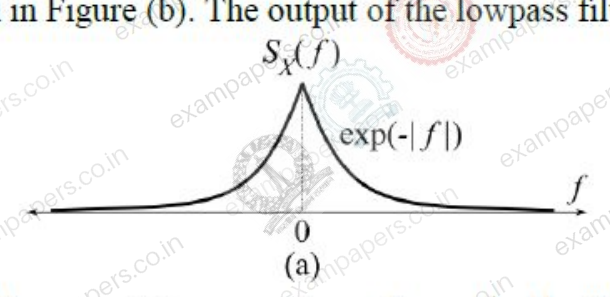
The random process
is input to an ideal lowpass filter with the frequency response
as shown in Figure (b).
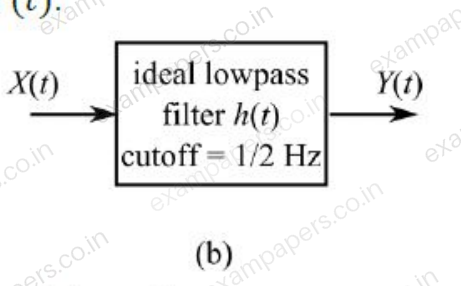
The output of the lowpass filter is
.Let
be the expectation operator and consider the following statements:I.
II.
III.
Select the correct option:
Your answerChoose one option.
Log in to check the answer
You can attempt this question now. Sign in to view the answer key, explanations and discussion.Log in to check answer