
Electrical Engineering
GATE EE branch:ee PYQs
Build your understanding with focused practice from past exam papers.
Questions 431–440 of 715. Imported answers require independent review unless marked reviewed.
Question 31
Open questionEEMCQ2 marksNeeds review
A non-ideal diode is biased with a voltage of −0.03 V, and a diode current of
is measured. The thermal voltage is 26 mV and the ideality factor for the diode is 15/13. The voltage, in V, at which the measured current increases to
is closest to:Your answerChoose one option.
Log in to check the answer
You can attempt this question now. Sign in to view the answer key, explanations and discussion.Log in to check answerQuestion 32
Open questionEEMCQ2 marksNeeds review
A benchtop dc power supply acts as an ideal 4 A current source as long as its terminal voltage is below 10 V. Beyond this point, it begins to behave as an ideal 10 V voltage source for all load currents going down to 0 A. When connected to an ideal rheostat, find the load resistance value at which maximum power is transferred, and the corresponding load voltage and current.
Your answerChoose one option.
Log in to check the answer
You can attempt this question now. Sign in to view the answer key, explanations and discussion.Log in to check answerQuestion 33
Open questionEEMCQ2 marksNeeds review
The static electric field inside a dielectric medium with relative permittivity,
, expressed in cylindrical coordinate system is given by the following expression
where
,
,
are unit vectors along
,
and
directions, respectively. If the above expression represents a valid electrostatic field inside the medium, then the volume charge density associated with this field in terms of free space permittivity,
, in SI units is given by:Your answerChoose one option.
Log in to check the answer
You can attempt this question now. Sign in to view the answer key, explanations and discussion.Log in to check answerQuestion 34
Open questionEEMCQ2 marksNeeds review
Consider a permanent magnet dc (PMDC) motor which is initially at rest. At
, a dc voltage of 5 V is applied to the motor. Its speed monotonically increases from 0 rad/s to 6.32 rad/s in 0.5 s and finally settles to 10 rad/s. Assuming that the armature inductance of the motor is negligible, the transfer function for the motor isYour answerChoose one option.
Log in to check the answer
You can attempt this question now. Sign in to view the answer key, explanations and discussion.Log in to check answerQuestion 35
Open questionEEMCQ2 marksNeeds review
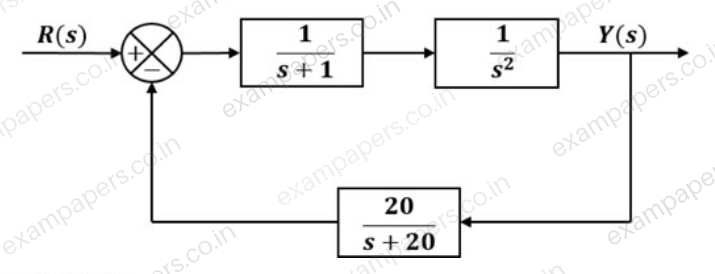
Which of the following options is correct for the system shown below?
Your answerChoose one option.
Log in to check the answer
You can attempt this question now. Sign in to view the answer key, explanations and discussion.Log in to check answerQuestion 36
Open questionEEMCQ2 marksNeeds review
Consider a negative unity feedback system with the forward path transfer function
, where
is a positive real number. The value of
for which the system will have some of its poles on the imaginary axis is ________.Your answerChoose one option.
Log in to check the answer
You can attempt this question now. Sign in to view the answer key, explanations and discussion.Log in to check answerQuestion 37
Open questionEEMCQ2 marksNeeds review
Suppose for input
, a linear time-invariant system with impulse response
produces output
, so that
. Further, if
, which of the following statements is true?Your answerChoose one option.
Log in to check the answer
You can attempt this question now. Sign in to view the answer key, explanations and discussion.Log in to check answerQuestion 38
Open questionEEMCQ2 marksNeeds review
The causal realization of a system transfer function
having poles at
,
and zeroes at
,
will beYour answerChoose one option.
Log in to check the answer
You can attempt this question now. Sign in to view the answer key, explanations and discussion.Log in to check answerQuestion 39
Open questionEEMCQ2 marksNeeds review
Which of the following options is true for a linear time-invariant discrete time system that obeys the difference equation:
Your answerChoose one option.
Log in to check the answer
You can attempt this question now. Sign in to view the answer key, explanations and discussion.Log in to check answerQuestion 40
Open questionEEMCQ2 marksNeeds review
Let
,
and
be unit vectors along
,
and
directions, respectively, in the cylindrical coordinate system. For the electric flux density given by
, the total electric flux, in Coulomb, emanating from the volume enclosed by a solid cylinder of radius 3 and height 5 m oriented along the z-axis with its base at the origin is:Your answerChoose one option.
Log in to check the answer
You can attempt this question now. Sign in to view the answer key, explanations and discussion.Log in to check answer